
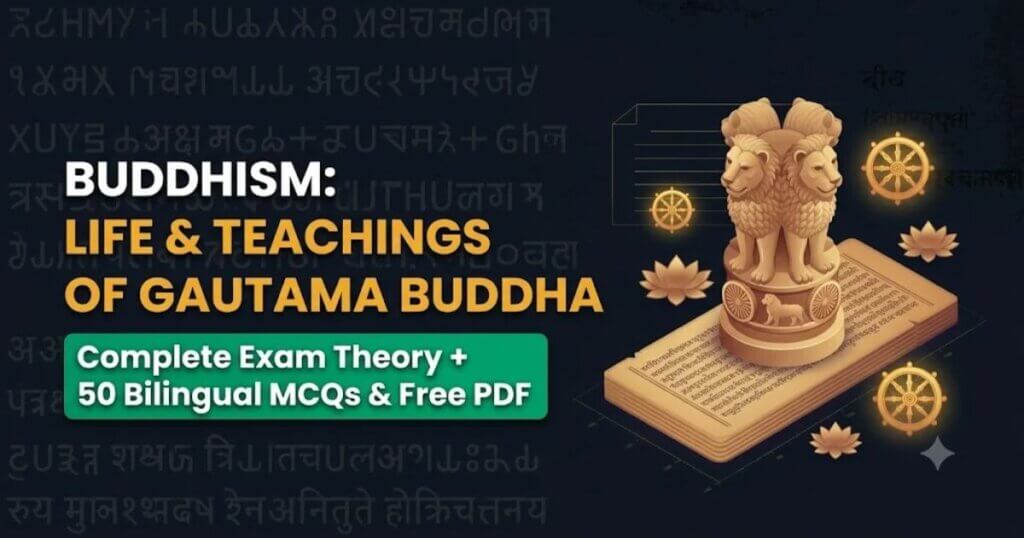
Buddhism (बौद्ध धर्म) 6th century BCE ke Sramana movement ka sabse prabhavshali darshan hai, jiski sthapna Siddhartha Gautama (Gautama Buddha) ne ki thi. Buddha ko Shakyamuni (Sage of the Shakyas) aur Light of Asia (एशिया का ज्योतिपुंज) bhi kaha jata hai. Unhone blind Vedic ritualism, animal sacrifices aur rigid caste hierarchy ke khilaf ek practical, ethical aur rational marg prastut kiya jise Madhyama Pratipada (मध्यम मार्ग / Middle Path) kaha jata hai.
SSC CGL (Tier 1 & Tier 2), RRB NTPC, UPSC Prelims, NDA, CDS aur State PSC (BPSC, UPPSC, RAS, MPPSC) exams ke Ancient Indian History section mein Buddha ke jeevan ke 5 mahatvapurna prateek (Symbols), Char Arya Satya (Four Noble Truths), Ashtangika Marga (Eightfold Path), Pratityasamutpada, Char Bauddh Sangitiyan (Four Buddhist Councils), aur Buddhist Sahitya (Tripitaka, Jatakas) par har saal direct factual aur analytical questions puche jaate hain. Niche is topic ka detailed study module aur 50 Moderate Exam-Standard Bilingual MCQs live interactive scorecard ke sath provide kiye gaye hain.
- Life of Gautama Buddha: Birth, Mahabhinishkramana & Mahaparinirvana
- Core Teachings: Four Noble Truths, Eightfold Path & Pratityasamutpada
- The Four Buddhist Councils & Sacred Tripitaka Literature
- Exam Weightage & Importance Matrix (SSC, Railway, State PSC & UPSC)
- 50 Practice MCQs (Bilingual Interactive Test)
- Download Buddhism Handwritten Revision Notes PDF
- Best Recommended Books for Ancient Indian History
- Frequently Asked Questions (FAQs)
1. Life of Gautama Buddha: Birth, Mahabhinishkramana & Mahaparinirvana
Gautama Buddha ka janm 563 BCE mein Kapilavastu ke nikat Lumbini Garden (modern Nepal ki Tarai) mein hua tha. Unke bachpan ka naam Siddhartha tha.
Key Biographical Milestones:
- Lineage & Parents: Father: Suddhodana (Elected chief of Shakya republic of Kapilavastu); Mother: Mayadevi (Mahamaya), Koliya republic ki princess thin. Janm ke 7 din baad unki maut ho gayi, jiske baad unka palan-poshan unki step-mother/mousi Mahaprajapati Gautami ne kiya (jo baad mein first woman to enter Buddhist Sangha bani).
- Marriage & Son: 16 varsh ki aayu mein unka vivah Shakya princess Yashodhara se hua. Unke ek putra the jinka naam Rahula tha.
- The Four Sights (चार दृश्य): Kapilavastu ki sair ke dauran Siddhartha ne 4 drishya dekhe jinhone unke man ko vairagya se bhar diya:
1. An Old Man (वृद्ध व्यक्ति) | 2. A Sick Man (रोगी) | 3. A Corpse/Dead Body (शव) | 4. A Serene Ascetic (प्रसन्न संन्यासी). - Mahabhinishkramana (महाभिनिष्क्रमण): 29 varsh ki aayu mein unhone apne charioteer Channa aur priya ashwa Kanthaka ke sath rajmahal ka tyag kiya.
- Spiritual Teachers: Unke pehle guru Alara Kalama the (Vaishali mein, Sankhya philosophy seekhi). Unke doosre guru Uddaka Ramaputta the (Rajgriha mein, yogic meditation seekha).
- Nirvana / Sambodhi (निर्वाण): 6 varsh ke kathin tap ke baad, 35 varsh ki aayu mein, Vaishakha Purnima ki raat Bodh Gaya mein Niranjana (Phalgu) River ke tat par ek Peepal Tree (Bodhi Vriksha) ke niche unhe Sambodhi prapt hui.
- Dharmachakrapravartana (धर्मचक्रप्रवर्तन): Unhone apna pehla updesh Sarnath (Rishipatana/Mrigadava, Varanasi) mein apne 5 purane tapasvi sathiyon (Kaundinya, Vappa, Bhaddiya, Mahanama, Asvajit) ko diya. Is ghatna ko ‘Dharmachakrapravartana’ (Turning of the Wheel of Law) kaha gaya.
- Mahaparinirvana (महापरिनिर्वाण): 80 varsh ki aayu mein 483 BCE mein Kushinagar (Kusinara, UP) mein Malla republic ke kshetra mein Chunda namak blacksmith dwara diye gaye bhojan (Sukara-maddava) ke uprant Sal tree ke niche unka dehant hua. Unka antim updesh Subhadda ko diya gaya tha.
Five Great Symbols of Buddha’s Life (बुद्ध के जीवन के 5 महान प्रतीक):
- Janm (Birth): Lotus and Bull (कमल एवं सांड़)
- Mahabhinishkramana (Renunciation): Horse / Kanthaka (घोड़ा)
- Nirvana / Sambodhi (Enlightenment): Bodhi Tree / Peepal (बोधि वृक्ष)
- Dharmachakrapravartana (First Sermon): Wheel with 8 Spokes (धर्मचक्र)
- Mahaparinirvana (Death): Stupa / Footprints (स्तूप / पदचिह्न)
2. Core Teachings: Four Noble Truths, Eightfold Path & Pratityasamutpada
Buddha ka darshan atyant vyavaharik hai. Unhone metaphysics aur aatma-parmatma ki vyarth bahas se door rehkar manav ke dukh nivaran par focus kiya.
The Four Noble Truths (चार आर्य सत्य):
- 1. Sabbe Dukkham (सर्वं दुःखम्): The world is full of suffering (संसार दुखों का घर है).
- 2. Dukkha Samudaya (दुःख समुदय): Desire / Craving is the root cause of suffering (तृष्णा ही दुखों का मूल कारण है).
- 3. Dukkha Nirodha (दुःख निरोध): Suffering can be ended by ending desires (तृष्णा का त्याग करने से दुखों का अंत संभव है).
- 4. Dukkha Nirodha Gamini Pratipada (दुःख निरोध गामिनी प्रतिपदा): The path leading to cessation of suffering is the Eightfold Path (दुःख निवारक मार्ग अष्टांगिक मार्ग है).
The Noble Eightfold Path (अष्टांगिक मार्ग – Middle Path):
Ye 8 marg 3 pramukh skandhon (Sila, Samadhi, Prajna) mein bante huye hain:
- Prajna (Wisdom): Samyak Drishti (Right View) & Samyak Sankalpa (Right Resolve).
- Sila (Morality): Samyak Vani (Right Speech), Samyak Karmanta (Right Action), & Samyak Aajiva (Right Livelihood).
- Samadhi (Meditation): Samyak Vyayama (Right Effort), Samyak Smriti (Right Mindfulness), & Samyak Samadhi (Right Concentration).
Core Doctrines:
- Pratityasamutpada (प्रतीत्यसमुत्पाद): Theory of Dependent Origination / Causal Nexus. Koi bhi ghatna bina kisi kaaran ke nahi hoti (“Iske hone par ye hota hai”). Iske 12 nidana (Dvadasa Nidana / Bhava-chakra) hain, jiska root cause Avidya (अविद्या / Ignorance) hai.
- Anattavada (अनात्मवाद): Doctrine of No-Self / No-Soul. Hinduism ke vipreet, Buddhism permanent immortal soul ke astitva ko reject karta hai.
- Aniccavada (क्षणिकवाद): Impermanence. Sansar mein kuch bhi sthayi nahi hai; sab kuch pratiksana parivartansheel hai.
3. The Four Buddhist Councils & Sacred Tripitaka Literature
| Council | Year & Venue | Patron King | President | Major Outcome / Compilation |
|---|---|---|---|---|
| 1st Council | 483 BCE, Saptaparni Cave, Rajgriha | Ajatashatru (Haryanka Dynasty) | Mahakassapa | Compilation of Vinaya Pitaka (monastic rules recited by Upali) and Sutta Pitaka (teachings recited by Ananda). |
| 2nd Council | 383 BCE, Chullavagga, Vaishali | Kalasoka (Shishunaga Dynasty) | Sabakami | First schism in Buddhist order: divided into Sthaviravadins (orthodox Theravada) and Mahasanghikas (reformist liberal monks). |
| 3rd Council | c. 250 BCE, Pataliputra | Emperor Ashoka (Maurya Dynasty) | Moggaliputta Tissa | Expulsion of heretical monks. Compilation of the third basket, Abhidhamma Pitaka (philosophical exposition) and Kathavatthu. |
| 4th Council | c. 72 CE, Kundalvana, Kashmir | Kanishka (Kushana Dynasty) | Vasumitra (VP: Asvaghosa) | Formal and permanent split into Hinayana (Lesser Vehicle) and Mahayana (Greater Vehicle, idol-worship of Buddha). Mahavibhasha Sastra written in Sanskrit. |
The Sacred Tripitakas (त्रिपितक – Pali Canon):
- Vinaya Pitaka (विनय पिटक): Rules, regulations, and monastic disciplines for monks and nuns (bhikkhus and bhikkhunis). Subdivided into Suttavibhanga, Khandhaka, and Parivara.
- Sutta Pitaka (सुत्त पिटक): Buddha ke direct sermons, dialogues aur religious discourses ka sankalan (Dictated by Ananda). Iske 5 Nikayas hain: Digha Nikaya, Majjhima Nikaya, Samyutta Nikaya, Anguttara Nikaya (contains list of 16 Mahajanapadas), aur Khuddaka Nikaya (contains Jataka Tales – 550 stories of Buddha’s previous births, Dhammapada, and Theragatha/Therigatha).
- Abhidhamma Pitaka (अभिधम्म पिटक): Buddhist darshan, metaphysics, psycho-ethical classification of phenomena (Dharmas) ka scientific analysis.
4. Exam Weightage & Importance Matrix
| Exam Category | Expected History Qs | Buddhism Weightage | High-Yield Exam Focus Areas |
|---|---|---|---|
| SSC CGL / CHSL / CPO | 4–6 Questions | 1–2 Direct Questions | Life symbols, 4 Councils table (President & King), Birth/Death places, Tripitaka divisions |
| RRB NTPC / Group D | 6–8 Questions | 1–2 Questions | First sermon venue, River of enlightenment, Meaning of Dharmachakrapravartana, Gandhara art |
| State PSC (BPSC, UPPSC, RAS, etc.) | 10–18 Questions | 2–4 Detailed Qs | BPSC focuses on Bodh Gaya, Nalanda, Rajgriha, Bimbisara links; UPPSC on Sarnath, Kushinagar, Shravasti |
| UPSC Civil Services Prelims | 12–16 Questions | Top Priority (Core) | Pratityasamutpada analysis, Bodhisattva concept (Maitreya, Avalokiteshvara), Vajrayana differences |
5. 50 Practice MCQs (Bilingual Interactive Test)
Is test ko real exam mode mein attempt karein. Kisi bhi option ko click karne par blue background highlight hoga. Jab aap 50 questions solve kar lein, aakhiri mein 🚀 Submit Test & Check Live Score button click karein. Sahi options Green, aapka galat selection Red, aur har question ka detailed solution reveal ho jayega.
📊 Live Performance Scorecard
Ancient Indian History: Buddhism & Teachings of Buddha Evaluation
5. Download Buddhism & Teachings of Buddha Revision Notes PDF
📥 Ancient India Quick Revision PDF (Buddhism & Buddha)
Download clean one-liner facts, 4 Buddhist Councils table, Ashtangika Marga flowchart, Tripitaka summary, and all 50 bilingual practice MCQs formatted for rapid printing and offline revision.
6. Best Recommended Books for Ancient Indian History
Standard academic reference covering the material background of Buddhism, second urbanization in Gangetic plains, and heterodox sects.
Precise point-to-point one-liners on the Buddhist Councils, Mudras, Bodhisattvas, and life events of Buddha.
Over 4500+ chapter-wise TCS PYQs with detailed explanations covering Ancient Indian religious traditions.
Comprehensive collection of authentic TCS pattern objective questions with solutions for SSC CGL, CHSL, CPO, and RRB NTPC.
📢 Join Our Official Exam Prep Groups
Access thousands of topic-wise chapter notes, previous years question papers, formula sheets, and live mock quizzes without any registration.
🔙 Go to Main Competitive Exam Notes Hub (All Subjects) ➔7. Frequently Asked Questions (FAQs)
- Buddhism Notes PDF: Life and Teachings of Buddha, 50 MCQs

- Jainism Teachings of Mahavira Notes PDF | 50 MCQs
- Satavahanas Dynasty Notes PDF: Rulers, Art & 50 MCQs
- Vijayanagar Empire: History, Founders, Rulers, and Key Facts for Aspirants

- Who is Sher Shah Suri? History, Admin Reforms, and Free PDF MCQs
- Who is Humayun? A Complete Guide for Government Exam Aspirants
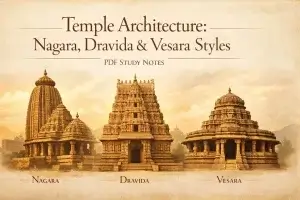
- Temple Architecture: Nagara, Dravida & Vesara Styles PDF
- Rashtrakutas Dynasty: Founder, Art, & History Study Notes
- Pallavas of Kanchi: History, Kings, Temples & Study Notes PDF
- Chalukyas of Badami: Founder, Capital, History & PDF Notes
- Quit India Movement: Causes, Date, PDF & Important MCQs
- Battle of Buxar: Main Aspects, Features & MCQs Guide
- 16 Mahajanapadas: Names, Capitals, Map & PDF Download

- Vedic Age: History, Time Period aur 100 Important MCQs PDF
- Indus Valley Civilization Town Planning: Layout & Key Features
- Prehistoric Age: Meaning, Time Period, and Stages in India

Exam Expert & Content Strategist with over 5+ years of experience in the competitive exam sector. I specialize in analyzing government recruitment patterns and simplifying complex syllabi for aspirants. Having helped thousands of students through Sarkari Exam PDF, my mission is to provide authentic, updated, and high-quality study materials for SSC, UPSC, Railways, and Banking exams to help every candidate achieve their career goals.
⚠️ Disclaimer: All study materials, notes, and PDFs shared on SarkariExamPDF.in are provided purely for educational and reference purposes to assist competitive exam aspirants. We do not claim ownership of any original books or official publications. If you are the rightful copyright owner and have any objection regarding any material, please contact us through our Contact Page for immediate removal.