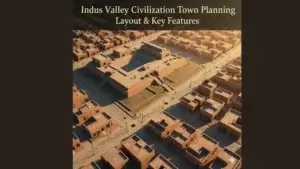
Indus Valley Civilization Town Planning: Layout & Key Features
Indus Valley Civilization Town Planning History of Indus Valley Civilization ki shuruat lagbhag 3300 BCE mein hui thi. Ye duniya ki chaar sabse purani civilizations (Egypt, Mesopotamia, aur China) mein se ek hai. Ise “Harappan Civilization” bhi kaha jata hai kyunki sabse pehla site Harappa hi khoja gaya tha.
Ye sabhyata (civilization) Bronze Age (Kansya Yug) ki thi aur ye aaj ke North-West India aur Pakistan ke ilakon mein phaili hui thi. Inka sabse bada ascharya (wonder) inka “Urban Life” yaani shehari jeevan tha.
What is Town Planning in Indus Valley Civilization?
Indus valley civilization town planning ka matlab hai woh tarika jis se unhone apne shehron ko basaya tha. Aaj ke daur mein hum “Smart Cities” ki baat karte hain, lekin Harappans ne ye kaam 4500 saal pehle hi kar diya tha.
Inka town planning “Grid System” par based tha, jo aaj ke Chandigarh ya New York jaise shehron mein dekhne ko milta hai.
Time Table of Indus Valley Civilization
Is sabhyata ko teen main phases mein baanta gaya hai:
Phase
Time Period
Key Feature
Early Harappan
3300 – 2600 BCE
Shuruati bastiyan aur kheti
Mature Harappan
2600 – 1900 BCE
Peak Urbanization (Town Planning ka asli maza)
Late Harappan
1900 – 1300 BCE
Decline yaani sabhyata ka khatma
Indus Valley Civilization Town Planning Layout
Jab hum indus valley civilization town planning layout ko dekhte hain, toh kuch khaas baatein samne aati hain jo ise sabse alag banati hain:
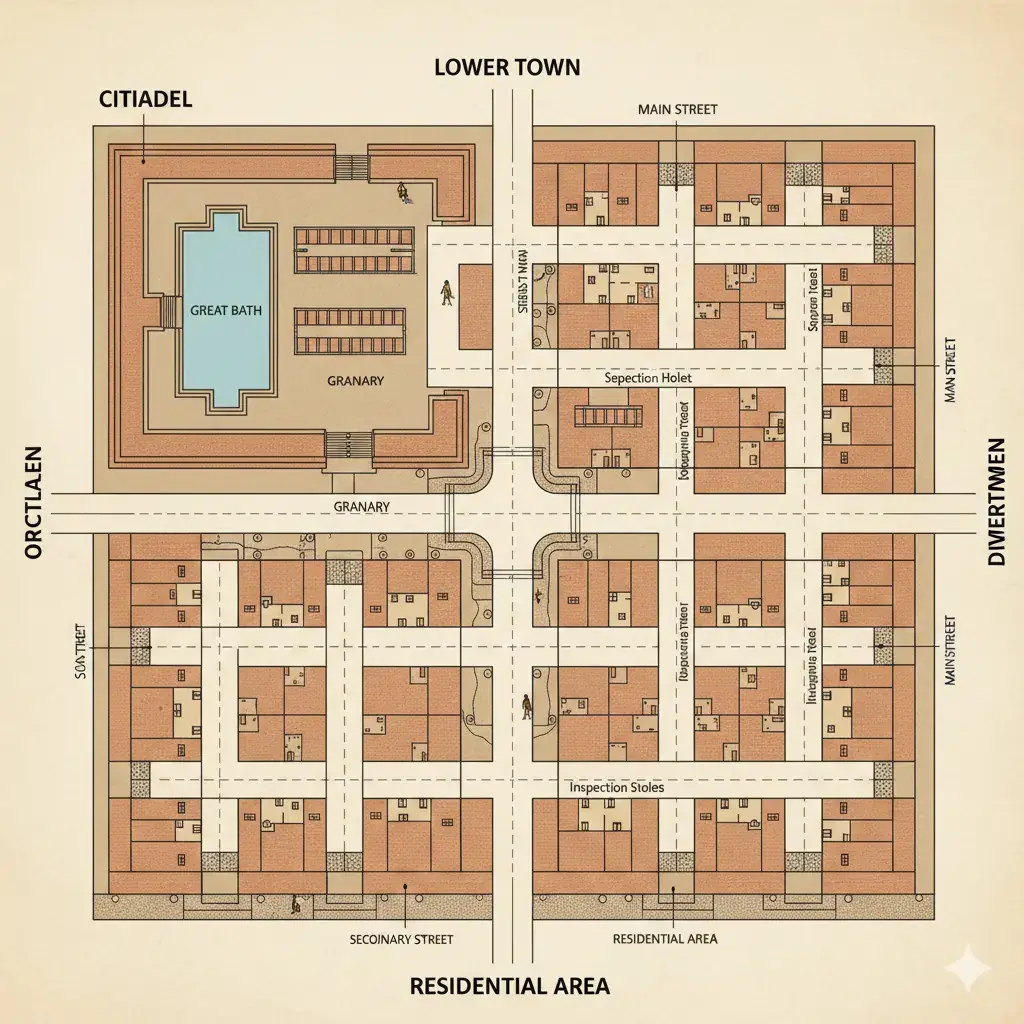
1. The Citadel and the Lower Town
Har shehar do hisson mein bata tha:
Citadel (Acropolis): Ye thoda uncha (raised platform) hota tha jahan ruler class ya bade log rehte the. Yahan important buildings jaise ‘Great Bath’ aur ‘Granary’ hoti thin.
Lower Town: Ye nichla hissa tha jahan aam janta (common people) rehti thi. Ye area Citadel se bada hota tha.
2. Grid System and Streets
Shehar ki sadkein ek dusre ko 90-degree angle (Right Angle) par kaat-ti thin. Sadkein North-to-South aur East-to-West jati thin, jis se poora shehar rectangular blocks mein divide ho jata tha.
3. Drainage System (Naliyon ka Intejam)
Ye sabse amazing feature tha. Har ghar ki nali bahar sadak ki nali se judi thi. Ye naliyan paki hui iton (burnt bricks) se bani thin aur upar se dhaki (covered) hoti thin taki safai bani rahe. Beech-beech mein “Inspection Holes” bhi hote the.
Theory of Indus Valley Civilization in Indian Map
Agar aap theory of indus valley civilization in indian map ko dekhenge, toh ye sabhyata ek “Triangle” shape banati hai jo:
North mein Manda (J&K)
South mein Daimabad (Maharashtra)
West mein Sutkagendor (Pakistan Border)
East mein Alamgirpur (UP) …tak phaili hui thi. Iska total area lagbhag 1.3 million sq. km tha.
Key Features of Town Planning
Standardized Bricks: Sabhi jagah iton ka size (ratio 4:2:1) ek jaisa tha.
The Great Bath (Mohenjo-daro): Ek bada swimming pool jaisa structure jo religious nahane ke liye kaam aata tha. Ismein paani rokne ke liye “Bitumen” ki layer lagayi gayi thi.
Granaries: Anaaj (Grains) ko store karne ke liye bade-bade kothar banaye gaye the, jo dikhate hain ki woh log future ke liye food security ka dhyan rakhte the.
No Windows on Main Street: Gharon ke darwaze aur khidkiyan main road par nahi, balki side ki galiyon mein khulti thin (shayad noise aur dust se bachne ke liye).
Indus Valley Civilization Town Planning: 100 MCQ Practice
Indus Valley Civilization 100 MCQs – SSC SHORTS WALLAH
Indus Valley Civilization (IVC)
100 Most Important Questions for All Government Exams
SSC SHORTS WALLAH
Q1. Which feature was most unique in Indus Valley towns? / सिंधु घाटी नगरों की सबसे अनोखी विशेषता क्या थी?
A) Planned drainage B) Big temples C) Stone houses D) Iron tools
Check Answer
Answer: A) Planned drainage / योजनाबद्ध नाली
Q2. Indus cities were divided into how many parts? / सिंधु नगर कितने भागों में बँटे थे?
A) Two / दो B) Three / तीन C) Four / चार D) One / एक
Check Answer
Answer: A) Two / दो
Q3. Which city is famous for the Great Bath? / कौन सा नगर महान स्नानागार के लिए प्रसिद्ध है?
A) Mohenjo-Daro B) Harappa C) Lothal D) Kalibangan
Check Answer
Answer: A) Mohenjo-Daro / मोहनजोदड़ो
Q4. Bricks of Indus Valley were made of? / सिंधु घाटी की ईंटें किससे बनी थीं?
A) Baked clay B) Stone C) Iron D) Wood
Check Answer
Answer: A) Baked clay / पकी मिट्टी
Q5. What was the typical brick ratio? / ईंटों का सामान्य अनुपात क्या था?
A) 1:2:4 B) 2:3:5 C) 4:5:6 D) 3:6:9
Check Answer
Answer: A) 1:2:4
Q6. Streets in Indus Valley were built in which pattern? / सिंधु घाटी की सड़कें किस रूप में बनी थीं?
A) Grid / जालीनुमा B) Circular C) Random D) Curved
Check Answer
Answer: A) Grid / जालीनुमा
Q7. Which Indus site is known for fire altars? / किस स्थल पर अग्निकुंड मिले हैं?
A) Kalibangan B) Harappa C) Mohenjo-Daro D) Dholavira
Check Answer
Answer: A) Kalibangan / कालीबंगन
Q8. Which public structure was in Mohenjo-Daro? / मोहनजोदड़ो में कौन सी सार्वजनिक इमारत थी?
A) Great Bath B) Ashokan Pillar C) Buddhist Stupa D) Iron Forge
Check Answer
Answer: A) Great Bath / महान स्नानागार
Q9. What was the main building material in Indus cities? / सिंधु नगरों की मुख्य निर्माण सामग्री क्या थी?
A) Baked bricks B) Stone C) Wood D) Iron
Check Answer
Answer: A) Baked bricks / पकी ईंटें
Q10. Indus drainage system was? / सिंधु घाटी की नालियाँ कैसी थीं?
A) Underground & covered B) Open C) Bamboo pipes D) Stone channels
Check Answer
Answer: A) Underground & covered / भूमिगत व ढकी हुई
Q11. Which city had a dockyard? / किस नगर में गोदीघर था?
A) Lothal B) Harappa C) Mohenjo-Daro D) Dholavira
Check Answer
Answer: A) Lothal / लोथल
Q12. The lower town of Indus cities was for? / नगर का निचला भाग किसके लिए था?
A) Common people B) Priests C) Soldiers D) Rulers
Check Answer
Answer: A) Common people / आम लोग
Q13. Houses in Indus Valley had? / सिंधु घाटी के घरों में क्या होता था?
A) Courtyards & wells B) Stone idols C) Iron doors D) Wooden floors
Check Answer
Answer: A) Courtyards & wells / आँगन व कुएँ
Q14. Citadel was built for? / दुर्ग किसके लिए बनाया जाता था?
A) Public & administration B) Farmers C) Laborers D) Soldiers only
Check Answer
Answer: A) Public & administration / सार्वजनिक व प्रशासन
Q15. Which city had a granary? / किस नगर में अनाज घर था?
A) Harappa B) Taxila C) Nalanda D) Ujjain
Check Answer
Answer: A) Harappa / हड़प्पा
Q16. The Great Bath was built of? / महान स्नानागार किससे बना था?
A) Baked bricks & bitumen B) Stone C) Wood D) Iron
Check Answer
Answer: A) Baked bricks & bitumen / पकी ईंटें व डामर
Q17. Which city shows evidence of stone weights? / किस नगर से पत्थर के बाट मिले?
A) Lothal B) Harappa C) Dholavira D) Kalibangan
Check Answer
Answer: A) Lothal / लोथल
Q18. Which site had a stadium? / किस स्थल पर स्टेडियम मिला?
A) Dholavira B) Harappa C) Mohenjo-Daro D) Kalibangan
Check Answer
Answer: A) Dholavira / धोलावीरा
Q19. Most Indus houses opened to? / अधिकतर घर किस ओर खुलते थे?
A) Lanes / गलियाँ B) Main road C) Courtyard D) River
Check Answer
Answer: A) Lanes / गलियाँ
Q20. Wells in Indus cities were made of? / कुएँ किससे बने थे?
A) Bricks B) Stone C) Iron D) Wood
Check Answer
Answer: A) Bricks / ईंटें
Q21. Which Harappan site shows evidence of radial streets?
A) Dholavira B) Harappa C) Lothal D) Mohenjo-Daro
Check Answer
Answer: A) Dholavira / धोलावीरा
Q22. Which Indus city shows earliest evidence of fortification?
A) Kalibangan B) Harappa C) Lothal D) Mohenjo-Daro
Check Answer
Answer: A) Kalibangan / कालीबंगन
Q23. Streets of Indus Valley were mostly?
A) Straight & wide B) Narrow & curved C) Circular D) Sloppy
Check Answer
Answer: A) Straight & wide / सीधी व चौड़ी
Q24. Which material was used to waterproof Great Bath?
A) Bitumen B) Clay C) Stone D) Lime
Check Answer
Answer: A) Bitumen / डामर
Q25. Which Indus site shows chessboard pattern planning?
A) Mohenjo-Daro B) Harappa C) Lothal D) Kalibangan
Check Answer
Answer: A) Mohenjo-Daro / मोहनजोदड़ो
Q26. What was the main purpose of citadel?
A) Administrative buildings B) Farmers’ huts C) Iron workshops D) Religious shrines
Check Answer
Answer: A) Administrative buildings / प्रशासनिक इमारतें
Q27. Which city shows evidence of bead-making workshops?
A) Lothal B) Harappa C) Mohenjo-Daro D) Dholavira
Check Answer
Answer: A) Lothal / लोथल
Q28. Which city had 16 water reservoirs?
A) Dholavira B) Harappa C) Lothal D) Mohenjo-Daro
Check Answer
Answer: A) Dholavira / धोलावीरा
Q29. What shape were Harappan houses?
A) Rectangular B) Circular C) Pyramid D) Octagonal
Check Answer
Answer: A) Rectangular / आयताकार
Q30. What indicates urban planning of Indus Valley?
A) Grid pattern B) Temples C) Iron tools D) Bamboo huts
Check Answer
Answer: A) Grid pattern / जालीनुमा सड़कें
Q31. Which Indus site is in Gujarat?
A) Lothal B) Harappa C) Mohenjo-Daro D) Kalibangan
Check Answer
Answer: A) Lothal / लोथल
Q32. Granary at Harappa was used for?
A) Storage of food grains B) Weapons C) Animals D) Metals
Check Answer
Answer: A) Storage of food grains / खाद्यान्न भंडारण
Q33. Which feature shows civic sense in Indus Valley?
A) Covered drains B) Iron roads C) Stone temples D) Large palaces
Check Answer
Answer: A) Covered drains / ढकी नालियाँ
Q34. Which structure shows importance of bathing?
A) Great Bath B) Citadel C) Dockyard D) Granary
Check Answer
Answer: A) Great Bath / महान स्नानागार
Q35. Indus bricks were generally of?
A) Standardized size B) Random size C) Wooden D) Stone
Check Answer
Answer: A) Standardized size / मानकीकृत आकार
Q36. Which city shows evidence of joint families?
A) Mohenjo-Daro B) Harappa C) Lothal D) Dholavira
Check Answer
Answer: A) Mohenjo-Daro / मोहनजोदड़ो
Q37. What was the purpose of fire altars?
A) Rituals B) Cooking C) Smelting iron D) Storage
Check Answer
Answer: A) Rituals / अनुष्ठान
Q38. What was used for lighting in houses?
A) Lamps B) Electric wires C) Gas lamps D) Iron torches
Check Answer
Answer: A) Lamps / दीपक
Q39. Which Harappan site shows evidence of burial grounds?
A) Harappa B) Lothal C) Mohenjo-Daro D) Dholavira
Check Answer
Answer: A) Harappa / हड़प्पा
Q40. The dockyard at Lothal proves?
A) Maritime trade B) Iron smelting C) Farming D) Animal domestication
Check Answer
Answer: A) Maritime trade / समुद्री व्यापार
Q41. Which stone was used for weights?
A) Chert B) Granite C) Marble D) Basalt
Check Answer
Answer: A) Chert / चर्ट
Q42. Which city had a college-like hall?
A) Mohenjo-Daro B) Harappa C) Lothal D) Kalibangan
Check Answer
Answer: A) Mohenjo-Daro / मोहनजोदड़ो
Q43. What was used to join bricks?
A) Mud mortar B) Iron nails C) Cement D) Wood
Check Answer
Answer: A) Mud mortar / मिट्टी का गारा
Q44. The main public utility in Mohenjo-Daro was?
A) Great Bath B) Temple C) Stupa D) Market
Check Answer
Answer: A) Great Bath / महान स्नानागार
Q45. What shows Harappans were hygienic?
A) Drainage & bathrooms B) Iron pots C) Stone walls D) Fire pits
Check Answer
Answer: A) Drainage & bathrooms / नालियाँ व स्नानघर
Q46. Which Indus city shows water harvesting?
A) Dholavira B) Harappa C) Lothal D) Kalibangan
Check Answer
Answer: A) Dholavira / धोलावीरा
Q47. Which Harappan city shows evidence of citadel wall?
A) Kalibangan B) Mohenjo-Daro C) Harappa D) Lothal
Check Answer
Answer: A) Kalibangan / कालीबंगन
Q48. Which evidence shows Harappans used measurement?
A) Weights & scales B) Temples C) Horses D) Weapons
Check Answer
Answer: A) Weights & scales / बाट व तराज़ू
Q49. Which building shows central authority?
A) Granary B) Fire altar C) Stupa D) Well
Check Answer
Answer: A) Granary / अनाज घर
Q50. Which feature is called hallmark of Indus planning?
A) Drainage system B) Iron smelting C) Stone temples D) Wooden huts
Check Answer
Answer: A) Drainage system / नाली व्यवस्था
Q51. Which system shows Harappans’ engineering skill?
A) Drainage B) Roads C) Dockyard D) All of these
Check Answer
Answer: D) All of these / उपरोक्त सभी
Q52. Which city had a unique water management system?
A) Dholavira B) Harappa C) Lothal D) Mohenjo-Daro
Check Answer
Answer: A) Dholavira / धोलावीरा
Q53. What material was used for street paving?
A) Burnt bricks B) Stones C) Mud D) Lime
Check Answer
Answer: A) Burnt bricks / पकी ईंटें
Q54. The largest building at Mohenjo-Daro?
A) Granary B) Great Bath C) Dockyard D) Citadel
Check Answer
Answer: A) Granary / अनाज घर
Q55. Which structure shows town’s planning was for floods?
A) Raised platforms B) Iron walls C) Temples D) Tunnels
Check Answer
Answer: A) Raised platforms / ऊँचे चबूतरे
Q56. What were houses made of?
A) Baked bricks B) Wood C) Stone D) Mud only
Check Answer
Answer: A) Baked bricks / पकी ईंटें
Q57. What was usually built at the corner of streets?
A) Wells B) Shops C) Temples D) Parks
Check Answer
Answer: A) Wells / कुएँ
Q58. What shows Harappans were secular?
A) No large temples B) Granaries C) Drainage system D) Citadel
Check Answer
Answer: A) No large temples / बड़े मंदिर नहीं
Q59. Which Indus site had fire altars?
A) Kalibangan B) Harappa C) Mohenjo-Daro D) Lothal
Check Answer
Answer: A) Kalibangan / कालीबंगन
Q60. Which crop’s evidence found in Kalibangan?
A) Barley B) Rice C) Maize D) Tea
Check Answer
Answer: A) Barley / जौ
Q61. Which planning aspect resembles modern towns?
A) Grid system B) Temples C) Forts D) Stupas
Check Answer
Answer: A) Grid system / जालीनुमा व्यवस्था
Q62. Where were public wells found?
A) Mohenjo-Daro B) Harappa C) Lothal D) Kalibangan
Check Answer
Answer: A) Mohenjo-Daro / मोहनजोदड़ो
Q63. How were drains cleaned?
A) Manholes B) Iron pipes C) Bamboo sticks D) Wooden covers
Check Answer
Answer: A) Manholes / मेनहोल
Q64. What shows Harappans valued privacy?
A) Bathrooms inside houses B) Citadel walls C) Granary D) Fire altars
Check Answer
Answer: A) Bathrooms inside houses / घरों के भीतर स्नानघर
Q65. Which feature is unique in Lothal?
A) Dockyard B) Great Bath C) Fire altar D) Stone temples
Check Answer
Answer: A) Dockyard / गोदीघर
Q66. Harappan houses had how many rooms?
A) 2–3 B) 10–12 C) Only 1 D) None
Check Answer
Answer: A) 2–3 / २–३
Q67. Which proves Harappans stored surplus food?
A) Granary B) Dockyard C) Citadel D) Drainage
Check Answer
Answer: A) Granary / अनाज घर
Q68. The town planning was mainly for?
A) Public utility B) Military forts C) Religious shrines D) Palaces
Check Answer
Answer: A) Public utility / सार्वजनिक सुविधा
Q69. Which building shows collective use?
A) Great Bath B) Fire altar C) Small well D) Kitchen
Check Answer
Answer: A) Great Bath / महान स्नानागार
Q70. The Indus houses had?
A) Courtyards B) Pyramid C) Vaults D) Dome
Check Answer
Answer: A) Courtyards / आँगन
Q71. Which proves Harappans had weights and measures?
A) Cubical stones B) Gold coins C) Clay tablets D) Shells
Check Answer
Answer: A) Cubical stones / घनाकार पत्थर
Q72. Streets met at what angle?
A) Right angle B) Acute C) Obtuse D) Curved
Check Answer
Answer: A) Right angle / समकोण
Q73. Which Harappan site shows ploughed field?
A) Kalibangan B) Harappa C) Lothal D) Mohenjo-Daro
Check Answer
Answer: A) Kalibangan / कालीबंगन
Q74. The Great Bath was made of?
A) Burnt bricks & bitumen B) Stone C) Wood D) Metal
Check Answer
Answer: A) Burnt bricks & bitumen / पकी ईंट व डामर
Q75. The granary at Harappa was divided into?
A) 6 chambers B) 3 chambers C) 2 chambers D) 10 chambers
Check Answer
Answer: A) 6 chambers / ६ कक्ष
Q76. Which was the lower town used for?
A) Residential houses B) Military C) Temples D) Palaces
Check Answer
Answer: A) Residential houses / आवासीय घर
Q77. Which was the upper town used for?
A) Citadel B) Shops C) Farmers’ huts D) Burial grounds
Check Answer
Answer: A) Citadel / दुर्ग
Q78. Which proves Harappans were traders?
A) Dockyard & weights B) Iron tools C) Fire altars D) Stone temples
Check Answer
Answer: A) Dockyard & weights / व्यापार का प्रमाण
Q79. Which material was absent in Harappan construction?
A) Iron B) Burnt brick C) Wood D) Clay
Check Answer
Answer: A) Iron / लोहा
Q80. What shows Harappans’ town was planned before construction?
A) Grid system B) Random huts C) Fort walls D) Fire altars
Check Answer
Answer: A) Grid system / जालीनुमा व्यवस्था
Q81. Which feature is common in all sites?
A) Drainage system B) Great Bath C) Dockyard D) Fire altar
Check Answer
Answer: A) Drainage system / नाली व्यवस्था
Q82. What were roofs of houses made of?
A) Wooden beams B) Metal sheets C) Stone slabs D) Glass
Check Answer
Answer: A) Wooden beams / लकड़ी की बल्ली
Q83. Which site has circular platforms?
A) Kalibangan B) Lothal C) Harappa D) Mohenjo-Daro
Check Answer
Answer: C) Harappa / हड़प्पा
Q84. Which Harappan city was destroyed by floods?
A) Mohenjo-Daro B) Lothal C) Harappa D) Dholavira
Check Answer
Answer: A) Mohenjo-Daro / मोहनजोदड़ो
Q85. Which system shows equality among citizens?
A) Uniform houses & bricks B) Big palaces C) Army forts D) Royal temples
Check Answer
Answer: A) Uniform houses & bricks / समान घर व ईंटें
Q86. Which crop was grown at Lothal?
A) Rice B) Cotton C) Tea D) Coffee
Check Answer
Answer: B) Cotton / कपास
Q87. The Indus Valley people were first to grow?
A) Cotton B) Wheat C) Barley D) Rice
Check Answer
Answer: A) Cotton / कपास
Q88. Which site is called “Manchester of Harappan civilization”?
A) Lothal B) Harappa C) Mohenjo-Daro D) Dholavira
Check Answer
Answer: A) Lothal / लोथल
Q89. Which construction proves advanced measurement knowledge?
A) Dockyard at Lothal B) Fire altars C) Granary D) Burial grounds
Check Answer
Answer: A) Dockyard at Lothal / लोथल का गोदीघर
Q90. Which feature shows decentralised living?
A) Separate wells for houses B) Citadel walls C) Granaries D) Great Bath
Check Answer
Answer: A) Separate wells for houses / घरों के लिए अलग कुएँ
Q91. Which Indus site shows earliest evidence of rice?
A) Lothal B) Kalibangan C) Harappa D) Mohenjo-Daro
Check Answer
Answer: A) Lothal / लोथल
Q92. Which proves Harappans knew town zoning?
A) Citadel & lower town B) Random huts C) Stone forts D) Temples
Check Answer
Answer: A) Citadel & lower town / दुर्ग व निचला नगर
Q93. Which shows Harappans were architects?
A) Planned streets & drainage B) Temples C) Iron forts D) Random huts
Check Answer
Answer: A) Planned streets & drainage / नियोजित सड़कें व नालियाँ
Q94. Which Indus feature still inspires urban planners?
A) Drainage & grid system B) Palaces C) Temples D) Army forts
Check Answer
Answer: A) Drainage & grid system / नाली व जालीनुमा योजना
Q95. Which craft was highly developed?
A) Bead-making B) Iron forging C) Stone carving D) Temple architecture
Check Answer
Answer: A) Bead-making / मनका निर्माण
Q96. Which metal was not known?
A) Iron B) Copper C) Bronze D) Gold
Check Answer
Answer: A) Iron / लोहा
Q97. Which Harappan city shows dual burial system?
A) Lothal B) Harappa C) Mohenjo-Daro D) Kalibangan
Check Answer
Answer: A) Lothal / लोथल
Q98. Which construction shows maritime engineering?
A) Dockyard at Lothal B) Granary C) Fire altar D) Great Bath
Check Answer
Answer: A) Dockyard at Lothal / लोथल का गोदीघर
Q99. Which proves Harappans were egalitarian?
A) Similar sized houses & streets B) Palaces C) Royal temples D) Big forts
Check Answer
Answer: A) Similar sized houses & streets / समानतावादी समाज
Q100. The most remarkable feature of Indus town planning?
A) Advanced drainage system B) Iron forts C) Stone temples D) Wooden huts
Check Answer
Answer: A) Advanced drainage system / उन्नत नाली व्यवस्था
Download Indus Valley Civilization Town Planning PDF
Indus valley civilization town planning humein sikhata hai ki discipline aur engineering kya hoti hai. Unka drainage system aaj ke modern India ke liye bhi ek misal hai. Halanki 1900 BCE ke baad ye sabhyata dheere-dheere khatam ho gayi, lekin inki urban planning aaj bhi history ka sabse interesting topic hai.
FAQs – Indus Valley Civilization Town Planning
How was the town planning of indus valley civilization?
Inka town planning Grid System par based tha jahan sadkein ek dusre ko right angle par kaat-ti thin aur shehar Citadel aur Lower Town mein divide tha.
Indus valley civilization town planning features kya hain?
Main features mein covered drainage system, burnt bricks ka use, Great Bath, Granaries, aur systematic street lighting (lamp posts) shamil hain.
What is meant by indus valley civilization town planning?
Iska matlab hai Sindhu Ghati ke logon dwara shehron ko ek nishchit dhang (planned manner) se basane ki kala, jisme safai aur suvidha ka poora dhyan rakha gaya tha.
What came after the indus valley civilization town planning?
IVC ke decline ke baad India mein Vedic Period shuru hua, jo ki ek “Rural” (gramin) sabhyata thi, na ki urban.
Exam Expert & Content Strategist with over 5+ years of experience in the competitive exam sector. I specialize in analyzing government recruitment patterns and simplifying complex syllabi for aspirants. Having helped thousands of students through Sarkari Exam PDF, my mission is to provide authentic, updated, and high-quality study materials for SSC, UPSC, Railways, and Banking exams to help every candidate achieve their career goals.