
For any student preparing for competitive exams like SSC, Railway, or school boards (Class 9 & 11), Gravitation is a fundamental pillar of Physics. It is the silent force that governs everything—from why we stay grounded on Earth to how planets dance around the sun.
In this guide, we break down the universal law of gravitation in easy-to-understand language to help you score high in your exams.
What exactly is Gravitation Force?
In simple terms, gravitation is the pull that exists between any two objects in the universe that have mass. You might think gravity only belongs to huge things like Earth, but the truth is, even two pens sitting on a desk are pulling toward each other. However, we only feel this gravitation force when one of the objects is massive, like a planet.
Key Characteristics:
- It is always attractive (it never pushes away).
- It works even at vast distances.
- It is the weakest of the four fundamental forces in nature, yet it controls the entire universe.
Newton’s Universal Law of Gravitation Explained
In 1687, Sir Isaac Newton gave the world a mathematical way to understand this pull. His theory, known as Newton’s law of gravitation, changed science forever.
State the Universal Law of Gravitation
The law states that every object in this universe attracts every other object. This force of attraction depends on two things:
- Mass: The heavier the objects, the stronger the pull.
- Distance: The farther apart the objects are, the weaker the pull becomes.
Why is it called “Universal”?
Because it isn’t just a “Rule of Earth.” It applies to a grain of sand, a human being, a moon, and a distant star equally.
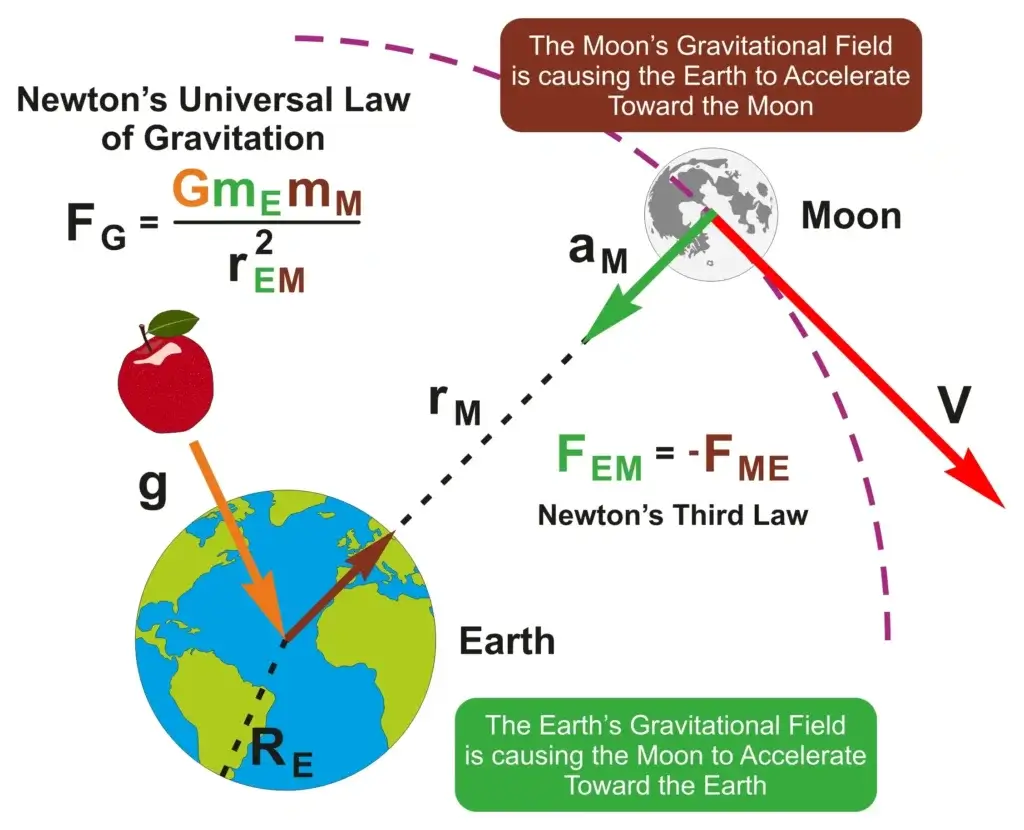
The Core Gravitation Formula
For numerical problems in gravitation class 9 or gravitation class 11, you must know this formula by heart:
Breaking down the components:
- G = Universal Gravitational Constant
- m1, m2 = Dono objects ka mass
- r² = Dono ke beech ki doori ka square
The Importance of Quantity G
Many aspirants get confused between G and g.
The value of quantity G in the law of gravitation is a constant. It does not change if you go to the Moon, Mars, or the center of the galaxy.
- Standard Value:
6.674 × 10⁻¹¹ Nm2/kg2
- Discovery: While Newton gave the law, the value of G was actually measured much later by Henry Cavendish.
Why is this Law Important for Exams?
The importance of universal law of gravitation lies in its ability to explain natural wonders:
- Atmosphere: It keeps the air we breathe from floating away into space.
- Tides: The rise and fall of ocean water are caused by the moon’s gravitational pull.
- Planetary Motion: It explains why Earth doesn’t fly off into the dark void but stays in a perfect orbit around the Sun.
For PDFs Related to Gravitation
| Study Material Name | Download Link |
|---|---|
| Gravitation Note With Practice Questions | 📥 Download PDF |
| Gravitation Short Note | 📥 Download PDF |
| Physics Notes: Gravitation & Satellite | 📥 Download PDF |
| Gravitation and Properties of Matter | 📥 Download PDF |
| Mechanics, Gravitation & Motion under Gravity | 📥 Download PDF |
All files are hosted on Google Drive for safe and fast downloading.
Top 100 Gravitation MCQs
Q1. Who gave the Universal Law of Gravitation? / सार्वभौमिक गुरुत्वाकर्षण का नियम किसने दिया?
A) Galileo गैलीलियो B) Newton न्यूटन C) Kepler केप्लर D) Einstein आइंस्टीन
Check Answer
Answer: B) Newton न्यूटन
Q2. Value of G (Universal Constant)? / G का मान कितना है?
A) $6.67 \times 10^{-11} \text{ Nm}^2/\text{kg}^2$ B) $9.8 \text{ m/s}^2$ C) $3 \times 10^8 \text{ m/s}$ D) $1.6 \times 10^{-19} \text{ C}$
Check Answer
Answer: A) $6.67 \times 10^{-11} \text{ Nm}^2/\text{kg}^2$
Q3. Dimensional formula of G? / G का विमीय सूत्र क्या है?
A) $[M^{-1}L^3T^{-2}]$ B) $[ML^{-1}T^{-2}]$ C) $[MLT^{-2}]$ D) $[M^0L^2T^{-2}]$
Check Answer
Answer: A) $[M^{-1}L^3T^{-2}]$
Q4. Acceleration due to gravity is maximum at? / g अधिकतम कहाँ है?
A) Poles ध्रुव B) Equator भूमध्य C) Tropics D) Center केंद्र
Check Answer
Answer: A) Poles ध्रुव
Q5. Value of g at equator compared to poles? / भूमध्य पर g ध्रुव से—
A) Less / कम B) More / अधिक C) Equal / समान D) Zero
Check Answer
Answer: A) Less / कम
Q6. Relation between g and Earth’s radius R? / g और R का संबंध?
A) $g \propto 1/R^2$ B) $g \propto R^2$ C) $g \propto R$ D) $g \propto 1/R$
Check Answer
Answer: A) $g \propto 1/R^2$
Q7. Orbital velocity formula? / कक्षीय वेग का सूत्र?
A) $\sqrt{GM/R}$ B) $\sqrt{2gR}$ C) $GM/R^2$ D) $2GM/R$
Check Answer
Answer: A) $\sqrt{GM/R}$
Q8. Escape velocity on Earth approx? / पृथ्वी पर पलायन वेग लगभग?
A) $11.2 \text{ km/s}$ B) $7.9 \text{ km/s}$ C) $9.8 \text{ km/s}$ D) $3.0 \text{ km/s}$
Check Answer
Answer: A) $11.2 \text{ km/s}$
Q9. Escape velocity on Moon? / चंद्रमा पर पलायन वेग?
A) $2.38 \text{ km/s}$ B) $11.2 \text{ km/s}$ C) $7.9 \text{ km/s}$ D) $1 \text{ km/s}$
Check Answer
Answer: A) $2.38 \text{ km/s}$
Q10. Why astronauts feel weightlessness? / अंतरिक्ष यात्री भारहीन क्यों?
A) Free fall / मुक्त पतन B) No gravity C) Zero mass D) Fast speed only
Check Answer
Answer: A) Free fall / मुक्त पतन
Q11. Which law explains planetary motion? / ग्रहों की गति कौन सा नियम बताता है?
A) Kepler’s laws B) Newton’s third C) Coulomb’s law D) Ohm’s law
Check Answer
Answer: A) Kepler’s laws
Q12. g at height h (h≪R)? / ऊँचाई h पर g?
A) $g(1 – 2h/R)$ B) $g(1 – h/R)$ C) $g(1 – h/2R)$ D) $g(1 + h/R)$
Check Answer
Answer: B) $g(1 – h/R)$
Q13. g at depth d inside Earth? / गहराई d पर g?
A) $g(1 – d/R)$ B) $g(1 – 2d/R)$ C) $g(1 – d/2R)$ D) $g$
Check Answer
Answer: A) $g(1 – d/R)$
Q14. Force between two $1\text{kg}$ masses $1\text{m}$ apart? / $1\text{kg}$ द्रव्यमान, $1\text{m}$ दूरी पर बल?
A) $6.67 \times 10^{-11} \text{ N}$ B) $9.8 \text{ N}$ C) $1 \text{ N}$ D) Zero
Check Answer
Answer: A) $6.67 \times 10^{-11} \text{ N}$
Q15. Earth’s orbital speed around Sun? / सूर्य के चारों ओर पृथ्वी का वेग?
A) $30 \text{ km/s}$ B) $11.2 \text{ km/s}$ C) $7.9 \text{ km/s}$ D) $3 \text{ km/s}$
Check Answer
Answer: A) $30 \text{ km/s}$
Q16. Weight at center of Earth? / पृथ्वी के केंद्र पर भार?
A) Zero B) Maximum C) Half D) Infinite
Check Answer
Answer: A) Zero
Q17. Dimension of g? / g का विमीय सूत्र?
A) $[LT^{-2}]$ B) $[L^2T^{-2}]$ C) $[MLT^{-2}]$ D) $[M^{-1}L^3T^{-2}]$
Check Answer
Answer: A) $[LT^{-2}]$
Q18. If Earth’s radius shrinks by half, g becomes? / R आधा होने पर g?
A) $4\times$ B) $2\times$ C) $1/2\times$ D) Same
Check Answer
Answer: A) $4\times$
Q19. Geostationary satellite orbital period? / भू-स्थिर उपग्रह की अवधि?
A) $24 \text{ hours}$ / $24$ घंटे B) $12 \text{ hrs}$ C) $6 \text{ hrs}$ D) $48 \text{ hrs}$
Check Answer
Answer: A) $24 \text{ hours}$
Q20. Height of geostationary satellite approx? / भू-स्थिर उपग्रह की ऊँचाई?
A) $36,000 \text{ km}$ B) $11,200 \text{ km}$ C) $7,900 \text{ km}$ D) $300 \text{ km}$
Check Answer
Answer: A) $36,000 \text{ km}$
Q21. Escape velocity independent of? / पलायन वेग किस पर निर्भर नहीं?
A) Mass of body / पिंड का द्रव्यमान B) Radius C) g D) Planet’s mass
Check Answer
Answer: A) Mass of body
Q22. Work done by gravity in circular orbit? / वृत्तीय कक्षा में गुरुत्व का कार्य?
A) Zero B) Positive C) Negative D) Variable
Check Answer
Answer: A) Zero
Q23. Ratio of escape velocity to orbital velocity? / पलायन वेग व कक्षीय वेग का अनुपात?
A) $\sqrt{2}$ B) $2$ C) $1/\sqrt{2}$ D) $1$
Check Answer
Answer: A) $\sqrt{2}$
Q24. Satellite weight in orbit? / कक्षा में उपग्रह का भार?
A) Zero B) Reduced C) Same D) Infinite
Check Answer
Answer: A) Zero
Q25. What provides centripetal force to satellites? / उपग्रहों को अभिकेंद्री बल कौन देता है?
A) Gravity B) Tension C) Centrifugal D) Air
Check Answer
Answer: A) Gravity
Q26. Value of g at Mount Everest ($8848\text{m}$)? / एवरेस्ट पर g?
A) Slightly less than $9.8$ B) $9.8$ exactly C) More D) Zero
Check Answer
Answer: A) Slightly less than $9.8$
Q27. Force is inversely proportional to? / बल किसके व्युत्क्रमानुपाती है?
A) $r^2$ B) $r$ C) $m$ D) $g$
Check Answer
Answer: A) $r^2$
Q28. Which scientist proved free fall equality? / मुक्त पतन की समानता किसने सिद्ध की?
A) Galileo B) Newton C) Kepler D) Einstein
Check Answer
Answer: A) Galileo
Q29. Orbital period depends on? / परिक्रमण अवधि किस पर निर्भर?
A) Distance from planet B) Mass of satellite C) Shape D) Size only
Check Answer
Answer: A) Distance from planet
Q30. If g decreases, weight of body? / g घटने पर पिंड का भार?
A) Decreases B) Increases C) Same D) Zero
Check Answer
Answer: A) Decreases
Q31. The orbital velocity of Moon around Earth is approx? / चंद्रमा की कक्षीय वेग लगभग कितना है?
A) $1 \text{ km/s}$ B) $11.2 \text{ km/s}$ C) $30 \text{ km/s}$ D) $7.9 \text{ km/s}$
Check Answer
Answer: A) $1 \text{ km/s}$
Q32. Value of g decreases with? / g किससे घटता है?
A) Height & Depth / ऊँचाई और गहराई B) Mass C) Temperature D) Rotation speed only
Check Answer
Answer: A) Height & Depth
Q33. At what depth is g reduced to half? / किस गहराई पर g आधा हो जाता है?
A) $R/2$ B) $R$ C) $R/4$ D) $2R$
Check Answer
Answer: A) $R/2$
Q34. Kepler’s 3rd law shows relation between? / केप्लर का तीसरा नियम किसके बीच संबंध दिखाता है?
A) $T^2 \propto r^3$ B) $T \propto r^2$ C) $T \propto 1/r$ D) $T^2 \propto 1/r^3$
Check Answer
Answer: A) $T^2 \propto r^3$
Q35. Which planet has maximum surface gravity? / किस ग्रह पर अधिकतम गुरुत्व है?
A) Jupiter बृहस्पति B) Earth पृथ्वी C) Mars मंगल D) Venus शुक्र
Check Answer
Answer: A) Jupiter बृहस्पति
Q36. Which planet has minimum escape velocity? / न्यूनतम पलायन वेग किसका है?
A) Moon B) Mercury C) Pluto D) Mars
Check Answer
Answer: C) Pluto
Q37. Unit of G? / G की इकाई क्या है?
A) $\text{Nm}^2/\text{kg}^2$ B) $\text{Nm/kg}$ C) $\text{N/kg}$ D) $\text{J/kg}$
Check Answer
Answer: A) $\text{Nm}^2/\text{kg}^2$
Q38. If Earth stops rotating, weight at equator will? / पृथ्वी घूमना बंद करे तो भूमध्य पर भार?
A) Increase B) Decrease C) Zero D) Infinite
Check Answer
Answer: A) Increase
Q39. Gravity is weakest on? / गुरुत्व कहाँ सबसे कम है?
A) Moon B) Mars C) Earth D) Jupiter
Check Answer
Answer: A) Moon
Q40. Which scientist measured G experimentally? / G का प्रयोगात्मक मान किसने निकाला?
A) Cavendish B) Newton C) Kepler D) Einstein
Check Answer
Answer: A) Cavendish
Q41. Acceleration due to gravity on Moon is approx? / चंद्रमा पर g कितना है?
A) $1.62 \text{ m/s}^2$ B) $9.8 \text{ m/s}^2$ C) $3.7 \text{ m/s}^2$ D) $24.8 \text{ m/s}^2$
Check Answer
Answer: A) $1.62 \text{ m/s}^2$
Q42. What is relation between weight and mass? / भार और द्रव्यमान का संबंध?
A) $W = mg$ B) $W = m/g$ C) $W = g/m$ D) $W = m^2g$
Check Answer
Answer: A) $W = mg$
Q43. Earth is not a perfect sphere, it is? / पृथ्वी पूर्ण गोलाकार नहीं है, यह क्या है?
A) Oblate spheroid / चपटी दीर्घवृत्ताकार B) Sphere C) Cylinder D) Cone
Check Answer
Answer: A) Oblate spheroid
Q44. Gravitational potential at infinity is taken as? / अनंत पर गुरुत्वाकर्षण विभव कितना माना जाता है?
A) Zero B) Infinite C) Negative D) Positive
Check Answer
Answer: A) Zero
Q45. If g is $9.8$ on Earth, on Jupiter it is? / बृहस्पति पर g लगभग?
A) $24.8 \text{ m/s}^2$ B) $1.6 \text{ m/s}^2$ C) $3.7 \text{ m/s}^2$ D) $19.6 \text{ m/s}^2$
Check Answer
Answer: A) $24.8 \text{ m/s}^2$
Q46. Satellite in LEO (Low Earth Orbit) height? / निचली पृथ्वी कक्षा की ऊँचाई?
A) $200–2000 \text{ km}$ B) $36,000 \text{ km}$ C) $100 \text{ km}$ D) $>50,000 \text{ km}$
Check Answer
Answer: A) $200–2000 \text{ km}$
Q47. Work done in lifting body against gravity? / गुरुत्व के विरुद्ध उठाने में कार्य?
A) Positive B) Negative C) Zero D) Variable
Check Answer
Answer: A) Positive
Q48. Gravitational potential energy at Earth’s surface? / सतह पर गुरुत्वीय स्थितिज ऊर्जा?
A) $-GMm/R$ B) $GMm/R$ C) Zero D) $-GM/R^2$
Check Answer
Answer: A) $-GMm/R$
Q49. Period of revolution of satellite depends on? / उपग्रह की अवधि किस पर निर्भर?
A) Distance from Earth B) Mass of satellite C) Shape D) Volume
Check Answer
Answer: A) Distance from Earth
Q50. Which orbit is used for communication satellites? / संचार उपग्रह किस कक्षा में होते हैं?
A) Geostationary B) Polar C) LEO D) Sun-synchronous
Check Answer
Answer: A) Geostationary
Q51. At poles, centrifugal force is? / ध्रुवों पर अपकेंद्री बल?
A) Zero B) Maximum C) Half D) Infinite
Check Answer
Answer: A) Zero
Q52. Which quantity decreases with altitude? / ऊँचाई से कौन सी मात्रा घटती है?
A) Weight B) Mass C) Density D) Momentum
Check Answer
Answer: A) Weight
Q53. Potential energy of satellite in orbit? / कक्षा में उपग्रह की स्थितिज ऊर्जा?
A) $-GMm/2R$ B) $GMm/2R$ C) Zero D) $-2GMm/R$
Check Answer
Answer: A) $-GMm/2R$
Q54. Kinetic energy of satellite in orbit? / कक्षा में गतिज ऊर्जा?
A) $+GMm/2R$ B) $-GMm/2R$ C) $GMm/R$ D) Zero
Check Answer
Answer: A) $+GMm/2R$
Q55. Total energy of satellite in orbit? / कक्षा में कुल ऊर्जा?
A) $-GMm/2R$ B) $GMm/2R$ C) Zero D) $-GMm/R$
Check Answer
Answer: A) $-GMm/2R$
Q56. Which factor causes bulging of Earth at equator? / भूमध्य पर पृथ्वी का उभार किस कारण?
A) Rotation B) Revolution C) Gravity D) Pressure
Check Answer
Answer: A) Rotation
Q57. Gravity on Mars approx? / मंगल पर g लगभग कितना है?
A) $3.7 \text{ m/s}^2$ B) $1.6 \text{ m/s}^2$ C) $9.8 \text{ m/s}^2$ D) $24.8 \text{ m/s}^2$
Check Answer
Answer: A) $3.7 \text{ m/s}^2$
Q58. What is geocentric theory? / भूकेन्द्रीय सिद्धांत क्या है?
A) Earth at center / पृथ्वी केंद्र में B) Sun at center / सूर्य केंद्र C) Moon at center D) Galaxy at center
Check Answer
Answer: A) Earth at center
Q59. According to Newton, gravity acts at? / न्यूटन के अनुसार गुरुत्व कहाँ कार्य करता है?
A) Center of mass / द्रव्यमान केंद्र B) Surface C) Poles D) Equator
Check Answer
Answer: A) Center of mass
Q60. The shape of Earth’s orbit around Sun? / सूर्य के चारों ओर पृथ्वी की कक्षा का आकार?
A) Elliptical B) Circular C) Parabolic D) Hyperbolic
Check Answer
Answer: A) Elliptical
Q61. The relation of orbital velocity with radius? / कक्षीय वेग और त्रिज्या का संबंध?
A) $v \propto 1/\sqrt{r}$ B) $v \propto \sqrt{r}$ C) $v \propto r$ D) $v \propto 1/r^2$
Check Answer
Answer: A) $v \propto 1/\sqrt{r}$
Q62. Which planet has strongest gravity after Jupiter? / बृहस्पति के बाद किस ग्रह का गुरुत्व सबसे अधिक है?
A) Neptune B) Saturn C) Earth D) Venus
Check Answer
Answer: B) Saturn
Q63. The factor affecting escape velocity? / पलायन वेग किस पर निर्भर करता है?
A) Radius & g B) Mass only C) Shape only D) Height only
Check Answer
Answer: A) Radius & g
Q64. If Earth’s mass doubles, g will? / पृथ्वी का द्रव्यमान दोगुना हो तो g?
A) Double B) Half C) Same D) Zero
Check Answer
Answer: A) Double
Q65. Artificial satellites remain in orbit due to? / कृत्रिम उपग्रह कक्षा में क्यों रहते हैं?
A) Balance of centripetal & centrifugal forces / अभिकेंद्री व अपकेंद्री बल का संतुलन B) Atmosphere C) Magnetism D) Engine force
Check Answer
Answer: A) Balance of centripetal & centrifugal forces
Q66. Which scientist gave law of falling bodies? / गिरते पिंडों का नियम किसने दिया?
A) Galileo B) Newton C) Kepler D) Pascal
Check Answer
Answer: A) Galileo
Q67. Variation of g with latitude is due to? / अक्षांश के अनुसार g का परिवर्तन क्यों?
A) Earth’s shape & rotation / पृथ्वी का आकार व घूर्णन B) Mass C) Density D) Tides
Check Answer
Answer: A) Earth’s shape & rotation
Q68. Inverse-square law applies to? / व्युत्क्रम वर्ग नियम किस पर लागू होता है?
A) Gravity & Electrostatics / गुरुत्व व स्थैतिकी B) Magnetism only C) Pressure D) Current
Check Answer
Answer: A) Gravity & Electrostatics
Q69. Escape velocity at Earth’s surface does not depend on? / पृथ्वी पर पलायन वेग किस पर निर्भर नहीं?
A) Mass of body B) Radius C) g D) Earth’s mass
Check Answer
Answer: A) Mass of body
Q70. Why tides occur on Earth? / पृथ्वी पर ज्वार-भाटा क्यों आते हैं?
A) Moon’s gravity / चंद्रमा का गुरुत्व B) Sun’s radiation C) Earth’s rotation D) Wind pressure
Check Answer
Answer: A) Moon’s gravity
Q71. At what height above Earth’s surface will g be $1/4$th of surface value? / किस ऊँचाई पर g सतह के मान का $1/4$ होगा?
A) R B) $R/2$ C) $\sqrt{3}R$ D) $3R$
Check Answer
Answer: C) $\sqrt{3}R$
Q72. If a body is projected with velocity less than escape velocity, it will? / यदि पलायन वेग से कम वेग से फेंका जाए तो वस्तु?
A) Fall back / लौटेगी B) Escape / निकल जाएगी C) Revolve indefinitely / अनिश्चितकाल तक घूमेगी D) Be at rest
Check Answer
Answer: A) Fall back / लौटेगी
Q73. What is the ratio of escape velocity to orbital velocity of Earth satellite? / पृथ्वी उपग्रह के पलायन व कक्षीय वेग का अनुपात?
A) $\sqrt{2}$ B) $2$ C) $1/\sqrt{2}$ D) $1$
Check Answer
Answer: A) $\sqrt{2}$
Q74. Gravitational force between two masses becomes half if distance is increased by? / दूरी कितनी बढ़े तो बल आधा हो जाएगा?
A) $\sqrt{2}$ times B) $2$ times C) $4$ times D) $1.5$ times
Check Answer
Answer: A) $\sqrt{2}$ times
Q75. The orbital velocity of a satellite depends on? / उपग्रह का कक्षीय वेग किस पर निर्भर करता है?
A) Mass of Earth B) Mass of satellite C) Atmosphere D) Rotation of Earth
Check Answer
Answer: A) Mass of Earth
Q76. Weightlessness in space is due to? / अंतरिक्ष में भारहीनता क्यों होती है?
A) Free fall condition / मुक्तपतन स्थिति B) No gravity C) No air D) Distance
Check Answer
Answer: A) Free fall condition
Q77. If g decreases by $10\%$, the escape velocity will change by? / g $10\%$ घटे तो पलायन वेग कितना बदलेगा?
A) $5\%$ decrease B) $10\%$ decrease C) $20\%$ decrease D) No change
Check Answer
Answer: A) $5\%$ decrease
Q78. The path of projectile with escape velocity will be? / पलायन वेग पर फेंकी वस्तु का पथ?
A) Parabola B) Hyperbola C) Circle D) Ellipse
Check Answer
Answer: B) Hyperbola
Q79. The mass of Earth is determined using? / पृथ्वी का द्रव्यमान कैसे ज्ञात किया जाता है?
A) Gravitational constant & radius / G व त्रिज्या से B) Rotation C) Density D) Orbit
Check Answer
Answer: A) Gravitational constant & radius
Q80. Why astronauts appear floating in ISS? / अंतरिक्ष स्टेशन में अंतरिक्ष यात्री क्यों तैरते हैं?
A) Both Earth & ISS are in free fall / दोनों मुक्तपतन में हैं B) No gravity C) High speed D) Magnetic field
Check Answer
Answer: A) Both Earth & ISS are in free fall
Q81. The acceleration due to gravity at poles is maximum because? / ध्रुवों पर g अधिक क्यों है?
A) Zero centrifugal force / अपकेंद्री बल शून्य B) Mass C) Rotation more D) Latitude
Check Answer
Answer: A) Zero centrifugal force
Q82. Value of G on Earth and Moon is? / G का मान पृथ्वी व चंद्रमा पर?
A) Same B) Different C) Zero on Moon D) Double on Earth
Check Answer
Answer: A) Same
Q83. A geostationary satellite appears stationary because? / भूस्थिर उपग्रह स्थिर क्यों दिखता है?
A) Period equals Earth’s rotation / अवधि पृथ्वी घूर्णन के बराबर B) Polar orbit C) Very small D) Sun synchronous
Check Answer
Answer: A) Period equals Earth’s rotation
Q84. First Indian satellite Aryabhata was launched in? / पहला भारतीय उपग्रह आर्यभट्ट कब छोड़ा गया?
A) 1975 B) 1969 C) 1972 D) 1980
Check Answer
Answer: A) 1975
Q85. If radius of Earth reduces to half, g will? / पृथ्वी की त्रिज्या आधी हो तो g?
A) Four times B) Double C) Half D) Same
Check Answer
Answer: A) Four times
Q86. Gravity assists spacecraft mainly for? / गुरुत्व सहायक (gravity assist) का प्रयोग किस लिए?
A) Speed gain / गति बढ़ाने B) Fuel saving C) Orbital change D) All
Check Answer
Answer: D) All
Q87. Escape velocity on Moon approx? / चंद्रमा पर पलायन वेग कितना?
A) $2.38 \text{ km/s}$ B) $11.2 \text{ km/s}$ C) $5 \text{ km/s}$ D) $1 \text{ km/s}$
Check Answer
Answer: A) $2.38 \text{ km/s}$
Q88. Who discovered tides are due to Moon? / ज्वार-भाटा चंद्रमा से होने की खोज किसने की?
A) Newton B) Galileo C) Kepler D) Laplace
Check Answer
Answer: A) Newton
Q89. If distance between two bodies is doubled, gravitational force becomes? / दूरी दोगुनी होने पर बल?
A) $1/4$ B) $1/2$ C) $1/8$ D) $1/16$
Check Answer
Answer: A) $1/4$
Q90. Weight of a body is maximum at? / वस्तु का भार कहाँ अधिकतम है?
A) Poles B) Equator C) Center of Earth D) Space
Check Answer
Answer: A) Poles
Q91. The satellite with period less than $24 \text{ hrs}$ is called? / $24$ घंटे से कम अवधि वाला उपग्रह कहलाता है?
A) Lower Earth orbit B) Geo-stationary C) Polar D) Sun-synchronous
Check Answer
Answer: A) Lower Earth orbit
Q92. Gravitational potential energy at infinity is? / अनंत पर गुरुत्व स्थितिज ऊर्जा?
A) Zero B) Positive C) Infinite D) Negative
Check Answer
Answer: A) Zero
Q93. The period of Moon’s revolution around Earth? / चंद्रमा की परिक्रमण अवधि?
A) $27.3 \text{ days}$ B) $30 \text{ days}$ C) $29.5 \text{ days}$ D) $365 \text{ days}$
Check Answer
Answer: A) $27.3 \text{ days}$
Q94. Which law explains planetary motion? / ग्रहों की गति कौन सा नियम समझाता है?
A) Kepler’s laws B) Newton’s 2nd law C) Law of inertia D) Bernoulli’s
Check Answer
Answer: A) Kepler’s laws
Q95. The apparent weight of a man in lift moving down with g? / g त्वरण से नीचे जाती लिफ्ट में भार?
A) Zero B) Double C) Infinite D) Half
Check Answer
Answer: A) Zero
Q96. What is Roche limit? / रोश सीमा क्या है?
A) Distance at which satellite breaks due to tidal forces / ज्वारीय बलों से उपग्रह टूटने की दूरी B) Escape distance C) Orbital height D) Rotation speed
Check Answer
Answer: A) Distance at which satellite breaks due to tidal forces
Q97. Sun’s gravitational force keeps Earth in orbit, preventing? / सूर्य का गुरुत्व पृथ्वी को किससे रोकता है?
A) Moving away in straight line / सीधी रेखा में दूर जाने से B) Falling in Sun C) Rotating faster D) Losing mass
Check Answer
Answer: A) Moving away in straight line
Q98. The ratio of gravitational force on body at surface and at height R? / सतह व ऊँचाई R पर बल का अनुपात?
A) $4:1$ B) $1:4$ C) $2:1$ D) $1:2$
Check Answer
Answer: A) $4:1$
Q99. Gravitational constant (G) was first measured in which year? / G का पहला मापन किस वर्ष हुआ?
A) 1798 B) 1687 C) 1801 D) 1856
Check Answer
Answer: A) 1798
Q100. Earth’s escape velocity is approx how many times greater than Moon’s? / पृथ्वी का पलायन वेग चंद्रमा से कितने गुना अधिक है?
A) $\sim 5$ times B) $\sim 10$ times C) $\sim 3$ times D) $\sim 7$ times
Check Answer
Answer: A) $\sim 5$ times
Study Tips for Gravitation Class 9 and 11
- For Class 9: Focus on the relationship between mass and weight. Remember, your mass is constant, but your weight changes based on the gravity of the place you are standing on.
- For Class 11: Pay attention to Kepler’s Laws and Escape Velocity. These are frequently asked in JEE and NEET.
- PDF Notes: Always keep a gravitation class 9 notes PDF handy that includes solved examples of the “Inverse Square Law.”
Class 9 Science Book PDF
Class 11 Science Book PDF
Frequently Asked Questions
What is gravitation?
It is the force of attraction between any two masses in the universe.
Who discovered gravitation?
Sir Isaac Newton formulated the law after observing an apple fall and wondering why it didn’t go sideways or up.
What is gravitation force?
It is a mutual force of attraction that acts along the line joining the centers of two objects.
What is the formula of gravitation?
The mathematical expression is F = G \frac{m1 m2}{r^2}.
State and explain Newton’s universal law of gravitation.
It explains that gravitational force is directly proportional to the product of masses and inversely proportional to the square of the distance between them.
State two applications of universal law of gravitation.
(a) To calculate the path of satellites. (b) To determine the mass of planets and stars.
What is the importance of the universal law of gravitation?
It provides a unified explanation for both terrestrial (falling objects on Earth) and celestial (movement of stars and planets) phenomena.
Conclusion for Aspirants
Gravitation is a high-yield topic for any competitive exam. Focus on understanding the gravitation formula and the difference between G and g.

Exam Expert & Content Strategist with over 5+ years of experience in the competitive exam sector. I specialize in analyzing government recruitment patterns and simplifying complex syllabi for aspirants. Having helped thousands of students through Sarkari Exam PDF, my mission is to provide authentic, updated, and high-quality study materials for SSC, UPSC, Railways, and Banking exams to help every candidate achieve their career goals.