
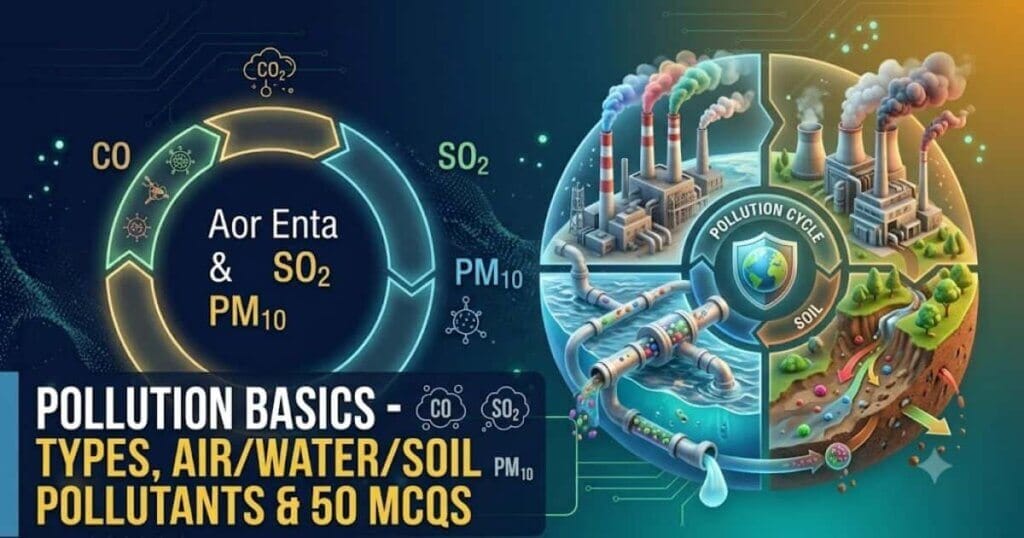
General Science (Ecology & Environmental Biology Section) | Target Exams: SSC CGL, CHSL, CPO, RRB NTPC, Group D, State PSCs & CDS
General Science aur Ecology section me Pollution Basics (पर्यावरणीय प्रदूषण के मूल सिद्धांत) ek high-weightage aur frequently recurring topic hai. Chahe primary vs secondary pollutants ka scientific difference ho, Photochemical Smog (PAN, Ozone) ka reaction mechanism ho, Acid Rain chemical equations hon, ya Water Pollution me BOD (Biochemical Oxygen Demand) aur Eutrophication ke concepts hon—har saal SSC, Railway aur State PSC exams me yahan se direct sawal puche jaate hain.
1. Environmental Pollution Core: Types, Indicators & Chemical Mechanisms
A. Air Pollution & Chemical Reactions
- Carbon Monoxide (CO): Silent killer gas. Incomplete combustion se release hoti hai. Hemoglobin ke sath bind karke Carboxyhemoglobin banati hai, jiski binding affinity oxygen se lagbhag 200-300 guna zyada hoti hai.
- Acid Rain (अम्लीय वर्षा): Atmospheric moisture me $SO_2$ aur $NO_2$ dissolve hokar Sulfuric acid ($H_2SO_4$) aur Nitric acid ($HNO_3$) banate hain:
- $$2SO_2 + O_2 + 2H_2O \rightarrow 2H_2SO_4$$
- $$4NO_2 + O_2 + 2H_2O \rightarrow 4HNO_3$$
- Acid rain ka pH aamtaur par 5.6 se kam hota hai. Ye Taj Mahal jaise marble monuments ko corrode karta hai (Stone Leprosy / Marble Cancer: $CaCO_3 + H_2SO_4 \rightarrow CaSO_4 + H_2O + CO_2$).
- Photochemical Smog vs. Classical (London) Smog:
- Classical (London) Smog: Cool, humid climate me banta hai. Isme smoke, fog aur $SO_2$ hota hai. Nature me Reducing hota hai.
- Photochemical (Los Angeles) Smog: Warm, dry aur sunny climate me banta hai. Hydrocarbons aur Nitrogen oxides par solar UV light padne se banta hai. Main components: Ozone ($O_3$), Acrolein, Formaldehyde, aur Peroxyacetyl Nitrate (PAN). Nature me Oxidizing hota hai.
B. Water Pollution & Biological Indicators
| Concept / Metric | Scientific Definition | Significance in Exam |
|---|---|---|
| DO (Dissolved Oxygen) | Water me dissolved $O_2$ ki matra. Healthy water me DO $\ge 8\text{ mg/L}$ hoti hai. | Agar DO $< 4\text{ mg/L}$ ho jaye, to water heavily polluted mana jata hai aur fish mortality badh jati hai. |
| BOD (Biochemical Oxygen Demand) | Aerobic bacteria dwara 1 liter water me present organic waste ko decompose karne me lagne wali oxygen ($5\text{ days at } 20^\circ\text{C}$). | High BOD indicates high sewage/organic pollution. Pure drinking water ka BOD $< 1\text{ ppm}$ hota hai. |
| COD (Chemical Oxygen Demand) | Strong chemical oxidizer ($K_2Cr_2O_7$) dwara biodegradable aur non-biodegradable dono organic matter ko oxidise karne ke liye required oxygen. | COD is always greater than BOD ($\text{COD} > \text{BOD}$). |
| Eutrophication | Nutrient enrichment (Phosphates & Nitrates) of water bodies leading to algal bloom. | Algae sun light block karti hain; decay hone par DO exhaust ho jati hai (Hypoxia / Dead zones). |
| Bioaccumulation & Biomagnification | Toxins (e.g., DDT, Mercury) ka trophic levels me progressively badhna. | DDT causes thinning of eggshells in fish-eating birds due to calcium metabolism disruption. |
C. Famous Pollution Episodes & Disease Disasters
- Minamata Disease (Japan, 1956): Industrial wastewater me Methylmercury ($Hg$) discharge hone se contaminated fish khane ke karan hui neurological bimari.
- Itai-Itai Disease (Japan, 1912): Mining activities se river me Cadmium ($Cd$) poisoning ke karan hui bimari (severe osteomalacia / bone softening and kidney failure).
- Blue Baby Syndrome (Methemoglobinemia): Drinking water me excess Nitrate ($NO_3^-$) (above $45\text{ mg/L}$) hone ke karan infants me oxygen-carrying capacity ghat jati hai.
- Black Foot Disease: Groundwater me excess Arsenic ($As$) poisoning ke karan peripheral vascular collapse.
- Bhopal Gas Tragedy (3 December 1984): Union Carbide pesticide plant se highly toxic Methyl Isocyanate (MIC, $C_2H_3NO$) gas leak hui thi.
2. Exam Weightage & Trends Table
| Competitive Exam | Average Questions | High-Yield Focus Areas |
|---|---|---|
| SSC CGL / CHSL (Tier 1 & Tier 2) | 2 – 3 Questions | Primary vs Secondary pollutants, Smog components (PAN/Ozone), Minamata & Itai-Itai diseases, Acid rain gases ($SO_2, NO_2$). |
| RRB NTPC / Group D / ALP | 2 – 4 Questions | BOD/COD definitions, Blue baby syndrome (Nitrates), Taj Mahal marble cancer, Sound pollution decibel limits, Green muffler technique. |
| State PSCs (BPSC, UPPSC, MPPSC) | 3 – 5 Questions | Fly ash composition, Biomagnification of DDT/Heavy metals, Montreal & Kyoto protocols, E-waste rules, Air Quality Index (AQI) parameters. |
| CDS / NDA / CAPF | 2 – 3 Questions | Chemical reactions of catalytic converters, greenhouse warming potentials, scrubber and electrostatic precipitator mechanisms. |
📥 Download Pollution Basics Complete Study Notes PDF
High-yield pollutant classification tables, acid rain & smog chemical equations, water quality parameter metrics (BOD/COD), and all 50 practice questions with complete solutions compiled in one offline revision PDF.
4. Recommended General Science Preparation Books
5. Frequently Asked Questions (FAQs)
Q1: What is the scientific difference between Primary and Secondary air pollutants?
Ans: Primary pollutants are emitted directly from an identifiable source into the atmosphere in a harmful form (e.g., Carbon Monoxide $CO$, Sulfur Dioxide $SO_2$, Nitrogen Oxides $NO_x$, Particulate Matter). Secondary pollutants are formed in the atmosphere when primary pollutants undergo chemical reactions with sunlight, moisture, or other atmospheric gases (e.g., Ground-level Ozone $O_3$, Peroxyacetyl Nitrate PAN, Photochemical Smog, Sulfuric Acid $H_2SO_4$).
Q2: Why is Biochemical Oxygen Demand (BOD) critical for water quality assessment?
Ans: Biochemical Oxygen Demand (BOD) measures the amount of dissolved oxygen required by aerobic microorganisms to biologically decompose organic waste in water over a 5-day period at 20°C. A high BOD value indicates high organic sewage pollution and severe depletion of dissolved oxygen ($DO$), rendering the water toxic for aquatic life.
Q3: What causes photochemical smog and why does it irritate human eyes?
Ans: Photochemical smog is formed on warm, sunny days when ultraviolet solar radiation acts on a mixture of unburnt hydrocarbons and nitrogen oxides ($NO_x$) emitted by vehicular exhaust. Its secondary reaction byproducts, specifically Ozone ($O_3$), Formaldehyde, Acrolein, and Peroxyacetyl Nitrate (PAN), are powerful eye and respiratory lachrymators (irritants).
Q4: What causes the disease Minamata and Itai-Itai?
Ans: Minamata disease is a severe neurological syndrome caused by Methylmercury ($Hg$) poisoning through the consumption of contaminated fish. Itai-Itai disease is caused by chronic Cadmium ($Cd$) poisoning from contaminated river water, resulting in severe osteomalacia (bone softening and severe joint pain) and renal failure.
- Nutrition and Vitamins Notes PDF: Deficiency & 50 MCQs

- Scientific Inventions Notes PDF: Discoveries & 50 MCQs
- Pollution Basics Notes PDF: Air, Water, Soil & 50 MCQs
- Vaccination and Immunization Notes PDF: Types, Schedule & 50 MCQs
- Magnetism Basics Notes & 50 Practice MCQs for SSC & Banking




Exam Expert & Content Strategist with over 5+ years of experience in the competitive exam sector. I specialize in analyzing government recruitment patterns and simplifying complex syllabi for aspirants. Having helped thousands of students through Sarkari Exam PDF, my mission is to provide authentic, updated, and high-quality study materials for SSC, UPSC, Railways, and Banking exams to help every candidate achieve their career goals.
⚠️ Disclaimer: All study materials, notes, and PDFs shared on SarkariExamPDF.in are provided purely for educational and reference purposes to assist competitive exam aspirants. We do not claim ownership of any original books or official publications. If you are the rightful copyright owner and have any objection regarding any material, please contact us through our Contact Page for immediate removal.