
General Science (Cytology Module) | Target Exams: SSC CGL, CHSL, CPO, RRB NTPC, Group D, State PSCs & NDA/CDS
Biology ke foundation section me Cell Structure (कोशिका संरचना) sabse zyada scoring aur repeatedly tested topic hai. Sabhi living organisms ki fundamental structural aur functional unit ‘Cell’ hoti hai. Chahe Robert Hooke ki cork cell discovery ho, Singer-Nicolson ka Fluid Mosaic Model ho, ya Mitochondria, Chloroplast aur Ribosomes ke biochemical functions hon—har competitive exam me yahan se direct factual aur conceptual sawal bante hain.
1. Cell Biology Core: Organelles, Models & Functions
A. Cell Theory (कोशिका सिद्धांत)
- Formulation: Theodor Schwann (1839) aur Matthias Schleiden (1838) ne Cell Theory formulate ki.
- Omnis Cellula-e-Cellula: Rudolf Virchow (1855) ne isme ahem point joda ki nayi koshikaon ka nirmaan pehle se maujood koshikaon ke vibhajan se hota hai (“All cells arise from pre-existing cells”).
- Exception: Viruses ko cell theory ka exception mana jata hai kyunki ye acellular (non-cellular) hote hain aur host ke bahar non-living crystal jaise behave karte hain.
B. Prokaryotic vs. Eukaryotic Cells
| Parameter | Prokaryotic Cell (असीमकेंद्रक) | Eukaryotic Cell (ससीमकेंद्रक) |
|---|---|---|
| Nucleus (केंद्रक) | Incipient nucleus (Nucleoid), no nuclear membrane | Well-defined true nucleus with double membrane |
| Ribosomes | 70S type (50S + 30S subunits) | 80S type in cytoplasm (60S + 40S); 70S in organelles |
| Membrane-Bound Organelles | Absent (Mitochondria, ER, Golgi absent) | Present (Mitochondria, Golgi, ER, Lysosomes) |
| Examples | Bacteria, Cyanobacteria (Blue-green algae), Mycoplasma | Protists, Fungi, Plants, and Animals |
C. Major Cell Organelles & Their Epithets
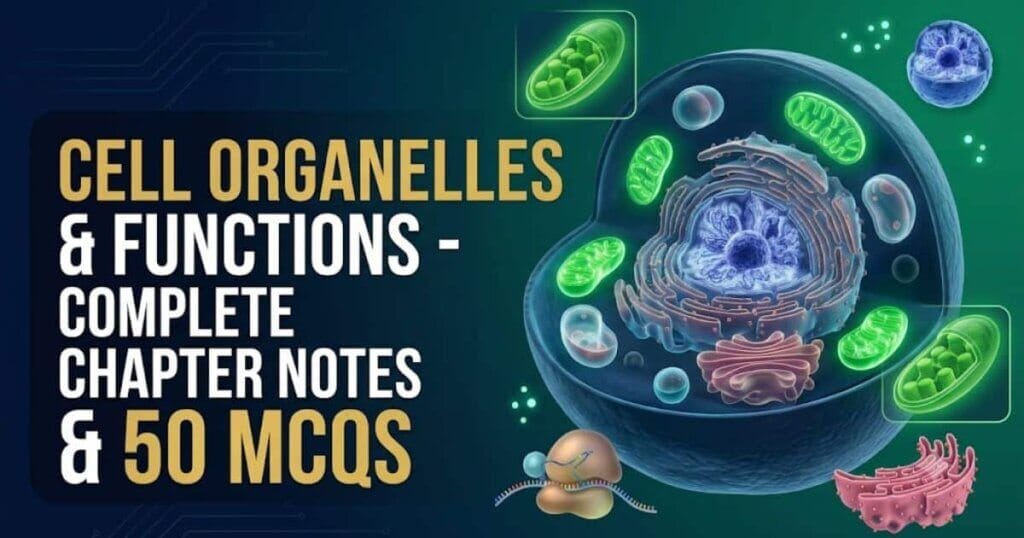
- Mitochondria: “Powerhouse of the Cell”. Double membrane-bound organelle. Inner membrane cristae banati hai jisme Oxysomes ($F_0-F_1$ particles) hote hain. Yahan Krebs cycle aur oxidative phosphorylation se ATP ($36-38\text{ ATP}$) synthesize hoti hai. Inke paas apna circular DNA aur 70S ribosomes hote hain (Semi-autonomous organelle).
- Lysosomes: “Suicide Bags of the Cell”. Christian de Duve ne discover kiya. Isme acidic pH ($\approx 5$) par kaam karne wale hydrolytic enzymes (hydrolases, lipases, proteases) hote hain jo autolysis aur phagocytosis karte hain.
- Ribosomes: “Protein Factory of the Cell”. George Palade ne discover kiya. Ye non-membrane bound RNA-protein complexes hote hain.
- Golgi Apparatus: “Traffic Controller of the Cell”. Camillo Golgi ne discover kiya. Post-translational modification, packaging, aur secretion (Glycosylation of proteins & lipids) ka kaam karta hai. Ye acrosome of sperm aur lysosomes banane me help karta hai.
- Endoplasmic Reticulum (ER): Rough ER (RER) ki surface par ribosomes hote hain jo protein synthesis karte hain. Smooth ER (SER) lipid, phospholipid aur steroid hormones synthesize karta hai tatha liver me detoxification karta hai.
- Plastids (Chloroplasts): “Kitchen of the Cell”. Double-membrane organelle containing chlorophyll. Stroma me dark reaction (Calvin cycle) aur Grana thylakoids me light reaction hoti hai. Ye bhi semi-autonomous hote hain.
D. Plant Cell vs. Animal Cell
| Feature | Plant Cell (पादप कोशिका) | Animal Cell (जंतु कोशिका) |
|---|---|---|
| Cell Wall | Present (composed of Cellulose, Hemicellulose, Pectin) | Completely absent; bounded only by plasma membrane |
| Plastids | Present (Chloroplasts, Chromoplasts, Leucoplasts) | Absent |
| Vacuole | Single large central vacuole covered by Tonoplast | Small, multiple or temporary vacuoles |
| Centrosome / Centriole | Absent in higher plants | Present (helps in spindle formation during cell division) |
| Storage Carbohydrate | Starch (स्टार्च) | Glycogen (ग्लाइकोजन) |
2. Exam Weightage & Trends
| Competitive Exam | Expected Questions | Core High-Yield Focus Areas |
|---|---|---|
| SSC CGL / CHSL / CPO (Tier 1 & 2) | 2 – 3 Questions | Discoverers, Cell organelle epithets, 70S vs 80S ribosomes, fluid mosaic model. |
| RRB NTPC / Group D / ALP | 2 – 4 Questions | Functions of Mitochondria, Lysosomes, Chloroplasts, Cell wall composition. |
| State PSCs / Police SI | 2 – 3 Questions | Cell cycle phases, Prokaryote differences, Semi-autonomous organelles. |
📥 Download Cell Structure & Cytology Master Notes PDF
High-yield diagrams, organelle summary tables, scientist discoveries and all 50 practice questions with detailed solutions compiled in one single offline revision PDF.
4. Recommended General Science Preparation Books
5. Frequently Asked Questions (FAQs)
Q1: What is the main difference between Plant Cells and Animal Cells?
Ans: Plant cells possess a rigid cellulose cell wall, plastids (chloroplasts), and a large central vacuole covered by a tonoplast. Animal cells lack a cell wall and plastids, but contain centrosomes with centrioles that assist in spindle formation during cell division.
Q2: Why are Mitochondria and Chloroplasts called Semi-Autonomous Organelles?
Ans: Both mitochondria and chloroplasts contain their own circular double-stranded DNA (ds-DNA) and 70S ribosomes. They can synthesize some of their own proteins and replicate independently of nuclear DNA through binary fission.
Q3: What makes the Fluid Mosaic Model of Singer and Nicolson widely accepted?
Ans: Proposed in 1972, this model accurately explains the quasi-fluid nature of the lipid bilayer that allows lateral movement of integral and peripheral proteins, explaining membrane elasticity, active/passive transport, endocytosis, and cell division.
Q4: Why are Lysosomes termed the ‘Suicidal Bags’ of the cell?
Ans: Lysosomes contain powerful hydrolytic enzymes that work at acidic pH. If a cell is damaged, starved, or infected, lysosomes can burst open, releasing these digestive enzymes to digest and autolyze their own host cell.
- DNA and RNA Notes PDF: Structure, Differences & 50 MCQs

- Human Digestive System Notes PDF: Enzymes, Organs & 50 MCQs
- Genetics Basics Notes PDF: Mendel Laws, DNA & 50 MCQs
- Cell Division Notes PDF: Mitosis, Meiosis & 50 Practice MCQs
- Cell Organelles Notes PDF: Structure, Functions & 50 MCQs
- Cell Structure Notes PDF: Organelles, Functions & 50 MCQs

Exam Expert & Content Strategist with over 5+ years of experience in the competitive exam sector. I specialize in analyzing government recruitment patterns and simplifying complex syllabi for aspirants. Having helped thousands of students through Sarkari Exam PDF, my mission is to provide authentic, updated, and high-quality study materials for SSC, UPSC, Railways, and Banking exams to help every candidate achieve their career goals.
⚠️ Disclaimer: All study materials, notes, and PDFs shared on SarkariExamPDF.in are provided purely for educational and reference purposes to assist competitive exam aspirants. We do not claim ownership of any original books or official publications. If you are the rightful copyright owner and have any objection regarding any material, please contact us through our Contact Page for immediate removal.