
General Science (Molecular Biology & Genetics) | Target Exams: SSC CGL, CHSL, CPO, RRB NTPC, Group D, State PSCs & CDS
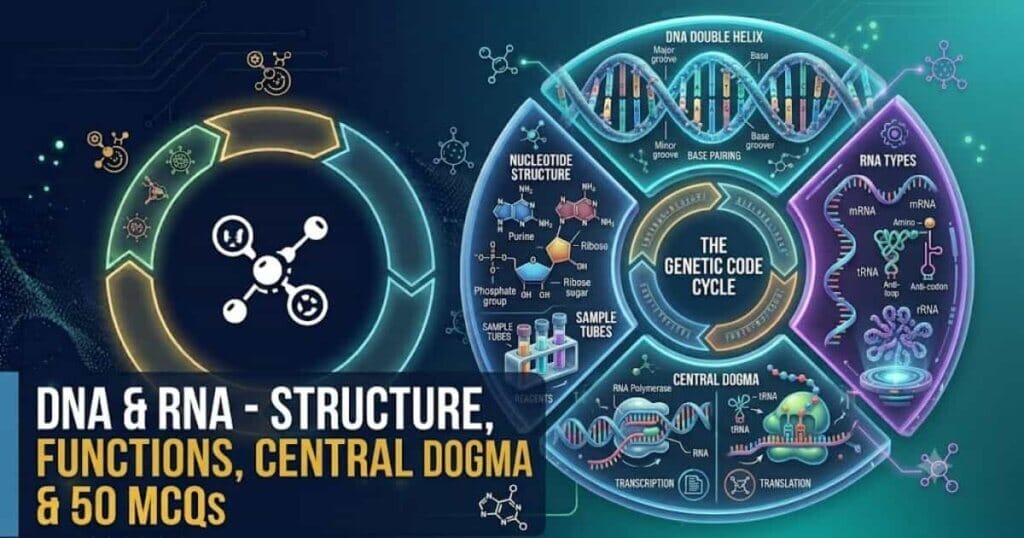
Molecular Biology aur Biochemistry ke antargat DNA and RNA (न्यूक्लिक अम्ल: डीएनए और आरएनए) ek aisa core conceptual topic hai jahan se competitive exams me direct factual, structural aur numerical problems puche jaate hain. Friedrich Miescher dwara ‘Nuclein’ ki discovery se lekar Watson aur Crick ka B-DNA double-helix model, Chargaff ke quantitative rules, RNA ke teen mukhya prakar (mRNA, tRNA, rRNA), aur Central Dogma (Replication, Transcription, Translation) tak—is single guide me sabhi high-yield points compile kiye gaye hain.
1. DNA & RNA Core: Structural Models, Differences & Central Dogma
A. Watson & Crick Double-Helix Model of B-DNA (1953)
- Discovery: James Watson aur Francis Crick ne Rosalind Franklin aur Maurice Wilkins ke X-ray crystallography data ke aadhar par 1953 me DNA ka double-helical model diya (Nobel Prize in 1962).
- Antiparallel Strands: DNA ke dono strands ek doosre ke anti-parallel run karte hain: ek strand $5′ \rightarrow 3’$ direction me aur doosra $3′ \rightarrow 5’$ direction me.
- Dimensions of B-DNA:
- Helix diameter: $20\ \text{Å}$ ($2.0\ \text{nm}$)
- Pitch of one complete turn: $34\ \text{Å}$ ($3.4\ \text{nm}$)
- Base pairs per helical turn: 10 base pairs
- Distance between two adjacent base pairs: $3.4\ \text{Å}$ ($0.34\ \text{nm}$)
- Hydrogen Bonding: Adenine hamesha Thymine ke sath 2 hydrogen bonds se judta hai ($A = T$), aur Guanine hamesha Cytosine ke sath 3 hydrogen bonds se judta hai ($G \equiv C$).
B. Chargaff’s Equivalence Rules (For dsDNA)
Erwin Chargaff ne double-stranded DNA ke liye quantitative equivalence rules diye:
- Purines ki kul matra hamesha Pyrimidines ke barabar hoti hai: $[A] + [G] = [T] + [C]$ ya $\frac{[A] + [G]}{[T] + [C]} = 1$.
- Individual pairs: $[A] = [T]$ aur $[G] = [C]$.
- Note: $[A + T] / [G + C]$ ka ratio (Base Ratio) alag-alag species me variable hota hai aur phylogenetic relationship show karta hai. Chargaff rule single-stranded DNA (ssDNA) ya RNA par lagu nahi hota.
C. DNA vs. RNA: Structural & Functional Comparison
| Feature | DNA (Deoxyribonucleic Acid) | RNA (Ribonucleic Acid) |
|---|---|---|
| Pentose Sugar | 2′-deoxyribose (lacks oxygen at 2′ position: $C_5H_{10}O_4$) | Ribose sugar (has reactive -OH at 2′ position: $C_5H_{10}O_5$) |
| Nitrogenous Bases | Adenine, Guanine, Cytosine, Thymine (5-methyl uracil) | Adenine, Guanine, Cytosine, Uracil |
| Strand Structure | Double-stranded helix (mostly) | Single-stranded (can fold into secondary shapes) |
| Chemical Stability | Highly stable; less reactive; ideal for genetic storage | Unstable and labile; 2′-OH makes it catalytic (Ribozyme) |
| Primary Role | Long-term storage of hereditary genetic information | Protein synthesis, genetic messenger, and catalytic adapter |
D. Types of RNA
- mRNA (Messenger RNA ~5%): DNA se genetic code lekar ribosomes tak pahunchata hai. Iske 3-nucleotide sequences ko Codons kehte hain. (Start codon: $AUG$, Stop codons: $UAA, UAG, UGA$).
- tRNA (Transfer RNA ~15%): Isko Soluble RNA (sRNA) ya Adapter molecule kehte hain. Holley ne iska Cloverleaf 2D model aur Kim ne L-shaped 3D structure diya. Iske paas specific amino acid binding site aur anticodon loop hota hai.
- rRNA (Ribosomal RNA ~80%): Abundant aur structurally stable RNA jo ribosomes ka structural framework aur catalytic role (Peptidyl transferase) nibhata hai.
E. Central Dogma of Molecular Biology
Francis Crick dwara 1958 me proposed: Genetic information ka unidirectional flow:
Exception: Retroviruses (e.g. HIV) me Reverse Transcription (Teminism) hota hai: $\text{RNA} \xrightarrow{\text{Reverse Transcriptase}} \text{cDNA}$.
2. Exam Weightage & Trends Table
| Competitive Exam | Average Questions | Core High-Yield Focus Areas |
|---|---|---|
| SSC CGL / CHSL (Tier 1 & Tier 2) | 2 – 3 Questions | Watson-Crick dimensions ($3.4\ \text{nm}$, $20\ \text{Å}$), Chargaff rule numericals, base pairing bonds, difference in sugars (2′-deoxyribose vs ribose). |
| RRB NTPC / Group D / ALP | 2 – 4 Questions | Nitrogenous bases (Uracil in RNA, Thymine in DNA), full forms, Central dogma stages, cloverleaf tRNA structure. |
| State PSCs (BPSC, UPPSC, MPPSC) | 3 – 4 Questions | Nucleoside vs Nucleotide, Meselson-Stahl semi-conservative replication proof, Reverse transcriptase, genetic code characteristics. |
| CDS / NDA / CAPF | 1 – 2 Questions | Phosphodiester bonds, Griffith & Hershey-Chase experiments, Start/Stop codons. |
📥 Download DNA and RNA Complete Study Notes PDF
High-yield molecular models, DNA replication steps, Chargaff formula problems, RNA types comparison table, and all 50 practice questions with complete solutions compiled in one offline revision PDF.
4. Recommended General Science Preparation Books
5. Frequently Asked Questions (FAQs)
Q1: What is the main structural difference between DNA and RNA?
Ans: DNA contains 2′-deoxyribose sugar (which lacks an oxygen atom at the 2′ carbon position) and the nitrogenous base Thymine, forming a stable double-stranded antiparallel helix. RNA contains Ribose sugar (with a reactive 2′-OH group) and Uracil instead of Thymine, typically existing as an unstable single-stranded molecule.
Q2: What is Chargaff’s Rule and where does it apply?
Ans: Chargaff’s rule applies strictly to double-stranded DNA (dsDNA). It states that the molar amount of purines always equals the molar amount of pyrimidines ($[A] + [G] = [T] + [C]$), and specifically $[A] = [T]$ and $[G] = [C]$. It does not apply to single-stranded DNA (ssDNA) or RNA.
Q3: What are the three primary types of cellular RNA and their functions?
Ans: The three primary types are: (1) mRNA (Messenger RNA ~5%), which carries the transcribed genetic code from DNA to the ribosome; (2) tRNA (Transfer RNA ~15%), which acts as an adapter molecule reading mRNA codons via anticodons and delivering specific amino acids; and (3) rRNA (Ribosomal RNA ~80%), which forms the structural core of ribosomes and catalytically synthesizes peptide bonds.
Q4: What is the Central Dogma of Molecular Biology and its exception?
Ans: Proposed by Francis Crick, the Central Dogma describes the unidirectional flow of genetic information: $\text{DNA} \rightarrow \text{mRNA} \rightarrow \text{Protein}$. The major exception is Reverse Transcription in retroviruses (e.g., HIV), where the enzyme reverse transcriptase synthesizes complementary DNA (cDNA) from an RNA template.
- DNA and RNA Notes PDF: Structure, Differences & 50 MCQs

- Human Digestive System Notes PDF: Enzymes, Organs & 50 MCQs
- Genetics Basics Notes PDF: Mendel Laws, DNA & 50 MCQs
- Cell Division Notes PDF: Mitosis, Meiosis & 50 Practice MCQs
- Cell Organelles Notes PDF: Structure, Functions & 50 MCQs
- Cell Structure Notes PDF: Organelles, Functions & 50 MCQs

Exam Expert & Content Strategist with over 5+ years of experience in the competitive exam sector. I specialize in analyzing government recruitment patterns and simplifying complex syllabi for aspirants. Having helped thousands of students through Sarkari Exam PDF, my mission is to provide authentic, updated, and high-quality study materials for SSC, UPSC, Railways, and Banking exams to help every candidate achieve their career goals.
⚠️ Disclaimer: All study materials, notes, and PDFs shared on SarkariExamPDF.in are provided purely for educational and reference purposes to assist competitive exam aspirants. We do not claim ownership of any original books or official publications. If you are the rightful copyright owner and have any objection regarding any material, please contact us through our Contact Page for immediate removal.