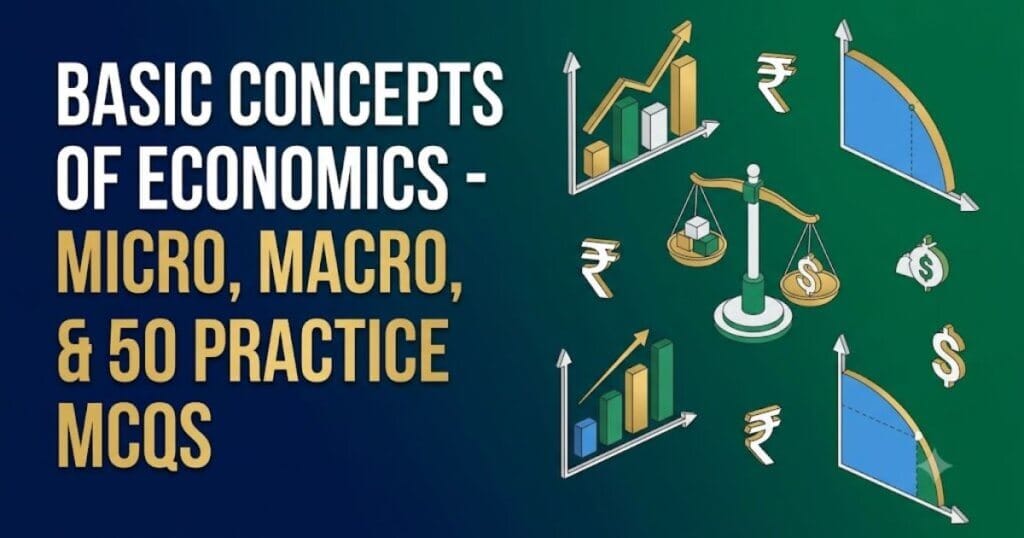
Basic Concepts of Economic Notes PDF: Principles & 50 MCQs

Basic-Concepts-of-Economic

General Studies (General Economics Foundation Module) | Target Exams: SSC CGL, CHSL, CPO, RRB NTPC, State PSCs & Banking GA

Economics ki understanding develop karne ke liye Basic Concepts of Economic (अर्थशास्त्र की मूलभूत अवधारणाएं) sabse pehla aur anivarya vishay hai. Adam Smith ki ‘Wealth of Nations’ (1776) se lekar modern welfare economics tak, arthashastra ka mool uddeshya simit sansadhano (scarce resources) ka asimit aavashyaktaon (unlimited wants) ke beech sarvochha upyog karna hai. Chahe Microeconomics vs Macroeconomics ka antar ho, Opportunity Cost ka principle ho, Production Possibility Frontier (PPF) curve ho, ya Capitalist, Socialist aur Mixed economies ki karyapranali ho—is module me sabhi high-yield concepts ko exam-oriented format me cover kiya gaya hai.

💡 Exam Pointer: Adam Smith ko ‘Father of Modern Economics’ kaha jata hai jinhone economics ko “Science of Wealth” ke roop me paribhashit kiya. Robbins ne ise “Science of Scarcity and Choice” aur Alfred Marshall ne “Study of Mankind in ordinary business of life (Welfare)” kaha.

1. Basic Concepts of Economic: Scarcity, PPF, Goods & Systems

A. The Central Economic Problem: Scarcity & Choice

  • Scarcity (दुर्लभता): Manav ki ichhayein asimit (unlimited) hain jabki unhe pura karne wale sansadhan (resources) durlabh (scarce) aur vaikalpik upyog (alternative uses) wale hote hain.
  • Opportunity Cost (अवसर लागत): Kisi ek vikalp ko chunne par agle sarvashreshtha tyage gaye vikalp (next best alternative forgone) ka mulya Opportunity Cost kehlata hai. $$\text{Opportunity Cost} = \text{Value of Next Best Alternative Forgone}$$
  • Three Central Problems of an Economy:
    1. What to produce and in what quantity? (Consumer goods vs Capital goods)
    2. How to produce? (Labour-intensive vs Capital-intensive technique)
    3. For whom to produce? (Distribution of national income among factors)

B. Production Possibility Frontier (PPF / PPC)

PPF ek aisa curve hai jo uplabdh sansadhano aur takneek ke sath do vastuon ke un sabhi sambhavit utpadan sanyojano (combinations) ko darshata hai jinhe ek arthvyavastha utpadit kar sakti hai.

  • Shape of PPF: Concave to the origin (मूल बिंदु की ओर नतोदर) hota hai, kyunki Marginal Opportunity Cost (MOC) ya Marginal Rate of Transformation (MRT) lagatar badhti hai. $$\text{MRT} = \frac{\Delta \text{Sacrifice of Good Y}}{\Delta \text{Gain of Good X}} = \frac{\Delta Y}{\Delta X}$$
  • Points on PPF: Optimum & Efficient utilization of resources.
  • Points inside PPF: Inefficient / Under-utilization of resources (e.g., Unemployment).
  • Points outside PPF: Unattainable / Non-feasible with current level of resources and technology (shifts outward when economic growth or technological progress occurs).

C. Microeconomics vs. Macroeconomics

ParameterMicroeconomics (व्यष्टि अर्थशास्त्र)Macroeconomics (समष्टि अर्थशास्त्र)
Origin & Coined ByRagnar Frisch (1933) – Greek word ‘Mikros’ (Small)Ragnar Frisch (1933) – Greek word ‘Makros’ (Large)
Focus of StudyIndividual units: Single consumer, firm, household, marketEconomy as a whole: Aggregate demand, National Income, Inflation
Central Determining VariablePrice mechanism (Also called Price Theory)Income and employment (Also called Income Theory)
Key AssumptionsAssumes macro variables (full employment, national output) constantAssumes micro variables (distribution of income, relative prices) constant
Primary ToolsIndividual Demand and SupplyAggregate Demand (AD) and Aggregate Supply (AS)

D. Classification of Goods in Economics

  • Free Goods vs Economic Goods: Free goods prakriti dwara asimit roop se uplabdh hote hain (e.g., hawa, dhoop) jinki koi opportunity cost ya keemat nahi hoti. Economic goods durlabh hote hain aur unki market price hoti hai.
  • Consumer Goods vs Capital Goods: Consumer goods manav ki ichhaon ko direct satisfy karte hain (e.g., roti, kapda, car). Capital goods doosri vastuon ke utpadan me upyog hote hain (e.g., machinery, tools, factory building).
  • Public Goods vs Private Goods: Public goods Non-excludable aur Non-rivalrous hote hain (e.g., National Defense, street lights, lighthouse). Private goods excludable aur rivalrous hote hain.
  • Giffen Goods & Veblen Goods: Giffen goods aisi highly inferior goods hain jahan Law of Demand fail hota hai (price badhne par demand badhti hai due to strong negative income effect). Veblen goods prestige / status goods hoti hain (e.g., diamonds, luxury watches) jinhe ameer log dikhawe ke liye mahangi hone par zyada khareedte hain.

E. Types of Economic Systems

FeatureCapitalist Economy (Market / Free)Socialist Economy (Command / Centrally Planned)Mixed Economy (मिश्रित अर्थव्यवस्था)
Ownership of MeansPrivate individuals and corporationsGovernment / Public collective ownershipCo-existence of both Private & Public sectors
Primary MotiveProfit maximization (लाभ कमाना)Social welfare (सामाजिक कल्याण)Profit motive balanced with social welfare
Price DeterminationInvisible hand / Free market forces ($D$ & $S$)Central Planning Authority (Government administered)Price mechanism regulated by government policies
ExamplesUSA, UK, Japan, GermanyFormer USSR, North Korea, CubaIndia, France, Brazil, Sweden

F. Utility Theory Formulas

  • Total Utility (TU): Kisi vastu ki vibhinn ikaiyon ke upbhog se prapt kul santushti ($TU = \sum MU$).
  • Marginal Utility (MU): Ek atirikt (additional) ikai ke upbhog se TU me hone wala parivartan: $$MU_n = TU_n – TU_{n-1} \quad \text{or} \quad MU = \frac{\Delta TU}{\Delta Q}$$
  • Consumer Equilibrium (Single Commodity): $\frac{MU_x}{P_x} = MU_m$
  • Law of Equi-Marginal Utility (Gossen’s Second Law): $$\frac{MU_x}{P_x} = \frac{MU_y}{P_y} = MU_m$$

3. 50 Practice MCQs: Basic Concepts of Economic

Standard Level: SSC CGL Tier 1/2, RRB NTPC & State PSCs | Bilingual (English & Hindi) | Submit at Bottom

Q1. Who is universally regarded as the ‘Father of Modern Economics’?
‘आधुनिक अर्थशास्त्र का जनक’ (Father of Modern Economics) किसे माना जाता है?
Solution: (B) एडम स्मिथ (1723–1790) को आधुनिक अर्थशास्त्र का जनक माना जाता है। उन्होंने 1776 में अपनी युगांतकारी पुस्तक ‘The Wealth of Nations’ प्रकाशित की थी।
Q2. In which year was Adam Smith’s landmark economic treatise ‘The Wealth of Nations’ published?
एडम स्मिथ की ऐतिहासिक पुस्तक ‘द वेल्थ ऑफ नेशंस’ किस वर्ष प्रकाशित हुई थी?
Solution: (C) एडम स्मिथ की पुस्तक का पूरा नाम ‘An Inquiry into the Nature and Causes of the Wealth of Nations’ था, जो 1776 में प्रकाशित हुई थी।
Q3. Who coined the terms ‘Microeconomics’ and ‘Macroeconomics’ in 1933?
वर्ष 1933 में ‘व्यष्टि अर्थशास्त्र’ (Microeconomics) और ‘समष्टि अर्थशास्त्र’ (Macroeconomics) शब्दों का प्रतिपादन किसने किया था?
Solution: (A) नॉर्वेजियन अर्थशास्त्री रैग्नर फ्रिश (Ragnar Frisch) ने 1933 में सबसे पहले अर्थशास्त्र को माइक्रो और मैक्रो दो शाखाओं में विभाजित किया। वे 1969 में अर्थशास्त्र के पहले नोबेल पुरस्कार विजेता भी थे।
Q4. The fundamental economic problem faced by every society arises primarily due to:
प्रत्येक समाज द्वारा सामना की जाने वाली मूलभूत आर्थिक समस्या मुख्य रूप से किसके कारण उत्पन्न होती है?
Solution: (D) सभी आर्थिक समस्याओं की जड़ ‘दुर्लभता और चयन’ (Scarcity & Choice) है। मानव की आवश्यकताएं असीमित हैं, जबकि उन्हें पूरा करने वाले साधन सीमित और वैकल्पिक उपयोग वाले हैं।
Q5. Opportunity cost is best defined in economic theory as the:
आर्थिक सिद्धांत में ‘अवसर लागत’ (Opportunity Cost) को सबसे उपयुक्त रूप से कैसे परिभाषित किया जाता है?
Solution: (B) जब किसी एक विकल्प को चुना जाता है, तो उसके लिए जो दूसरा सबसे अच्छा विकल्प छोड़ना पड़ता है, उसका मूल्य ‘अवसर लागत’ कहलाता है।
Q6. The Production Possibility Frontier (PPF) is typically concave to the origin due to:
उत्पादन संभावना वक्र (PPF) मूल बिंदु की ओर नतोदर (Concave) क्यों होता है?
Solution: (A) कोई भी संसाधन सभी वस्तुओं के उत्पादन में समान रूप से कुशल नहीं होता। एक वस्तु का उत्पादन बढ़ाने के लिए दूसरी वस्तु का अधिक से अधिक त्याग करना पड़ता है, जिससे सीमांत रूपांतरण दर (MRT) बढ़ती है और वक्र नतोदर (Concave) बनता है।
Q7. Any point lying strictly INSIDE the Production Possibility Curve indicates:
उत्पादन संभावना वक्र के अंदर स्थित कोई भी बिंदु क्या दर्शाता है?
Solution: (C) PPF के भीतर का कोई बिंदु यह दर्शाता है कि अर्थव्यवस्था में उपलब्ध संसाधनों का पूर्ण और कुशल उपयोग नहीं हो रहा है (जैसे बेरोजगारी या मंदी)। वक्र के ऊपर स्थित बिंदु कुशल उपयोग दर्शाते हैं।
Q8. An outward (rightward) shift of the Production Possibility Curve is caused by:
उत्पादन संभावना वक्र का दाईं ओर (बाहर की ओर) खिसकाव किसके कारण होता है?
Solution: (D) जब अर्थव्यवस्था में कुल संसाधनों की मात्रा बढ़ती है या नई तकनीक का विकास होता है, तो दोनों वस्तुओं की उत्पादन क्षमता बढ़ जाती है और PPF दाईं ओर विस्थापित (Shift rightward) हो जाता है।
Q9. Which branch of economics is also popularly known as ‘Price Theory’?
अर्थशास्त्र की किस शाखा को ‘कीमत सिद्धांत’ (Price Theory) के नाम से भी जाना जाता है?
Solution: (B) व्यष्टि अर्थशास्त्र (Microeconomics) में व्यक्तिगत वस्तुओं और उत्पादन के साधनों की कीमतों के निर्धारण का अध्ययन मांग और पूर्ति द्वारा किया जाता है, इसलिए इसे Price Theory भी कहते हैं।
Q10. Who defined economics as a “Science of Scarcity and Choice” in his 1932 book?
1932 में अपनी पुस्तक में अर्थशास्त्र को “दुर्लभता और चयन का विज्ञान” किसने परिभाषित किया था?
Solution: (C) लियोनेल रॉबिंस ने अपनी पुस्तक ‘An Essay on the Nature and Significance of Economic Science’ (1932) में दुर्लभता आधारित परिभाषा दी जो आधुनिक अर्थशास्त्र का आधार बनी।
Q11. Macroeconomics is alternatively referred to in economic literature as the theory of:
आर्थिक साहित्य में समष्टि अर्थशास्त्र (Macroeconomics) को वैकल्पिक रूप से किसका सिद्धांत कहा जाता है?
Solution: (A) समष्टि अर्थशास्त्र का मुख्य सरोकार पूरी अर्थव्यवस्था में कुल राष्ट्रीय आय, समग्र मांग और रोजगार के स्तर को निर्धारित करना है, इसलिए इसे Theory of Income and Employment कहते हैं।
Q12. What are the four primary factors of production and their respective factor rewards?
उत्पादन के चार प्राथमिक साधन और उनके संबंधित प्रतिफल (पारिश्रमिक) कौन से हैं?
Solution: (D) उत्पादन के चार कारक हैं: भूमि (Land) को लगान/किराया, श्रम (Labour) को मजदूरी, पूंजी (Capital) को ब्याज, और उद्यमी (Entrepreneur) को लाभ प्राप्त होता है।
Q13. India’s economic system is officially categorized as which type of economy?
भारत की आर्थिक प्रणाली को आधिकारिक रूप से किस प्रकार की अर्थव्यवस्था में वर्गीकृत किया गया है?
Solution: (B) भारत एक ‘मिश्रित अर्थव्यवस्था’ (Mixed Economy) है जहाँ निजी क्षेत्र (Private Sector) और सार्वजनिक क्षेत्र (Public/Government Sector) दोनों एक साथ सह-अस्तित्व में कार्य करते हैं।
Q14. The economic concept of the ‘Invisible Hand’ operating in free competitive markets was introduced by:
मुक्त प्रतिस्पर्धी बाजारों में काम करने वाली ‘अदृश्य हाथ’ (Invisible Hand) की अवधारणा किसके द्वारा दी गई थी?
Solution: (C) एडम स्मिथ ने बताया कि बाजार में प्रत्येक व्यक्ति अपने निजी लाभ के लिए काम करता है, लेकिन मांग और पूर्ति की एक ‘अदृश्य शक्ति’ (Invisible hand) स्वतः ही पूरे समाज का कल्याण कर देती है।
Q15. In a pure Capitalist Economy, the allocation of scarce resources is determined entirely by:
एक विशुद्ध पूंजीवादी अर्थव्यवस्था में दुर्लभ संसाधनों का आवंटन पूरी तरह से किसके द्वारा निर्धारित होता है?
Solution: (A) पूंजीवादी अर्थव्यवस्था में सरकार का कोई हस्तक्षेप नहीं होता (Laissez-faire)। वहां ‘क्या, कैसे और किसके लिए उत्पादन करें’ का फैसला बाजार की स्वतंत्र कीमत प्रणाली (Price mechanism) द्वारा होता है।
Q16. Positive Economics deals with ________, while Normative Economics deals with ________:
सकारात्मक अर्थशास्त्र (Positive Economics) ________ से संबंधित है, जबकि आदर्शात्मक अर्थशास्त्र (Normative Economics) ________ से संबंधित है:
Solution: (D) सकारात्मक अर्थशास्त्र वास्तविक तथ्यों और वैज्ञानिक नियमों का विश्लेषण करता है (“What is”), जबकि आदर्शात्मक अर्थशास्त्र नैतिक निर्णयों और सुझावों से संबंधित होता है (“What ought to be / क्या होना चाहिए”)।
Q17. Which of the following is the most accurate example of a pure ‘Public Good’?
निम्नलिखित में से कौन सा एक विशुद्ध ‘सार्वजनिक वस्तु’ (Public Good) का सबसे सटीक उदाहरण है?
Solution: (B) सार्वजनिक वस्तुएं गैर-अपवर्जक (Non-excludable) और गैर-प्रतिद्वंद्वी (Non-rivalrous) होती हैं। राष्ट्रीय रक्षा का लाभ देश के सभी नागरिकों को समान रूप से मिलता है और किसी को इससे वंचित नहीं किया जा सकता।
Q18. The “Free-Rider Problem” is a market failure typically associated with which category of goods?
“फ्री-राइडर समस्या” (मुफ्तखोरी की समस्या) एक बाजार विफलता है जो आमतौर पर किस श्रेणी की वस्तुओं से जुड़ी है?
Solution: (C) सार्वजनिक वस्तुओं में किसी को उपभोग से रोका नहीं जा सकता (Non-excludable)। इसलिए लोग बिना भुगतान किए उसका लाभ उठाना चाहते हैं (Free-rider problem), जिससे निजी फर्में इन्हें बनाने से कतराती हैं।
Q19. The French phrase ‘Laissez-faire’ historically means:
ऐतिहासिक फ्रांसीसी वाक्यांश ‘लेसेज-फेयर’ (Laissez-faire) का शाब्दिक अर्थ क्या है?
Solution: (A) Laissez-faire का अर्थ है ‘अहस्तक्षेप की नीति’। इसका मानना है कि सरकार को आर्थिक गतिविधियों, व्यापार और उद्योग में किसी भी प्रकार का दखल नहीं देना चाहिए।
Q20. In economic analysis, what does the Latin phrase ‘Ceteris Paribus’ signify?
आर्थिक विश्लेषण में लैटिन वाक्यांश ‘सेटरिस पैरिबस’ (Ceteris Paribus) का क्या अर्थ होता है?
Solution: (D) Ceteris Paribus का अर्थ है “अन्य बातें समान रहने पर”। जैसे मांग का नियम कहता है कि उपभोक्ता की आय, पसंद आदि समान रहने पर (Ceteris Paribus), कीमत घटने पर मांग बढ़ती है।
Q21. The psychological want-satisfying power of a good or service is scientifically defined as:
किसी वस्तु या सेवा की मानवीय आवश्यकता को संतुष्ट करने की क्षमता को अर्थशास्त्र में क्या कहा जाता है?
Solution: (B) उपयोगिता (Utility) किसी वस्तु का वह गुण है जो किसी व्यक्ति की किसी इच्छा को संतुष्ट करता है। यह एक व्यक्तिपरक (Subjective) और मनोवैज्ञानिक अवधारणा है।
Q22. The Law of Diminishing Marginal Utility was formally formulated by which German economist as his First Law?
घटती सीमांत उपयोगिता का नियम (ह्रासमान तुष्टिगुण नियम) सबसे पहले किस जर्मन अर्थशास्त्री द्वारा अपने ‘प्रथम नियम’ के रूप में दिया गया था?
Solution: (C) हरमन हेनरिक गोसेन ने 1854 में यह नियम दिया, इसलिए इसे ‘गोसेन का प्रथम नियम’ (Gossen’s First Law) कहते हैं। बाद में अल्फ्रेड मार्शल ने इसे लोकप्रिय बनाया।
Q23. When Total Utility (TU) reaches its absolute maximum, Marginal Utility (MU) is equal to:
जब कुल उपयोगिता (Total Utility) अपने अधिकतम शिखर पर पहुंचती है, तब सीमांत उपयोगिता (Marginal Utility) होती है:
Solution: (A) जब उपभोक्ता पूर्ण तृप्त (Point of Satiety) हो जाता है, तो TU अधिकतम होता है और उस बिंदु पर $MU = 0$ होती है। इसके बाद भी उपभोग करने पर MU ऋणात्मक हो जाती है और TU घटने लगती है।
Q24. Gossen’s Second Law of consumption is popularly known in economics as the:
गोसेन का उपभोग का द्वितीय नियम अर्थशास्त्र में किस नाम से प्रसिद्ध है?
Solution: (B) गोसेन का दूसरा नियम ‘सम-सीमांत उपयोगिता नियम’ (Law of Equi-Marginal Utility) कहलाता है। इसके अनुसार उपभोक्ता अपनी आय विभिन्न वस्तुओं पर इस प्रकार व्यय करता है कि प्रत्येक वस्तु से प्राप्त सीमांत उपयोगिता और कीमत का अनुपात बराबर हो ($\frac{MU_x}{P_x} = \frac{MU_y}{P_y}$).
Q25. Which of the following is a Capital Good rather than a Consumer Good?
निम्नलिखित में से कौन सी वस्तु उपभोक्ता वस्तु के बजाय एक ‘पूंजीगत वस्तु’ (Capital Good) है?
Solution: (D) कपड़ा कारखाने की मशीन सीधे किसी मानवीय उपभोग को शांत नहीं करती बल्कि दूसरी उपभोक्ता वस्तुओं (कपड़ा) के उत्पादन में सहायता करती है, अतः यह एक पूंजीगत वस्तु (Capital Good) है।
Q26. What does the Marginal Rate of Transformation (MRT) measure along a Production Possibility Frontier?
उत्पादन संभावना वक्र के साथ सीमांत रूपांतरण दर (MRT) क्या मापती है?
Solution: (C) MRT यह मापती है कि वस्तु X की एक अतिरिक्त इकाई का उत्पादन करने के लिए वस्तु Y की कितनी इकाइयों का त्याग करना पड़ेगा ($MRT = \frac{\Delta Y}{\Delta X}$)। यह PPF के ढाल (Slope) को दर्शाती है।
Q27. The famous ‘Diamond-Water Paradox’ (Value-in-use vs Value-in-exchange) was solved using the concept of:
प्रसिद्ध ‘हीरा-जल विरोधाभास’ (उपयोग मूल्य बनाम विनिमय मूल्य) का समाधान किस अवधारणा द्वारा किया गया?
Solution: (A) पानी की कुल उपयोगिता बहुत अधिक है लेकिन प्रचुरता के कारण उसकी सीमांत उपयोगिता (MU) नगण्य है, इसलिए वह सस्ता है। हीरे की कुल उपयोगिता कम है लेकिन अत्यधिक दुर्लभता के कारण उसकी सीमांत उपयोगिता (MU) बहुत अधिक है, इसलिए वह महंगा है।
Q28. In an economy, when all available productive resources are fully and efficiently employed, producing more of one good requires:
किसी अर्थव्यवस्था में जब सभी संसाधन पूर्ण और कुशल रूप से कार्यरत हों, तो किसी एक वस्तु का अधिक उत्पादन करने के लिए क्या आवश्यक है?
Solution: (B) जब संसाधन पूर्ण रोजगार पर हों, तो अर्थव्यवस्था PPF वक्र की सीमा पर होती है। दुर्लभता के कारण एक वस्तु का उत्पादन बढ़ाने के लिए दूसरी वस्तु से संसाधनों को हटाना ही पड़ता है (Trade-off)।
Q29. A point lying outside (beyond) the Production Possibility Curve is currently:
उत्पादन संभावना वक्र के बाहर (परे) स्थित बिंदु वर्तमान में कैसा होता है?
Solution: (D) PPF के बाहर स्थित बिंदु वर्तमान सीमित संसाधनों और मौजूदा तकनीक के साथ प्राप्त नहीं किया जा सकता। इसे भविष्य में आर्थिक संवृद्धि या पूंजी निर्माण द्वारा ही प्राप्त किया जा सकता है।
Q30. Who is considered the pioneer of the ‘Welfare definition’ of economics focusing on material human well-being?
भौतिक मानव कल्याण पर केंद्रित अर्थशास्त्र की ‘कल्याणकारी परिभाषा’ के प्रतिपादक कौन माने जाते हैं?
Solution: (C) अल्फ्रेड मार्शल ने 1890 में अर्थशास्त्र को धन के अध्ययन से हटाकर मानव जीवन के सामान्य व्यवसाय के अध्ययन और ‘भौतिक कल्याण’ (Material Welfare) से जोड़ा।
Q31. Which of the following is a classic characteristic feature of a Socialist Command Economy?
निम्नलिखित में से कौन सी समाजवादी (आदेशात्मक) अर्थव्यवस्था की प्रमुख विशेषता है?
Solution: (A) समाजवादी अर्थव्यवस्था में उत्पादन के सभी भौतिक साधनों पर राज्य का नियंत्रण होता है, निजी संपत्ति सीमित होती है और समाज कल्याण को ध्यान में रखकर केंद्रीय नियोजन प्राधिकरण योजना बनाता है।
Q32. ‘Consumer Sovereignty’ (उपभोक्ता की संप्रभुता) is an essential hallmark feature of which economic system?
‘उपभोक्ता की संप्रभुता’ (Consumer Sovereignty) किस आर्थिक प्रणाली की मुख्य विशेषता है?
Solution: (B) पूंजीवादी व्यवस्था में उपभोक्ता को ‘राजा’ माना जाता है। उपभोक्ता जिस वस्तु को प्राथमिकता देते हैं और जिसके लिए भुगतान करने को तैयार होते हैं, उत्पादक केवल उसी का उत्पादन करते हैं।
Q33. What is the fundamental difference between an Economic Good and a Free Good?
एक आर्थिक वस्तु (Economic Good) और एक निःशुल्क वस्तु (Free Good) के बीच मूलभूत अंतर क्या है?
Solution: (D) आर्थिक वस्तुएं मांग की तुलना में दुर्लभ होती हैं और उनकी कीमत होती है। निःशुल्क वस्तुएं (जैसे खुली हवा, सूर्य का प्रकाश) प्रकृति में इतनी प्रचुर हैं कि उनके उपभोग की अवसर लागत शून्य होती है।
Q34. An economy in which there are NO economic transactions or foreign trade with the rest of the world is called a:
वह अर्थव्यवस्था जिसमें शेष विश्व के साथ कोई आर्थिक लेनदेन या विदेशी व्यापार नहीं होता, क्या कहलाती है?
Solution: (A) एक ‘बंद अर्थव्यवस्था’ (Closed Economy / Autarky) आत्मनिर्भर होती है और उसका अन्य देशों के साथ आयात, निर्यात या वित्तीय पूंजी का कोई लेन-देन नहीं होता ($Y = C + I + G$, जहां $(X – M) = 0$)।
Q35. The term ‘Microeconomics’ is derived from which ancient Greek word meaning ‘small’?
‘माइक्रोइकॉनॉमिक्स’ (व्यष्टि अर्थशास्त्र) शब्द किस प्राचीन ग्रीक शब्द से लिया गया है जिसका अर्थ ‘छोटा’ होता है?
Solution: (C) ‘Mikros’ एक ग्रीक शब्द है जिसका अर्थ होता है ‘छोटा’। इसी से Microeconomics बना है। ‘Makros’ का अर्थ होता है ‘बड़ा’ (Macroeconomics)।
Q36. The original Greek word ‘Oikonomia’, from which the word ‘Economics’ originated, literally means:
मूल ग्रीक शब्द ‘ओइकोनोमिया’ (Oikonomia), जिससे ‘इकोनॉमिक्स’ शब्द बना है, का शाब्दिक अर्थ क्या है?
Solution: (B) ‘Oikos’ (घर) और ‘Nemein’ (प्रबंधन) से मिलकर ‘Oikonomia’ बना, जिसका प्राचीन ग्रीस में अर्थ सीमित आय में घर का प्रबंधन (Household management) करना था।
Q37. Which of the following is considered an investigation under MACROECONOMICS rather than microeconomics?
निम्नलिखित में से किसे व्यष्टि अर्थशास्त्र के बजाय ‘समष्टि अर्थशास्त्र’ (Macroeconomics) के तहत अध्ययन का विषय माना जाएगा?
Solution: (D) राष्ट्रीय स्तर पर सामान्य मूल्य स्तर (मुद्रास्फीति), बेरोजगारी, और राष्ट्रीय आय समग्र अर्थव्यवस्था से संबंधित हैं, इसलिए ये समष्टि अर्थशास्त्र (Macroeconomics) के विषय हैं।
Q38. What is the Marginal Utility derived from the consumption of the 4th unit of a good if Total Utility of 3 units is 30 utils and 4 units is 38 utils?
यदि किसी वस्तु की 3 इकाइयों की कुल उपयोगिता 30 यूटिल और 4 इकाइयों की 38 यूटिल है, तो चौथी इकाई की सीमांत उपयोगिता क्या होगी?
Solution: (A) सूत्र: $MU_n = TU_n – TU_{n-1}$। यहाँ $MU_4 = TU_4 – TU_3 = 38 – 30 = 8\text{ utils}$।
Q39. If an economy operates on its Production Possibility Frontier, it implies that:
यदि कोई अर्थव्यवस्था अपने उत्पादन संभावना वक्र पर काम कर रही है, तो इसका क्या अर्थ है?
Solution: (C) PPF की परिधि पर स्थित कोई भी बिंदु ‘उत्पादक दक्षता’ (Productive efficiency) दर्शाता है, जिसका अर्थ है कि बिना किसी अपव्यय के संसाधनों का अधिकतम संभव उपयोग हो रहा है।
Q40. Goods whose demand drops as the consumer’s income increases are categorized as:
उपभोक्ता की आय बढ़ने पर जिन वस्तुओं की मांग घट जाती है, उन्हें किस श्रेणी में रखा जाता है?
Solution: (B) निकृष्ट वस्तुओं (Inferior Goods) में ऋणात्मक आय लोच ($E_y < 0$) होती है। आय बढ़ने पर उपभोक्ता इनका उपभोग कम करके श्रेष्ठ वस्तुओं की ओर बढ़ जाता है।
Q41. In an indifference curve analysis, the slope of the Indifference Curve measures the:
तटस्थता वक्र (Indifference Curve) का ढाल क्या मापता है?
Solution: (D) तटस्थता वक्र का ढाल सीमांत प्रतिस्थापन दर ($MRS_{xy} = \frac{\Delta Y}{\Delta X} = \frac{MU_x}{MU_y}$) को दर्शाता है, जो संतुष्टि के समान स्तर पर एक वस्तु के लिए दूसरी वस्तु के त्याग की दर है।
Q42. Which property of Indifference Curves (IC) ensures that two different levels of satisfaction never cross each other?
तटस्थता वक्रों की कौन सी विशेषता यह सुनिश्चित करती है कि वे एक-दूसरे को कभी नहीं काट सकते?
Solution: (A) यदि दो IC एक दूसरे को काटें, तो प्रतिच्छेदन बिंदु पर दो अलग-अलग संतुष्टि स्तर समान हो जाएंगे, जो तार्किक रूप से असंभव (ट्रांजिटिविटी का उल्लंघन) है।
Q43. A consumer is in equilibrium under indifference curve analysis when:
तटस्थता वक्र विश्लेषण के तहत उपभोक्ता किस स्थिति में संतुलन में होता है?
Solution: (C) उपभोक्ता संतुलन की दो शर्तें हैं: (1) बजट रेखा का ढाल ($\frac{P_x}{P_y}$) तटस्थता वक्र के ढाल ($MRS_{xy}$) के बराबर हो (स्पर्श रेखा), और (2) IC मूल बिंदु की ओर उत्तल (Convex) हो।
Q44. Which factor of production is completely immobile geographically?
उत्पादन का कौन सा साधन भौगोलिक रूप से पूर्णतया अचल (Immobile) होता है?
Solution: (B) भूमि (Land) प्रकृति का उपहार है और यह भौगोलिक रूप से पूरी तरह स्थिर/अचल (Geographically immobile) होती है; इसे एक स्थान से दूसरे स्थान पर स्थानांतरित नहीं किया जा सकता।
Q45. The reward earned by an entrepreneur for undertaking business risks and innovation is called:
व्यापारिक जोखिम उठाने और नवाचार करने के बदले उद्यमी को मिलने वाले प्रतिफल को क्या कहते हैं?
Solution: (D) जोसेफ शुम्पीटर और एफ.एच. नाइट के अनुसार जोखिम उठाने और नवाचार के बदले उद्यमी को मिलने वाला अवशिष्ट प्रतिफल ‘लाभ’ (Profit) कहलाता है। यह धनात्मक, शून्य या ऋणात्मक भी हो सकता है।
Q46. What type of economic statement is: “The government should provide free healthcare to all poor citizens”?
“सरकार को सभी गरीब नागरिकों को मुफ्त स्वास्थ्य सेवाएं प्रदान करनी चाहिए”—यह किस प्रकार का आर्थिक कथन है?
Solution: (A) जिस कथन में “चाहिए” (ought to be / should be) या व्यक्तिगत नैतिक मूल्य शामिल हों और जिसे सीधे आंकड़ों से सिद्ध या गलत न किया जा सके, वह आदर्शात्मक (Normative) कथन होता है।
Q47. If a straight-line Production Possibility Curve exists, what does it imply about the Marginal Opportunity Cost?
यदि उत्पादन संभावना वक्र एक सीधी रेखा (Straight line) हो, तो इसका सीमांत अवसर लागत के बारे में क्या निष्कर्ष निकलता है?
Solution: (C) जब दोनों वस्तुओं के उत्पादन में साधन पूरी तरह से एक समान रूप से कुशल हों, तो वस्तु Y की एक समान मात्रा का त्याग करके X की एक समान मात्रा मिलेगी, जिससे MOC स्थिर रहेगा और वक्र सीधी रेखा बनेगा।
Q48. Goods that yield satisfaction only when used together in a fixed proportion (e.g. Left shoe and Right shoe) are:
वे वस्तुएं जो एक निश्चित अनुपात में एक साथ उपयोग किए जाने पर ही संतुष्टि देती हैं (जैसे बायां और दायां जूता), कहलाती हैं:
Solution: (B) पूर्ण पूरक वस्तुओं (Perfect Complements) का उपभोग केवल एक साथ ही संभव है। इनके बीच सीमांत प्रतिस्थापन दर ($MRS$) शून्य होती है और इनका तटस्थता वक्र L-आकार का होता है।
Q49. In economics, the reward for capital as a factor of production is termed:
अर्थशास्त्र में उत्पादन के साधन के रूप में पूंजी (Capital) के प्रतिफल को क्या कहा जाता है?
Solution: (D) पूंजी का उपयोग करने के बदले में पूंजीपति को जो भुगतान किया जाता है, उसे अर्थशास्त्र में ‘ब्याज’ (Interest) कहा जाता है।
Q50. The central economic problem “How to produce” is technically concerned with the selection of:
अर्थव्यवस्था की केंद्रीय समस्या “उत्पादन कैसे किया जाए” तकनीकी रूप से किसके चयन से संबंधित है?
Solution: (C) ‘उत्पादन कैसे करें’ (How to produce) समस्या का संबंध तकनीक के चयन से है—कि क्या अधिक श्रमिकों का उपयोग किया जाए (Labour Intensive) या अधिक आधुनिक मशीनों का (Capital Intensive)।

📊 Live Performance Scorecard

Test Submitted Successfully! Detailed result breakdown:

50
Total Questions
0
Attempted
0
Correct Answers
0
Wrong Answers
Overall Percentage: 0%

📥 Download Basic Concepts of Economic Complete Study Notes PDF

High-yield economics cheat sheets, PPF diagrams, opportunity cost formulas, market systems comparison tables, and all 50 practice questions with complete solutions compiled in one offline revision PDF.

Explore Competitive Exam Preparation Vault

Access all master subjects, chapter-wise PDF booklets, and solved question sets on our central portal:

🔙 Go to Main Competitive Exam Notes Hub (All Subjects) ➔

5. Frequently Asked Questions (FAQs)

Q1: What is the fundamental difference between Microeconomics and Macroeconomics?

Ans: Microeconomics studies individual economic units such as a single consumer, firm, or industry, focusing on price determination through demand and supply (Price Theory). Macroeconomics studies the economy as a whole, focusing on aggregate variables like National Income, inflation, total employment, and fiscal policy (Income & Employment Theory).

Q2: Why is the Production Possibility Frontier (PPF) concave to the origin?

Ans: The PPF is concave to the origin due to the Law of Increasing Marginal Opportunity Cost (or Marginal Rate of Transformation – MRT). Resources are specialized and not equally efficient in the production of all commodities. Therefore, to produce each additional unit of one commodity, increasingly more units of the alternative commodity must be sacrificed.

Q3: What are the primary features of a Mixed Economy like India?

Ans: A Mixed Economy combines features of both capitalism and socialism. Key features include: the co-existence of private enterprise and the public sector, price determination by market forces regulated by state economic planning, and a balance between private profit motive and government social welfare objectives.

Q4: What defines a Public Good and what is the Free-Rider Problem?

Ans: A Public Good is characterized by two criteria: non-excludability (no individual can be prevented from consuming it) and non-rivalry (one person’s consumption does not reduce availability for others), such as national defense or street lighting. The Free-Rider Problem occurs because consumers can enjoy the benefits of public goods without paying for them, leading to private market failure.

⚠️ Disclaimer: All study materials, notes, and PDFs shared on SarkariExamPDF.in are provided purely for educational and reference purposes to assist competitive exam aspirants. We do not claim ownership of any original books or official publications. If you are the rightful copyright owner and have any objection regarding any material, please contact us through our Contact Page for immediate removal.

Leave a Comment

Your email address will not be published. Required fields are marked *

Scroll to Top