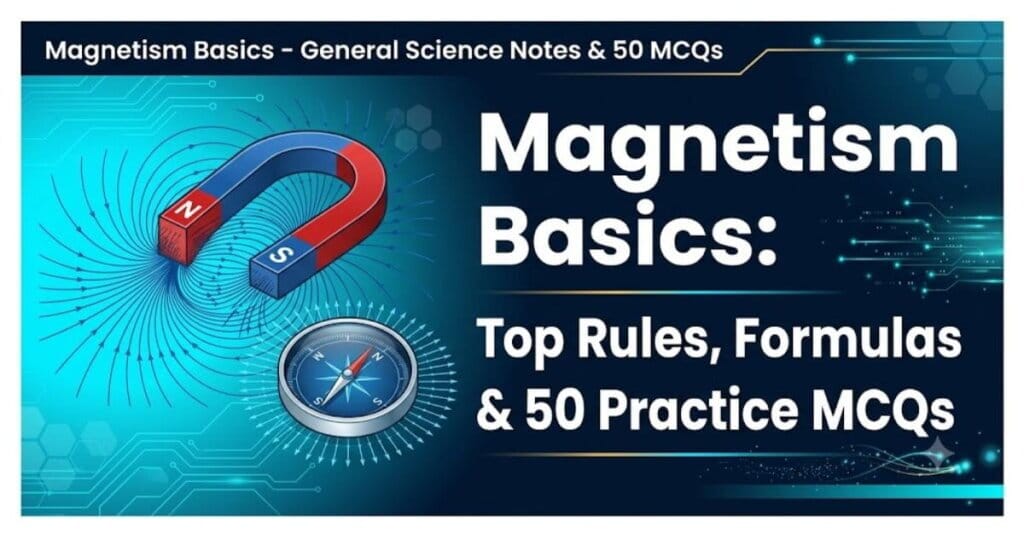
Magnetism Basics Notes & 50 Practice MCQs for SSC & Banking
Magnetism Basics: Comprehensive Study Material & Practice Test
Welcome aspirants! Magnetism Basics is a crucial segment under the General Science (Physics) section for exams like SSC CGL, CHSL, RRB NTPC, Group D, IBPS, and State PSCs. Understanding magnetic fields, poles, flux, and electromagnetic principles guarantees 2 to 4 direct marks in your competitive examinations.
In this post, you get complete high-yield notes, key mathematical formulas, weightage analysis, downloadable free PDF notes, and 50 Moderate Level Practice MCQs with a real-time exam mode scorecard and detailed explanations.
Magnetism is a force generated by moving electrical charges. Key points to remember for SSC and Railway exams:
Magnetic Poles: Every magnet has two poles—North (N) and South (S). Monopoles do not exist; breaking a magnet creates two smaller magnets.
Like & Unlike Poles: Like poles repel each other, while unlike poles attract.
Magnetic Field Lines: Continuous closed loops that originate outside from the North Pole to the South Pole, and inside from the South Pole to the North Pole. They never intersect.
Coulomb’s Law of Magnetism: Force between two magnetic poles is directly proportional to the product of their pole strengths and inversely proportional to the square of the distance between them.
Essential Physics Equations & Formulas
• Magnetic Force on a Moving Charge: F = q * (v × B) = q * v * B * sin(θ)
• Magnetic Flux (Φ): Φ = B * A * cos(θ) [SI Unit: Weber (Wb)]
• Magnetic Field Intensity (B): SI Unit = Tesla (T) or Weber/m² (1 Tesla = 10⁴ Gauss)
• Force on Current-Carrying Conductor: F = I * L * B * sin(θ)
Types of Magnetic Materials
Diamagnetic Materials: Feebly repelled by magnets (e.g., Bismuth, Copper, Water, Gold). Susceptibility (χ) is negative and small.
Paramagnetic Materials: Feebly attracted by magnets (e.g., Aluminum, Oxygen, Platinum). Susceptibility (χ) is positive and small.
Ferromagnetic Materials: Strongly attracted by magnets (e.g., Iron, Cobalt, Nickel). Susceptibility (χ) is positive and very large. Curie Temperature transforms ferromagnetic into paramagnetic material.
2. Exam Weightage & Importance Table
Exam Category
Expected Questions
Difficulty Level
High Priority Focus Areas
SSC CGL / CHSL / CPO
1 – 2 Questions
Moderate
Magnetic Materials, SI Units, Curie Temp, Earth’s Magnetism
RRB NTPC / Group D
2 – 3 Questions
Moderate to High
Electromagnets, Right-Hand Thumb Rule, Solenoid, Fleming’s Rules
State PSCs / Police Exams
1 – 3 Questions
Easy to Moderate
Basic Properties, Natural vs Artificial Magnets, Uses of Magnets
Banking / Insurance (General Science)
1 Question
Conceptual
SI Units, Basic Scientific Applications
3. 50 Moderate Level Practice MCQs
Select your options below. In Real Exam Mode, correct/wrong colors won’t show immediately. Complete all questions and click Submit Test & Check Live Score at the end to unlock your score and explanations.
Q1. What is the SI unit of Magnetic Flux Density? / चुंबकीय प्रवाह घनत्व की SI इकाई क्या है?
Explanation: The SI unit of Magnetic Flux Density (B) is Tesla (T) or Weber per square meter (Wb/m²). Weber is the unit of Magnetic Flux, and Henry is for Inductance.
Q2. Which of the following is a diamagnetic substance? / निम्नलिखित में से कौन सा एक प्रतिचुंबकीय (diamagnetic) पदार्थ है?
Explanation: Copper, Bismuth, Water, and Gold are diamagnetic substances that are weakly repelled by a magnetic field. Iron and Nickel are ferromagnetic, while Aluminum is paramagnetic.
Q3. Outside a bar magnet, magnetic field lines travel from: / एक छड़ चुंबक के बाहर, चुंबकीय क्षेत्र रेखाएं यात्रा करती हैं:
Explanation: Outside a magnet, field lines flow from North Pole to South Pole. Inside the magnet, they move from South Pole to North Pole, forming a closed continuous loop.
Q4. At Curie temperature, a ferromagnetic material becomes: / क्यूरी तापमान पर, एक लौह-चुंबकीय (ferromagnetic) पदार्थ बन जाता है:
Explanation: Above the Curie Temperature, ferromagnetic materials lose their permanent magnetic properties and behave as paramagnetic materials.
Q5. What is 1 Tesla equal to in CGS system units (Gauss)? / CGS प्रणाली की इकाइयों (गॉस) में 1 टेस्ला किसके बराबर होता है?
Explanation: 1 Tesla = 10⁴ Gauss. Tesla is the SI unit of magnetic induction, while Gauss is the CGS unit.
Q6. Which law states that the induced e.m.f. is proportional to the rate of change of magnetic flux? / किस नियम के अनुसार प्रेरित e.m.f. चुंबकीय प्रवाह के परिवर्तन की दर के समानुपाती होता है?
Explanation: Faraday’s Second Law of Electromagnetic Induction states that the magnitude of induced EMF is directly proportional to the rate of change of magnetic flux linked with the circuit.
Q7. The direction of induced current is determined by: / प्रेरित धारा की दिशा किसके द्वारा निर्धारित की जाती है?
Explanation: Fleming’s Right Hand Rule is used to determine the direction of induced current in electric generators, whereas the Left Hand Rule gives force direction in motors.
Q8. Magnetic susceptibility of a diamagnetic substance is: / किसी प्रतिचुंबकीय पदार्थ की चुंबकीय सुग्राहिता (susceptibility) होती है:
Explanation: Diamagnetic materials have a small, negative magnetic susceptibility (χ < 0), meaning they repel magnetic fields slightly.
Q9. Which material is best suited for making core of a transformer or electromagnet? / ट्रांसफार्मर या विद्युत चुंबक का कोर बनाने के लिए कौन सा पदार्थ सबसे उपयुक्त है?
Explanation: Soft iron has high magnetic permeability and low retentivity/coercivity, making it ideal for temporary electromagnets and transformer cores.
Q10. Permanent magnets are usually made of: / स्थायी चुंबक आमतौर पर किससे बनाए जाते हैं?
Explanation: Permanent magnets require high retentivity and high coercivity, which alloys like Alnico (Aluminum-Nickel-Cobalt) or Steel provide.
Q11. The angle of dip at the geomagnetic equator of Earth is: / पृथ्वी के भू-चुंबकीय भूमध्य रेखा पर नति कोण (angle of dip) कितना होता है?
Explanation: The Angle of Dip is 0° at the magnetic equator and 90° at the magnetic poles of Earth.
Q12. What happens to the strength of magnetic field inside a current-carrying solenoid? / धारावाही परिनालिका (solenoid) के अंदर चुंबकीय क्षेत्र की तीव्रता का क्या होता है?
Explanation: The magnetic field inside a long straight current-carrying solenoid is uniform and parallel to its axis (B = μ₀nI).
Q13. Unit of magnetic pole strength in SI system is: / SI प्रणाली में चुंबकीय ध्रुव सामर्थ्य की इकाई क्या है?
Explanation: Magnetic pole strength (m) is measured in Ampere-meter (A·m) or Newton per Tesla (N/T).
Q14. Work done in moving a magnetic pole around a closed path in a magnetic field is: / चुंबकीय क्षेत्र में एक चुंबकीय ध्रुव को बंद पथ पर घुमाने में किया गया कार्य है:
Explanation: Magnetic forces are conservative in nature for static magnetic fields, so work done along a closed loop is zero.
Q15. Natural magnet is an ore of iron known as: / प्राकृतिक चुंबक लोहे का एक अयस्क है जिसे किस नाम से जाना जाता है?
Explanation: Magnetite (Fe₃O₄), also known as lodestone, is a naturally occurring magnetic iron oxide.
Q16. If a magnet is cut into two equal halves perpendicular to its length, the pole strength of each piece will be: / यदि किसी चुंबक को उसकी लंबाई के लंबवत दो बराबर भागों में काटा जाए, तो प्रत्येक टुकड़े का ध्रुव सामर्थ्य क्या होगा?
Explanation: Cutting perpendicular to length keeps cross-sectional area same, so pole strength remains unchanged. Magnetic moment gets halved.
Q17. The magnetic needle of a compass always points towards: / कम्पास की चुंबकीय सुई हमेशा किस दिशा की ओर संकेत करती है?
Explanation: A freely suspended compass needle aligns along Earth’s local Magnetic North pole, which slightly differs from True Geographic North.
Q18. The phenomenon of inducing EMF in a coil due to change of current in a neighboring coil is called: / पड़ोसी कुंडली में धारा परिवर्तन के कारण किसी कुंडली में EMF प्रेरित होने की परिघटना कहलाती है:
Explanation: Mutual Induction is the working principle behind transformers, where changing current in primary coil induces EMF in secondary coil.
Q19. Tangent Galvanometer works on the principle of: / स्पर्शज्या गैल्वेनोमीटर (Tangent Galvanometer) किस सिद्धांत पर कार्य करता है?
Explanation: Tangent Galvanometer works on Tangent Law: B = B_h * tan(θ), comparing Earth’s horizontal magnetic field component with coil’s magnetic field.
Q20. Which instrument is used to measure magnetic flux? / चुंबकीय प्रवाह को मापने के लिए किस उपकरण का उपयोग किया जाता है?
Explanation: A Fluxmeter is a specialized form of galvanometer designed to measure total magnetic flux passing through a test coil.
Q21. The value of magnetic permeability of free space (μ₀) is: / मुक्त स्थान (free space) की चुंबकीय पारगम्यता (μ₀) का मान है:
Explanation: Permeability of vacuum/free space μ₀ = 4π × 10⁻⁷ T·m/A or Henry per meter (H/m).
Q22. Force acting on a charge ‘q’ moving with velocity ‘v’ parallel to magnetic field ‘B’ is: / चुंबकीय क्षेत्र ‘B’ के समानांतर ‘v’ वेग से गतिमान आवेश ‘q’ पर लगने वाला बल है:
Explanation: F = q * v * B * sin(θ). Since motion is parallel, θ = 0°, sin(0°) = 0, hence Magnetic Force F = 0.
Q23. Non-magnetic materials have magnetic susceptibility equal to: / अचुंबकीय पदार्थों की चुंबकीय सुग्राहिता किसके बराबर होती है?
Explanation: Non-magnetic materials (like vacuum or air roughly) do not magnetize, hence their magnetic susceptibility χ = 0.
Q24. Which rule gives the direction of magnetic field around a straight current conductor? / किसी सीधे धारावाही चालक के चारों ओर चुंबकीय क्षेत्र की दिशा कौन सा नियम बताता है?
Explanation: Right Hand Thumb Rule states that pointing thumb in current direction gives magnetic field direction curled along fingers.
Q25. The Earth’s magnetic field is believed to be caused by: / माना जाता है कि पृथ्वी का चुंबकीय क्षेत्र किसके कारण है?
Explanation: Earth’s magnetic field is generated by electric currents flowing in liquid outer iron core—known as the Geodynamo Effect.
Q26. Relative permeability (μ_r) of paramagnetic materials is: / अनुचुंबकीय (paramagnetic) पदार्थों की आपेक्षिक पारगम्यता (μ_r) होती है:
Explanation: For paramagnetic materials, μ_r is slightly greater than unity (μ_r > 1). For diamagnetic μ_r < 1, and for ferromagnetic μ_r ≫ 1.
Q27. Eddy currents are minimized in transformer cores by using: / ट्रांसफार्मर कोर में भंवर धाराओं (Eddy currents) को किसके उपयोग से कम किया जाता है?
Explanation: Lamination cuts down closed continuous paths for eddy currents, thereby minimizing heating power loss (I²R).
Q28. What is the unit of magnetic dipole moment? / चुंबकीय द्विध्रुव आघूर्ण की इकाई क्या है?
Explanation: Magnetic Dipole Moment M = I * A (A·m²). Also Torque τ = M × B, so M = τ / B (Joule/Tesla). Both units are correct.
Q29. Lines of magnetic field due to a straight current wire form: / सीधे धारावाही तार के कारण बने चुंबकीय क्षेत्र की रेखाएं बनाती हैं:
Explanation: Magnetic field lines around a straight conductor are concentric circles centered on the wire.
Q30. Which property of a magnetic material is responsible for energy loss during magnetization cyclic process? / चुंबकीयकरण चक्र के दौरान ऊर्जा हानि के लिए चुंबकीय पदार्थ का कौन सा गुण जिम्मेदार है?
Explanation: Hysteresis is the lagging of magnetic flux behind magnetizing force. Area of B-H hysteresis loop represents heat energy loss per cycle.
Q31. Electromagnets are temporary magnets because: / विद्युत चुंबक अस्थायी चुंबक होते हैं क्योंकि:
Explanation: Electromagnets work on electric current. Stopping electric current collapses magnetic field due to low retentivity of soft iron core.
Q32. Gauss’s Law for Magnetism (∇ · B = 0) implies that: / चुंबकत्व के लिए गॉस का नियम सिद्ध करता है कि:
Explanation: Gauss’s Law for magnetism states net magnetic flux through any closed surface is zero, proving magnetic monopoles do not exist in nature.
Q33. Device used to accelerate charged particles using magnetic & electric fields is: / चुंबकीय और विद्युत क्षेत्रों का उपयोग करके आवेशित कणों को त्वरित करने वाला उपकरण है:
Explanation: Cyclotron uses perpendicular electric and magnetic fields to accelerate positive ions to high speeds.
Q34. Superconductors exhibit perfect diamagnetism. This effect is known as: / अतिचालक (superconductors) पूर्ण प्रतिचुंबकत्व प्रदर्शित करते हैं। इस प्रभाव को कहा जाता है:
Explanation: The expulsion of magnetic field from a superconductor during transition to superconducting state is called Meissner Effect (χ = -1).
Q35. What is the magnetic declination? / चुंबकीय दिकपात (Magnetic Declination) क्या है?
Explanation: Magnetic declination (or magnetic declination angle) is the angle on horizontal plane between magnetic north and true geographic north.
Q36. Which element has highest Curie temperature among transition metals? / संक्रमण धातुओं में किसका क्यूरी तापमान सबसे अधिक होता है?
Explanation: Cobalt (Co) has the highest Curie temperature of approx 1121°C (~1394 K), compared to Iron (770°C) and Nickel (358°C).
Q37. A current-carrying loop placed in a uniform magnetic field experiences: / एक समान चुंबकीय क्षेत्र में रखा एक धारावाही लूप अनुभव करता है:
Explanation: In a uniform magnetic field, net translational force on a closed current loop is zero, but it experiences a torque τ = M × B.
Q38. Lenz’s Law is a direct consequence of the law of conservation of: / लेंज का नियम किसके संरक्षण के नियम का प्रत्यक्ष परिणाम है?
Explanation: Lenz’s Law obeys Conservation of Energy; mechanical work done in moving magnet against induced opposition converts to electrical energy.
Q39. What is Maxwell’s 1st CGS unit of magnetic flux? / चुंबकीय प्रवाह की 1 CGS इकाई क्या है?
Explanation: Maxwell is CGS unit of magnetic flux. 1 Weber = 10⁸ Maxwell, hence 1 Maxwell = 10⁻⁸ Weber.
Q40. The force between two parallel wires carrying current in opposite directions is: / विपरीत दिशाओं में धारा ले जाने वाले दो समानांतर तारों के बीच का बल होता है:
Explanation: Parallel wires with currents in same direction attract each other; with currents in opposite directions, they repel each other.
Q41. A magnetic compass needle placed near a current-carrying straight wire deflects. Who discovered this electro-magnetic effect? / धारावाही तार के पास रखी कम्पास सुई विक्षेपित होती है। इस प्रभाव की खोज किसने की?
Explanation: H.C. Oersted discovered in 1820 that electric current creates a magnetic field around it.
Q42. Which component of Earth’s magnetic field becomes zero at magnetic poles? / पृथ्वी के चुंबकीय क्षेत्र का कौन सा घटक चुंबकीय ध्रुवों पर शून्य हो जाता है?
Explanation: At poles, angle of dip is 90°. Horizontal component B_h = B * cos(90°) = 0.
Q43. The core of a choke coil used in fluorescent tubes is made of soft iron to: / ट्यूबलाइट में प्रयुक्त चोक कॉइल का कोर नरम लोहे का बनाया जाता है ताकि:
Explanation: Soft iron high permeability increases self-inductance L of choke coil, reducing current without wasting energy as heat.
Q44. What is the magnetic field inside a hollow current-carrying cylindrical conductor? / खोखले धारावाही बेलनाकार चालक के अंदर चुंबकीय क्षेत्र कितना होता है?
Explanation: According to Ampere’s Circuital Law, enclosed current inside hollow space is zero, hence magnetic field B = 0 inside.
Q45. Relative permeability (μ_r) and magnetic susceptibility (χ) are related by formula: / आपेक्षिक पारगम्यता (μ_r) और चुंबकीय सुग्राहिता (χ) किस सूत्र से संबंधित हैं?
Explanation: The standard relation is μ_r = 1 + χ, connecting material permeability with magnetic susceptibility.
Q46. Curie-Weiss Law for paramagnetic susceptibility (χ) states that: / अनुचुंबकीय सुग्राहिता (χ) के लिए क्यूरी-वेस नियम बताता है कि:
Explanation: Curie-Weiss Law states χ = C / (T – T_c), where T is absolute temperature and T_c is Curie temperature.
Q47. Which rule is used to determine direction of force on a current-carrying conductor in a magnetic field? / चुंबकीय क्षेत्र में धारावाही चालक पर बल की दिशा निर्धारित करने के लिए किस नियम का प्रयोग किया जाता है?
Explanation: Fleming’s Left Hand Rule (FBI: Thumb=Force, Forefinger=Field, Center finger=Current) determines force on current conductor.
Q48. The SI unit of magnetic moment is equivalent to: / चुंबकीय आघूर्ण की SI इकाई किसके समतुल्य है?
Explanation: All choices (J/T, N·m/T, A·m²) are dimensionally identical SI equivalents for magnetic dipole moment.
Q49. Magnetic lines of force prefer to pass through: / चुंबकीय बल रेखाएं अधिमानतः किससे होकर गुजरती हैं?
Explanation: Ferromagnetic substances have very high permeability (μ_r ≫ 1), offering a path of low magnetic reluctance to field lines.
Q50. A freely suspended bar magnet always rests along which direction? / एक स्वतंत्र रूप से लटका हुआ छड़ चुंबक हमेशा किस दिशा में ठहरता है?
Explanation: A freely suspended bar magnet aligns itself in the geographic North-South direction due to Earth’s geomagnetic field.
📊 Live Performance Scorecard
50
Total Questions
0
Attempted
0
Correct
0
Wrong
0%
Score (%)
📄
Magnetism Basics Official Notes PDF
Complete theory, shortcuts, and key points formatted for quick revision.
BESTSELLER
Lucent’s General Science (English/Hindi)
Must-have science book for SSC CGL, Railway & State Exams.
Q1. Why are magnetic field lines called continuous closed loops?
Magnetic field lines extend from North Pole to South Pole outside a magnet, and continue from South Pole to North Pole inside the magnet, forming continuous closed loops with no beginning or end.
Q2. What is the main difference between Soft Iron and Steel magnets?
Soft Iron magnetizes and demagnetizes quickly (low retentivity/coercivity), ideal for electromagnets. Steel retains its magnetism for a long time (high coercivity), making it suitable for permanent magnets.
Q3. Why do two magnetic lines of force never intersect each other?
If two magnetic field lines intersect, it would mean that at the point of intersection, there are two different directions of magnetic field, which is physically impossible.
Q4. How many questions on Magnetism appear in SSC CGL exams?
Generally, 1 to 2 direct questions on magnetism, SI units, magnetic field rules, or properties of materials appear under the Physics section in SSC CGL Tier 1 and Tier 2.
Exam Expert & Content Strategist with over 5+ years of experience in the competitive exam sector. I specialize in analyzing government recruitment patterns and simplifying complex syllabi for aspirants. Having helped thousands of students through Sarkari Exam PDF, my mission is to provide authentic, updated, and high-quality study materials for SSC, UPSC, Railways, and Banking exams to help every candidate achieve their career goals.
⚠️ Disclaimer: All study materials, notes, and PDFs shared on SarkariExamPDF.in are provided purely for educational and reference purposes to assist competitive exam aspirants. We do not claim ownership of any original books or official publications. If you are the rightful copyright owner and have any objection regarding any material, please contact us through our Contact Page for immediate removal.