General Science (Biology & Heredity Section) | Target Exams: SSC CGL, CHSL, CPO, RRB NTPC, Group D, State PSCs & CDS
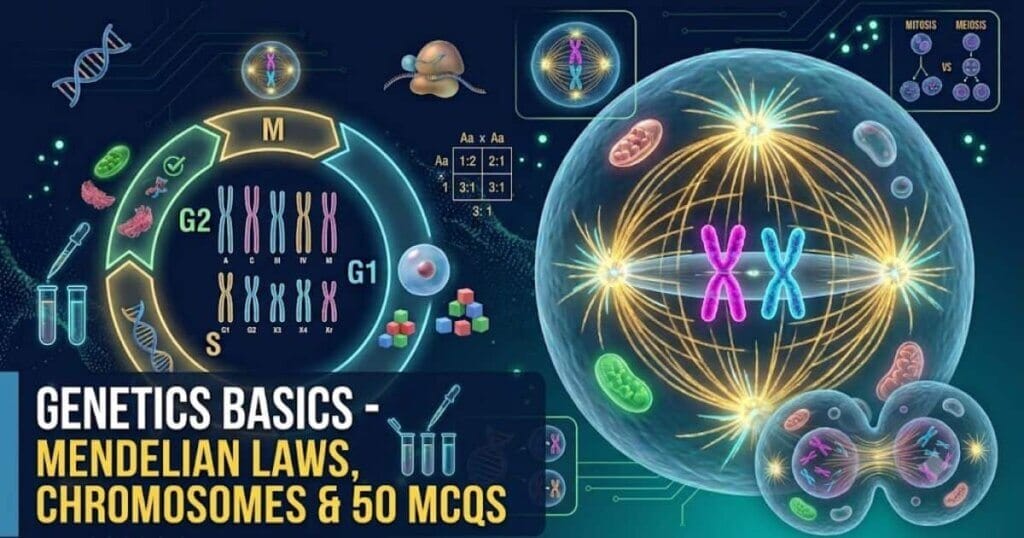
General Science Biology ke antargat Genetics Basics (आनुवंशिकी के मूल सिद्धांत) ek aisa core conceptual topic hai jahan se competitive exams me consistently direct numerical ratios, laws, disorders aur discovery-based questions puche jaate hain. Gregor Johann Mendel ke pea plant experiments se lekar Chromosomal Theory of Inheritance, DNA vs RNA molecular structure, Sex-linked inheritance, aur Down/Turner syndromes jaise genetic disorders tak—is comprehensive guide me complete high-yield material compile kiya gaya hai.
1. Genetics Core: Mendelian Laws, Punnett Squares & Disorders
A. Key Genetic Terminologies
- Gene: Heredity ki basic physical and functional unit jo DNA segment par encoded hoti hai.
- Alleles: Ek hi gene ke alternative forms jo same chromosome locus par hote hain (e.g., $T$ for tall, $t$ for dwarf).
- Homozygous vs Heterozygous: Identical alleles pair ($TT$ ya $tt$) ko homozygous kehte hain; contrasting alleles pair ($Tt$) ko heterozygous kehte hain.
- Phenotype vs Genotype: Observable physical expression (e.g., Tall or Dwarf) ko Phenotype kehte hain; genetic constitution ($TT, Tt, tt$) ko Genotype kehte hain.
B. Mendel’s Three Fundamental Laws of Inheritance
- Law of Dominance (प्रभाविता का नियम): Heterozygous state ($Tt$) me sirf ek allele apna prabhav dikha pata hai (Dominant allele – $T$), jabki doosra chhipa rehta hai (Recessive allele – $t$).
- Law of Segregation (विपर्यय / पृथक्करण का नियम): Allele pairs gamete formation ke dauran ek doosre se alag ho jaate hain, taaki har gamete me sirf ek allele jaye. Isliye ise “Law of Purity of Gametes” bhi kehte hain. Iska koi universal exception nahi hai.
- Law of Independent Assortment (स्वतंत्र अपव्यूहन का नियम): Dihybrid cross me do alag-alag characters ke alleles ek doosre se bilkul independently distribute hote hain. (Exception: Genetic Linkage discovered by T.H. Morgan).
C. High-Yield Mendelian Ratios
| Cross Type | Phenotypic Ratio (लक्षणप्ररूपी अनुपात) | Genotypic Ratio (जीनप्ररूपी अनुपात) |
|---|---|---|
| Monohybrid Cross (F2 Generation) | 3 : 1 (3 Tall : 1 Dwarf) | 1 : 2 : 1 ($1\ TT : 2\ Tt : 1\ tt$) |
| Monohybrid Test Cross ($Tt \times tt$) | 1 : 1 (50% Tall : 50% Dwarf) | 1 : 1 ($1\ Tt : 1\ tt$) |
| Dihybrid Cross (F2 Generation) | 9 : 3 : 3 : 1 (Yellow Round : Green Round : Yellow Wrinkled : Green Wrinkled) | 1:2:2:4:1:2:1:2:1 |
| Dihybrid Test Cross ($RrYy \times rryy$) | 1 : 1 : 1 : 1 | 1 : 1 : 1 : 1 |
| Incomplete Dominance (e.g., Mirabilis jalapa) | 1 : 2 : 1 (1 Red : 2 Pink : 1 White) | 1 : 2 : 1 ($1\ RR : 2\ Rr : 1\ rr$) |
D. Human Genetic Disorders & Karyotypes
- Autosomal Aneuploidy:
- Down Syndrome: Trisomy of Chromosome 21 ($2n + 1 = 47$). Features: Flat facial profile, simian crease, mental retardation.
- Edward Syndrome: Trisomy of Chromosome 18 ($2n + 1 = 47$).
- Patau Syndrome: Trisomy of Chromosome 13 ($2n + 1 = 47$).
- Sex Chromosomal Disorders:
- Klinefelter Syndrome: Sterile male having an extra X chromosome ($44 + XXY = 47$). Features: Gynaecomastia, tall stature, sparse body hair.
- Turner Syndrome: Monosomy of X chromosome in females ($44 + X0 = 45$). Features: Sterile female, rudimentary ovaries, webbed neck, short stature.
- Mendelian / Gene Disorders:
- Sickle-Cell Anemia: Autosomal recessive disorder caused by a point mutation at the 6th position of the beta-globin chain (Glutamic acid replaced by Valine: $GAG \rightarrow GUG$).
- Hemophilia (“Royal Disease”): X-linked recessive disorder where blood clotting factor VIII (Type A) or factor IX (Type B) is deficient.
- Color Blindness: X-linked recessive defect causing inability to distinguish red and green colors. Transmitted from carrier mother to son (Criss-cross inheritance).
2. Exam Weightage & Trends Table
| Competitive Exam | Average Questions | Core High-Yield Focus Areas |
|---|---|---|
| SSC CGL / CHSL (Tier 1 & Tier 2) | 2 – 3 Questions | Mendel’s monohybrid/dihybrid ratios, Test cross, Father of Genetics, Down syndrome, Blood grouping genetics (ABO co-dominance). |
| RRB NTPC / Group D / ALP | 2 – 4 Questions | Sex determination in humans (XX/XY), Hemophilia carrier problems, Sickle cell anemia point mutation, Chromosome numbers. |
| State PSCs (BPSC, UPPSC, MPPSC) | 3 – 4 Questions | Linkage and crossing over (T.H. Morgan), Incomplete dominance, Karyotypes (Turner/Klinefelter), Epistasis and Pleiotropy. |
| Banking & Insurance (Specialist Officers) | 1 – 2 Questions | Basic biological genetics terminologies and hereditary diseases awareness. |
📥 Download Genetics Basics Complete Study Notes PDF
Pointwise Mendelian laws, Punnett square cheat sheets, genetic disorders comparison table, and all 50 practice questions with complete solutions compiled in one offline revision PDF.
4. Recommended General Science Preparation Books
5. Frequently Asked Questions (FAQs)
Q1: What are the phenotypic and genotypic ratios of Mendel’s monohybrid cross?
Ans: In the F2 generation of a Mendelian monohybrid cross ($Tt \times Tt$), the phenotypic ratio is 3 : 1 (3 Tall : 1 Dwarf) and the genotypic ratio is 1 : 2 : 1 ($1\ TT : 2\ Tt : 1\ tt$).
Q2: Why is a Test Cross performed in genetics?
Ans: A Test Cross is performed by breeding an individual displaying a dominant phenotype with a homozygous recessive parent. It determines whether the dominant individual is homozygous ($TT$) or heterozygous ($Tt$). If heterozygous, offspring show a 1:1 ratio.
Q3: What causes Down Syndrome in humans?
Ans: Down Syndrome is caused by Trisomy of Autosome Chromosome 21 ($2n + 1 = 47$ chromosomes). It arises from non-disjunction of chromosome 21 during meiotic cell division in gametogenesis.
Q4: Why are males more frequently affected by hemophilia and red-green color blindness?
Ans: Both hemophilia and red-green color blindness are X-linked recessive disorders. Human males have only one X chromosome ($XY$), so a single defective allele on their X chromosome will cause the disease, whereas females require two defective alleles ($X^c X^c$) to express it.
- DNA and RNA Notes PDF: Structure, Differences & 50 MCQs

- Human Digestive System Notes PDF: Enzymes, Organs & 50 MCQs
- Genetics Basics Notes PDF: Mendel Laws, DNA & 50 MCQs
- Cell Division Notes PDF: Mitosis, Meiosis & 50 Practice MCQs
- Cell Organelles Notes PDF: Structure, Functions & 50 MCQs
- Cell Structure Notes PDF: Organelles, Functions & 50 MCQs

Exam Expert & Content Strategist with over 5+ years of experience in the competitive exam sector. I specialize in analyzing government recruitment patterns and simplifying complex syllabi for aspirants. Having helped thousands of students through Sarkari Exam PDF, my mission is to provide authentic, updated, and high-quality study materials for SSC, UPSC, Railways, and Banking exams to help every candidate achieve their career goals.
⚠️ Disclaimer: All study materials, notes, and PDFs shared on SarkariExamPDF.in are provided purely for educational and reference purposes to assist competitive exam aspirants. We do not claim ownership of any original books or official publications. If you are the rightful copyright owner and have any objection regarding any material, please contact us through our Contact Page for immediate removal.