
General Studies (Microeconomics Core Module) | Target Exams: SSC CGL, CHSL, CPO, RRB NTPC, State PSCs & Banking GA
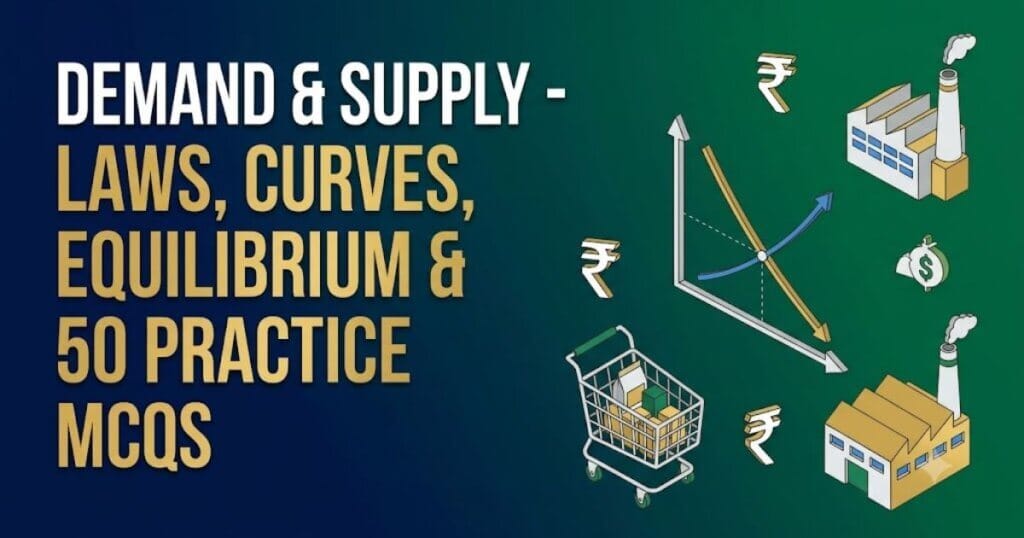
Microeconomics ke core foundation me Demand & Supply (मांग और पूर्ति) sabse ahem aur practical topic hai. Kisi bhi competitive market me kisi vastu ya seva ki keemat (price) aur bechi jaane wali matra (quantity) ka nirdharan maang aur poorti ki aapsi antarkriya (interaction) se hi hota hai. Alfred Marshall ne is interaction ko “Scissor’s two blades” ki tarah bataya tha—jis tarah kagaz kaatne ke liye dono blades anivarya hain, waise hi keemat tay karne ke liye demand aur supply dono ka hona zaroori hai. Is comprehensive guide me hum Law of Demand, Law of Supply, Movement vs. Shift, Market Equilibrium, Price Ceiling, Price Floor, aur 50 standard MCQs ko deeply examine karenge.
1. Demand & Supply Core: Laws, Curves, Shifts & Equilibrium
A. The Law of Demand (मांग का नियम)
Alfred Marshall ke mutabiq, “Ceteris Paribus” (anya baatein saman rehne par), kisi vastu ki keemat badhne par uski maangi gayi matra ghati hai, aur keemat ghatne par maangi gayi matra badhti hai.
- Demand Function: $$Q_d = f(P_x, P_r, Y, T, E)$$ (Jahan $P_x$ = Price of good X, $P_r$ = Price of related goods, $Y$ = Income, $T$ = Tastes/Preferences, $E$ = Future expectations).
- Why Demand Curve Slopes Downward? (ऋणात्मक ढाल के कारण):
- Law of Diminishing Marginal Utility (DMU): Jaise-jaise upbhog badhta hai, agli ikai ki upyogita ghat-ti hai, isliye consumer kam price par hi zyada khareedta hai.
- Income Effect: Price ghatne par consumer ki real purchasing power badh jaati hai.
- Substitution Effect: Relative sasti hone par consumer doosri mehengi vastuon ki jagah ise substitute karta hai.
- New Consumers: Price girne par naye buyers market me enter hote hain.
- Exceptions to Law of Demand: Giffen Goods (highly inferior staples), Veblen Goods (conspicuous consumption/status goods like diamonds), Emergency/War situations, Speculative goods (Shares).
B. Movement Along Demand Curve vs. Shift in Demand Curve
| Parameter | Movement Along Demand Curve (मांग में विस्तार / संकुचन) | Shift in Demand Curve (मांग में वृद्धि / कमी) |
|---|---|---|
| Cause (कारण) | Change in Own Price of the commodity ($P_x$) only. | Change in factors other than own price (Income, Substitutes, Tastes). |
| Terminology | Expansion (Extension) and Contraction of Demand. | Increase in Demand (Right shift) and Decrease in Demand (Left shift). |
| Graphical Action | Movement from one point to another on the same demand curve. | Entire demand curve shifts either rightward ($D \rightarrow D_1$) or leftward ($D \rightarrow D_2$). |
| Ceteris Paribus Condition | Other factors ($Y, P_r, T$) remain strictly constant. | Own price of the commodity ($P_x$) remains strictly constant. |
C. The Law of Supply (पूर्ति का नियम)
Other things remaining constant, kisi vastu ki keemat aur uski market me bikri hetu pesh ki gayi matra ke beech direct positive relationship hota hai:
- Supply Function: $$Q_s = f(P_x, P_f, T_e, G_t, N)$$ (Jahan $P_f$ = Price of factors of production, $T_e$ = Technology, $G_t$ = Government taxation/subsidy, $N$ = Number of firms).
- Supply Curve Slope: Upward sloping from left to right (Positive slope), kyunki higher price ka matlab producer ke liye higher profit margin hota hai.
- Exceptions to Law of Supply: Perishable goods (vegetables/fish), rare historical artifacts/paintings, clearance sales, agricultural goods during crop failure, and Backward-bending supply curve of labour (high wages par leisure preference badh jati hai).
D. Market Equilibrium & Government Interventions
Market Equilibrium us point par sthapit hota hai jahan Market Demand curve aur Market Supply curve ek doosre ko intersect karte hain:
- Excess Demand (Shortage): Agar Current Price < Equilibrium Price, to $Q_d > Q_s$. Shortage ke kaaran keemat upar ki taraf pressure me aati hai.
- Excess Supply (Surplus): Agar Current Price > Equilibrium Price, to $Q_s > Q_d$. Unsold stock ke kaaran keemat niche ki taraf aati hai.
- Price Ceiling (अधिकतम मूल्य सीमा): Government dwara equilibrium price ke niche tay ki gayi statutory limit (e.g., essential medicines, ration food grains). Isse market me shortage aur black marketing ki sambhavna hoti hai.
- Price Floor / Minimum Support Price (न्यूनतम समर्थन मूल्य): Government dwara equilibrium price ke upar tay kiya gaya price floor (e.g., MSP for agricultural crops). Isse market me surplus paida hota hai jise government buffer stock me purchase karti hai.
2. Exam Weightage & Trends Table
| Competitive Exam | Average Questions | Core High-Yield Focus Areas |
|---|---|---|
| SSC CGL / CHSL (Tier 1 & Tier 2) | 2 – 3 Questions | Movement vs Shift in curves, Giffen goods paradox, Substitute vs Complementary goods impact, Equilibrium shifts. |
| RRB NTPC / Group D / ALP | 2 – 3 Questions | Law of Demand definition, Downward slope causes (DMU, Income effect), Price Ceiling & Price Floor definitions. |
| State PSCs (BPSC, UPPSC, MPPSC) | 3 – 4 Questions | Backward-bending labour supply curve, Marshall’s scissors analogy, Conspicuous consumption (Veblen effect), Cross-price impacts. |
| Banking & Insurance (RBI Grade B / SEBI / IBPS) | 1 – 2 Questions | Equilibrium price calculations using linear equations ($Q_d = a – bP$, $Q_s = c + dP$), Elasticity intersection effects. |
📥 Download Demand & Supply Complete Study Notes PDF
High-yield microeconomics cheat sheets, demand-supply shift diagrams, equilibrium algebraic formulas, price ceiling/floor notes, and all 50 practice questions with complete solutions compiled in one offline revision PDF.
4. Recommended Economics Preparation Books
5. Frequently Asked Questions (FAQs)
Q1: What is the main difference between ‘Movement along a Demand Curve’ and a ‘Shift in the Demand Curve’?
Ans: A movement along the demand curve (expansion or contraction) is caused solely by a change in the commodity’s own price, while all other determinants remain constant. A shift in the demand curve (increase or decrease) occurs when factors other than own price change (such as consumer income, tastes, population, or prices of substitute and complementary goods), with the commodity’s own price remaining unchanged.
Q2: Why does a normal demand curve slope downward from left to right?
Ans: A normal demand curve slopes downward due to four primary economic reasons: (1) The Law of Diminishing Marginal Utility (consumers pay less for additional units); (2) The Income Effect (price fall increases the real purchasing power of income); (3) The Substitution Effect (consumers substitute relatively cheaper goods for expensive ones); and (4) The Entry of New Consumers at lower price levels.
Q3: What are Price Ceiling and Price Floor, and where are they placed relative to equilibrium?
Ans: A Price Ceiling is a legally established maximum price set below the market equilibrium price to protect consumers (e.g., rent control, essential food grain rationing), which typically leads to market shortages. A Price Floor is a legally established minimum price set above the market equilibrium price to protect producers (e.g., Minimum Support Price – MSP for crops), which typically generates market surpluses.
Q4: What are the main exceptions to the Law of Demand?
Ans: Major exceptions include: (1) Giffen Goods (highly inferior staples where a price rise forces poor households to consume more of them due to a massive negative income effect); (2) Veblen Goods (luxury prestige items like diamonds and designer goods consumed for status); (3) Speculative Expectations (goods whose purchases increase when prices rise because buyers expect prices to climb even higher); and (4) Emergencies and War conditions.
- Demand and Supply Notes PDF: Laws, Equilibrium & 50 MCQs

- Basic Concepts of Economic Notes PDF: Principles & 50 MCQs
- Elasticity in Economics Notes PDF: Types, Formulas & 50 MCQs

Exam Expert & Content Strategist with over 5+ years of experience in the competitive exam sector. I specialize in analyzing government recruitment patterns and simplifying complex syllabi for aspirants. Having helped thousands of students through Sarkari Exam PDF, my mission is to provide authentic, updated, and high-quality study materials for SSC, UPSC, Railways, and Banking exams to help every candidate achieve their career goals.
⚠️ Disclaimer: All study materials, notes, and PDFs shared on SarkariExamPDF.in are provided purely for educational and reference purposes to assist competitive exam aspirants. We do not claim ownership of any original books or official publications. If you are the rightful copyright owner and have any objection regarding any material, please contact us through our Contact Page for immediate removal.