
General Science (Cytology & Genetics Section) | Target Exams: SSC CGL, CHSL, CPO, RRB NTPC, Group D, State PSCs & CDS
General Science Biology me Cell Division (कोशिका विभाजन) ek aisa cornerstone topic hai jahan se examiners regularly factual aur phase-specific sawal frame karte hain. Rudolf Virchow ke “Omnis cellula-e-cellula” principle ke mutabiq nayi koshikaon ka nirmaan purani koshikaon ke vibhajan se hi hota hai. Is comprehensive module me hum Cell Cycle (G1, S, G2, M phase), Mitosis (समसूत्री विभाजन), Meiosis (अर्धसूत्री विभाजन – Prophase-I substages), Crossing Over, Chiasmata aur Karyokinesis vs Cytokinesis ko deeply examine karenge.
1. Cell Cycle & Division: Key Phases, Formulas & Concepts
A. The Cell Cycle: Interphase & M-Phase
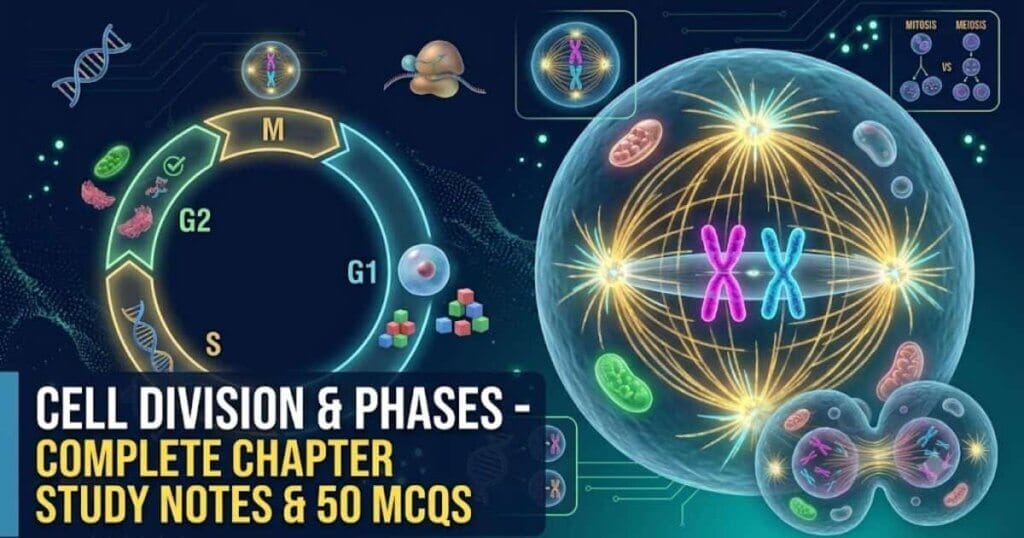
Cell cycle do mukhya charano me bati hoti hai: Interphase (Antaravastha) aur M-Phase (Mitosis/Meiosis Phase).
- G1 Phase (Gap 1 / Post-mitotic gap): Cell metabolically active hoti hai, RNA aur proteins synthesize hote hain, par DNA replication nahi hota.
- S Phase (Synthesis Phase): DNA replication hota hai. Agar initial DNA $2C$ tha, to badhkar $4C$ ho jata hai. Lekin chromosome number same rehta hai ($2n \rightarrow 2n$). Animal cells me centriole ka duplication bhi S-phase me cytoplasm ke andar hota hai.
- G2 Phase (Gap 2 / Pre-mitotic gap): Spindle formation ke liye Tubulin protein synthesize hota hai aur cell M-phase me enter karne ke liye prepare hoti hai.
- G0 Phase (Quiescent Stage): Kuch cells jaise adult heart cells aur neurons divide nahi karti aur metabolic active rehte hue cell cycle se suspend hokar G0 phase me rehti hain.
B. Mitosis vs. Meiosis Comparative Analysis
| Parameter | Mitosis (समसूत्री विभाजन) | Meiosis (अर्धसूत्री विभाजन) |
|---|---|---|
| Discovery | Walther Flemming (1882) | Oscar Hertwig (1876) / Farmer & Moore (Coined term) |
| Site of Occurrence | Somatic (body) cells | Germ cells / Reproductive gamete mother cells |
| Number of Daughter Cells | 2 genetically identical diploid ($2n$) daughter cells | 4 genetically diverse haploid ($n$) daughter cells |
| Chromosome Number | Remains unchanged (Equational division) | Halved ($2n \rightarrow n$) (Reductional division) |
| Crossing Over / Chiasmata | Absent | Present during Pachytene stage of Prophase-I |
| Number of Divisions | Single nuclear division | Two sequential divisions: Meiosis-I and Meiosis-II |
C. Prophase-I Substages of Meiosis-I (High-Yield Mnemonics)
Meiosis-I ka Prophase-I sabse lamba aur complex stage hota hai. Isko yaad rakhne ki trick: L-Z-P-D-D:
- Leptotene (लेप्टोटीन): Chromatin condense hota hai aur chromosomes bouquet-stage banate hain.
- Zygotene (जाइगोटीन): Homologous chromosomes ke beech pairing (Synapsis) hoti hai, jisse Synaptonemal complex banta hai. Bivalents/tetrads form hote hain.
- Pachytene (पैकिटीन): Non-sister chromatids ke beech Crossing Over (genetic recombination) hota hai. Isme Recombinase enzyme kaam karta hai.
- Diplotene (डिप्लोटीन): Synaptonemal complex dissolve hota hai aur X-shaped structures bante hain jinhe Chiasmata kehte hain.
- Diakinesis (डायकाइनेसिस): Chiasmata ka terminalization (sir par phisalna) hota hai, nucleolus aur nuclear envelope vanish ho jate hain.
D. Important Mathematical Rules in Cell Division
- Number of Mitotic Generations ($n$) to produce $N$ cells: $$N = 2^n$$ (e.g., 1 cell se 128 cells banane ke liye $2^n = 128 \implies n = 7$ divisions lagte hain).
- Mitotic divisions required to form $N$ cells: $$N – 1$$ (e.g., 100 cells banane ke liye $100 – 1 = 99$ divisions).
- Meiotic divisions required to produce $N$ seeds/zygotes in Angiosperms: $$N + \frac{N}{4} = \frac{5N}{4}$$ (Kyunki 1 pollen mother cell se 4 pollen grains bante hain, par 1 megaspore mother cell se sirf 1 functional ovule banta hai).
2. Exam Weightage & Important Trends
| Competitive Exam | Expected Questions | High-Yield Focus Areas |
|---|---|---|
| SSC CGL / CHSL (Tier 1 & Tier 2) | 2 – 3 Questions | Substages of Prophase-I, S-phase DNA doubling, Colchicine action, Anaphase sister chromatid separation. |
| RRB NTPC / Group D / ALP | 2 – 4 Questions | Equational vs Reductional division, Cleavage furrow vs Cell plate, Chromosome morphology in Metaphase. |
| State PSCs (BPSC, UPPSC, MPPSC) | 2 – 3 Questions | G0 Quiescent stage, Synaptonemal complex, Recombinase enzyme, Number of meiotic divisions for seeds. |
📥 Download Cell Division & Cell Cycle Master Notes PDF
High-yield diagrams, phase summaries, comparative tables and all 50 practice questions with detailed solutions compiled in one single offline revision PDF.
4. Recommended General Science Preparation Books
5. Frequently Asked Questions (FAQs)
Q1: What is the main difference between Mitosis and Meiosis?
Ans: Mitosis is an equational division that occurs in somatic cells yielding 2 identical diploid ($2n$) daughter cells for growth and repair. Meiosis is a reductional division occurring in germ cells that yields 4 genetically diverse haploid ($n$) daughter cells with half the original chromosome number for sexual reproduction.
Q2: In which phase of Meiosis does crossing over occur?
Ans: Crossing over occurs during the Pachytene stage of Prophase-I of Meiosis-I. Non-sister chromatids of homologous chromosomes exchange genetic material catalyzed by the enzyme recombinase, which introduces genetic variation.
Q3: What happens during the S-phase of the cell cycle?
Ans: During the S-phase (Synthesis phase) of interphase, DNA replication takes place inside the nucleus, doubling the amount of DNA from $2C$ to $4C$, while the chromosome number remains unchanged ($2n$). In animal cells, centriole duplication also occurs in the cytoplasm.
Q4: How does plant cytokinesis differ from animal cytokinesis?
Ans: In animal cells, cytokinesis occurs through a cleavage furrow that deepens centripetally (outside-in). In plant cells, due to the rigid cell wall, cytokinesis occurs through the formation of a cell plate (Phragmoplast) that grows centrifugally (from the center outward toward the cell walls).
- DNA and RNA Notes PDF: Structure, Differences & 50 MCQs

- Human Digestive System Notes PDF: Enzymes, Organs & 50 MCQs
- Genetics Basics Notes PDF: Mendel Laws, DNA & 50 MCQs
- Cell Division Notes PDF: Mitosis, Meiosis & 50 Practice MCQs
- Cell Organelles Notes PDF: Structure, Functions & 50 MCQs
- Cell Structure Notes PDF: Organelles, Functions & 50 MCQs

Exam Expert & Content Strategist with over 5+ years of experience in the competitive exam sector. I specialize in analyzing government recruitment patterns and simplifying complex syllabi for aspirants. Having helped thousands of students through Sarkari Exam PDF, my mission is to provide authentic, updated, and high-quality study materials for SSC, UPSC, Railways, and Banking exams to help every candidate achieve their career goals.
⚠️ Disclaimer: All study materials, notes, and PDFs shared on SarkariExamPDF.in are provided purely for educational and reference purposes to assist competitive exam aspirants. We do not claim ownership of any original books or official publications. If you are the rightful copyright owner and have any objection regarding any material, please contact us through our Contact Page for immediate removal.