
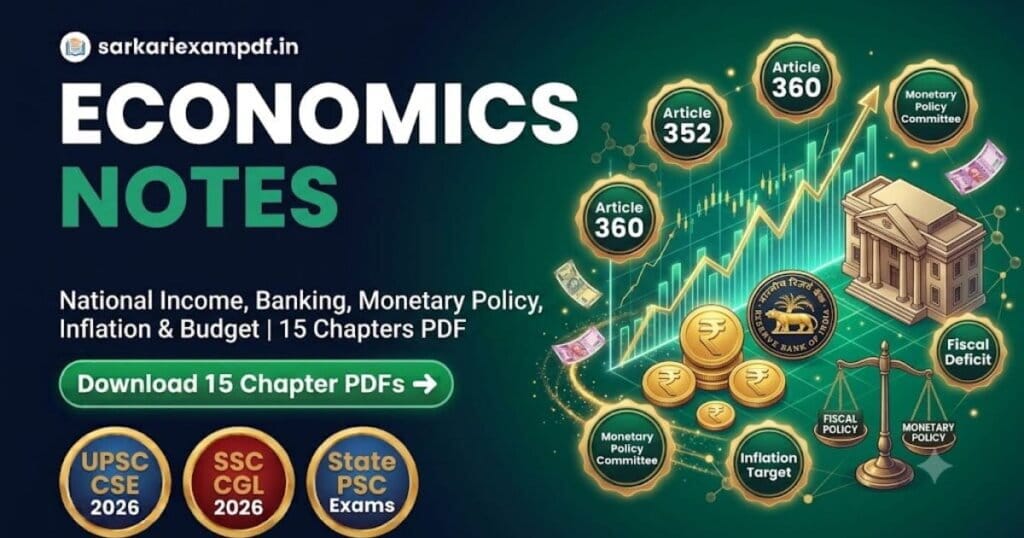
Overview: Economics Notes (Indian Economy & Macroeconomics)
UPSC Civil Services Prelims & Mains (GS Paper 3), SSC (CGL, CHSL, CPO), State PSCs, Railway (RRB NTPC, JE), aur Banking examinations ke General Awareness segment me Indian Economy ek high-weightage aur dynamic vishay hai. Is Economics Notes repository me Micro & Macroeconomics fundamentals se lekar National Income accounting, Reserve Bank of India (RBI) ki Monetary Policy, Banking Structure, Inflation dynamics, Union Budget, Taxation (Direct & GST), aur Five-Year Plans tak ke sabhi 15 chapters structured format me provide kiye gaye hain.
Key Economic Domains Covered in this 15-Module Set
- National Income & Growth Accounting: GDP, GNP, NNP, National Income at Factor Cost vs Market Price, Nominal vs Real GDP, aur Green GDP concepts.
- Money, Banking & Monetary Policy: RBI formation, Qualitative & Quantitative tools (Repo Rate, Reverse Repo, CRR, SLR, Bank Rate, MSF), aur Scheduled Commercial Banks classification.
- Inflation, Business Cycles & Fiscal Policy: Demand-pull vs Cost-push inflation, WPI vs CPI indices, Philip’s Curve, Deflation, Stagflation, Union Budget components (Revenue vs Capital Budget), aur Fiscal Deficit metrics.
- Taxation, Planning & External Sector: Direct vs Indirect taxes, GST council structure, Planning Commission history, NITI Aayog framework, Balance of Payments (BoP), aur Forex reserves.
Sabhi subjects ke complete study materials aur notes download karne ke liye hamare central Competitive Exam Notes Master Hub ko zaroor access karein.
Key Macroeconomic Indicators & Budget Deficits
| Indicator / Metric | Standard Economic Formula | Core Significance |
|---|---|---|
| Gross Domestic Product (GDP) | $$GDP = C + I + G + (X – M)$$ | Monetary value of all finished goods & services produced within domestic territory. |
| Net National Product (NNP) | $$NNP = GNP – \text{Depreciation}$$ | True measure of national income when calculated at Factor Cost ($NNP_{FC}$). |
| Fiscal Deficit | $$\text{Total Expenditure} – (\text{Revenue Receipts} + \text{Non-debt Capital Receipts})$$ | Total borrowing requirements of the government from domestic and external sources. |
| Revenue Deficit | $$\text{Revenue Expenditure} – \text{Revenue Receipts}$$ | Indicates government shortfall in meeting everyday routine administrative operational costs. |
| Primary Deficit | $$\text{Fiscal Deficit} – \text{Interest Payments}$$ | Reflects current fiscal imbalance excluding accumulated past debt interest burdens. |
High-Yield Practice Questions on Indian Economy
Apni preparation evaluate karne ke liye ye 5 selected standard exam questions solve karein:
Q1. Which quantitative tool is used by the RBI when it lends short-term money to commercial banks against government securities?
Check Answer
Answer: Repo Rate (Repurchase Option Rate). Reverse Repo Rate is the rate at which RBI absorbs liquidity from commercial banks.
Q2. What economic phenomenon occurs when high inflation is accompanied by stagnant economic growth and high unemployment?
Check Answer
Answer: Stagflation (Stagnation + Inflation), which contradicts the traditional inverse relationship shown by the Phillips Curve.
Q3. Which five-year plan in India was based on the Mahalanobis Model emphasizing heavy industries and capital goods?
Check Answer
Answer: Second Five-Year Plan (1956–1961). The First Five-Year Plan (1951–1956) was based on the Harrod-Domar Model focused on agriculture.
Q4. Which index is officially used by the Reserve Bank of India (RBI) as the key headline measure of inflation for policy rate targeting?
Check Answer
Answer: Consumer Price Index – Combined (CPI-C), on the recommendations of the Urjit Patel Committee.
Q5. The ‘Gini Coefficient’ and ‘Lorenz Curve’ are economic instruments primarily used to measure:
Check Answer
Answer: Income inequality and wealth distribution within a population (0 represents perfect equality, 1 represents maximum inequality).
Download 15 Chapter-Wise Economics Notes PDF
Niche diye gaye topic buttons me se kisi par bhi click karein. 20-second timer ke baad direct Google Drive download link unlock ho jayega:
🌐 Foreign Trade
Export-import policies, Trade Deficit, BoP equilibrium & trade agreements.
💰 National Income
GDP, GNP, NNP calculations, Factor Cost vs Market Price & per capita income.
🏦 Banking in India
RBI monetary instruments, Commercial banks, NPA management & Basel norms.
💼 Trade and Commerce
Domestic retail/wholesale commerce, supply chain, WTO & multilateral trade.
🏭 Industry in India
Index of Industrial Production (IIP), Core industries, Maharatna & MSME policy.
📊 Characteristics of Indian Economy
Developing mixed economy traits, structural composition & sectoral shifts.
📉 Unemployment
Disguised, structural, cyclical unemployment, labor force surveys & job metrics.
🏢 Indian Financial System
Money market, Capital market, stock exchanges, SEBI regulations & debt markets.
📑 Indian Fiscal System
Union Budget, Fiscal & Revenue deficits, FRBM Act & government expenditures.
🌾 Agriculture and Land Development
Green Revolution, land reforms, crop pricing (MSP), NABARD & food security.
🚀 New Economic Policy (1991 LPG)
Liberalisation, Privatisation, Globalisation, industrial de-licensing & reforms.
📖 Economic & Financial Glossary
Essential terminology: Stagflation, Gini Coefficient, Fiscal Drag, Hawkish policy.
🧾 Tax System in India
Direct vs Indirect taxes, Income tax slabs, GST structure & tax revenue buoyancy.
🗺️ Economic Planning & Five-Year Plans
Planning Commission history, Harrod-Domar & Mahalanobis models, NITI Aayog.
📌 Economics Miscellaneous Facts (Master Module)
High-yield factual pointers, Economic survey takeaways, Census demographics & previous year repeated exam pointers.
Indian Economy by Ramesh Singh (Latest Edition)
The most comprehensive reference guide for UPSC CSE, State PSCs and banking examinations.
Parmar Sir SSC GK Batch Notes (Complete 8 Booklets)
Complete theory coverage for Indian Economy, Polity, History, Geography & Static GK.
Disha 33 Year-wise SSC Solved Question Bank
Combined Graduate Level comprehensive economics & general studies PYQs with detailed keys.
Railway & SSC Samanya Vigyan & GK by Radhika Ma'am
General Awareness Theory + 2000+ Chapterwise PYQs for Railway & SSC CBTs.
📥 Join Our Social Channels for Daily Free Study Material
FAQs: Economics Notes
Q1: How many chapters are covered in these Economics Notes?
Ans: Is handbook me Indian Economy aur Macroeconomics ke sabhi 15 core chapters shamil hain, jisme National Income, Monetary Policy, Banking, Inflation, Budget, Taxation aur NITI Aayog cover kiye gaye hain.
Q2: Are these notes suitable for UPSC CSE and State PSC examinations?
Ans: Haan, NCERT Macroeconomics ke fundamental concepts aur standard reference books (jaise Ramesh Singh & Sanjiv Verma) ke main analytical frameworks ko isme exam-oriented format me cover kiya gaya hai.
Q3: How do I download the Chapter-Wise Economics Notes PDFs on SarkariExamPDF?
Ans: Upar diye gaye kisi bhi chapter card par click karein, 20-second countdown timer ke pura hone ka intezar karein, aur unlocked download button se Google Drive file access karein.
Q4: Are all PDF study files free on SarkariExamPDF?
Ans: Haan, SarkariExamPDF par uplabdh sabhi study notes, practice sheets aur formula books 100% free hain.
- RRB Mechanical Engineering Notes PDF: 5 Solved Technical Modules

- RRB Civil Engineering Notes PDF: 8 Chapter-Wise Technical Modules
- RRB Electrical and Electronics Notes PDF: 7 Engineering Modules
- Computers Notes PDF: 16 Chapter-Wise Computer Awareness Modules
- English Language Notes PDF: 15 Chapter-Wise Grammar & Vocab Modules
- English Chapter Wise Notes PDF: 11 Solved Grammar & Vocab Modules
- Reasoning Notes PDF: 23 Chapter-Wise Solved Topic Modules
- Reasoning Verbal Notes PDF: 18 Chapter-Wise Solved Topic Modules
- General Awareness Chapter Wise PDF: Complete 7 Subject Modules
- Static GK Notes PDF: 36 Chapter-Wise General Knowledge Modules
- Economics Notes PDF: 15 Chapter-Wise Indian Economy Modules
- RRB Polity Notes PDF: 29 Chapter-Wise Railway Exam Study Modules
- Polity and Civics Notes PDF: 38 Chapter-Wise Indian Constitution Modules
- RRB General Science Chapter Wise PDF: Physics, Chemistry & Biology Notes
- Chemistry Notes PDF: 15 Chapter-Wise General Science Topics
- Arts and Culture Notes PDF: 8 Chapter-Wise Indian Heritage & Architecture Modules
- Physics Notes PDF: 23 Chapter-Wise General Science Topics
- World History Notes PDF: 34 Chapter-Wise Global History Modules
- Modern History Notes PDF: 15 Chapter-Wise Freedom Struggle Modules
- Medieval History Notes PDF: 6 Chapter-Wise Indian History Modules
- Ancient History Notes PDF: 7 Chapter-Wise Indian History Modules
- Geography Notes PDF: 46 Chapter-Wise Physical, Indian & World Geography Modules
- Environment Notes PDF: 13 Chapter-Wise Ecology & Biodiversity Modules
- Mathematics Chapter Wise Notes PDF: 14 Solved Math Topics for Competitive Exams
- Aptitude Notes PDF: 28 Chapter-Wise Quantitative Aptitude Topics
- Computer Basics Mcqs for Government Exams Notes+100 MCQs

- Reasoning Questions – Best Guide for Competitive Exams
- Gagan Pratap – Best Maths PDFs and Books for SSC & Competitive Exams

- Rakesh Yadav – Best Maths Books and PDFs for SSC & Competitive Exams
- Aditya Ranjan Sir – Best Maths & GK PDFs for Competitive Exams
- Piyush Sir Reasoning Book PDF – Best Resource for SSC, Banking & Other Competitive Exams
- Computer Questions for All Competitive Exams
- GENERAL STUDIES Complete 138 PDF Series: High-Yield Notes & Topic Booster
- QUANTITATIVE APTITUDE PDF Complete 133 Series: Arithmetic & Advanced Maths Notes
- REASONING PRACTICE SETS Complete 139 Series: Verbal & Non-Verbal PDF Notes
- Competitive Exam Notes PDF: Subject-Wise Complete Study Material




















Exam Expert & Content Strategist with over 5+ years of experience in the competitive exam sector. I specialize in analyzing government recruitment patterns and simplifying complex syllabi for aspirants. Having helped thousands of students through Sarkari Exam PDF, my mission is to provide authentic, updated, and high-quality study materials for SSC, UPSC, Railways, and Banking exams to help every candidate achieve their career goals.
⚠️ Disclaimer: All study materials, notes, and PDFs shared on SarkariExamPDF.in are provided purely for educational and reference purposes to assist competitive exam aspirants. We do not claim ownership of any original books or official publications. If you are the rightful copyright owner and have any objection regarding any material, please contact us through our Contact Page for immediate removal.