Satavahanas Dynasty Notes PDF: Rulers, Art & 50 MCQs

Satavahanas-Dynasty

Satavahana Dynasty (jise Puranon mein Andhras ya Andhra-Jatiyah ke naam se jana jata hai) ne post-Mauryan period mein Deccan aur Central India par lagbhag 400 saalon (1st century BCE se lekar 3rd century CE tak) tak shasan kiya. Maurya Empire ke disintegration ke baad Simuka dwara sthapit is dynasty ne North India aur South India ke beech ek cultural aur economic bridge ka kaam kiya. Satavahanas ne Pratishthana (Paithan, Maharashtra) aur baad mein Amaravati / Dharanikota (Andhra Pradesh) ko apni capitals banaya.

SSC CGL (Tier 1 & Tier 2), RRB NTPC, UPSC Prelims aur State PSC (APPSC, TSPSC, MPSC, UPPSC) exams ke Ancient Indian History section mein Satavahana rulers (Satakarni I, Hala, Gautamiputra Satakarni, Vasishthiputra Pulumavi, Yajna Sri Satakarni), inscriptions (Nanaghat, Nasik Prasasti), matronymics (mothers’ names prefix karna), lead and potin coinage, early tax-free land grants to Brahmins and Buddhist monks, aur Amaravati school of art par har saal direct factual aur conceptual questions puche jaate hain. Niche high-yield study material, rulers’ chronological summary, aur 50 Moderate Exam-Standard Bilingual MCQs diye gaye hain jinhe attempt karke aap live scorecard check kar sakte hain.

1. Satavahana Dynasty: Origin, Capitals & Prominent Rulers

Satavahanas ka rise third century BCE ke aakhiri hisse mein shuru hua. Puranas mein 30 Andhra kings ki list milti hai jinhone lagbhag 450 saalon tak govern kiya.

Key Rulers & Chronological Milestones:

  • Simuka (Founder): Kanva ruler Susarman ko dethrone karke aur Sunga power ke bache hue remnants ko hara kar Satavahana rule ki neev rakhi. Primary capital: Pratishthana (modern Paithan, Aurangabad district, Maharashtra).
  • Satakarni I: Dynasty ka 3rd ruler. Usne Western Malwa, Narmada valley, aur Vidarbha tak empire expand kiya. Usne Ashvamedha (do baar) aur Rajasuya sacrifices perform kiye. Unki queen Nayanika (Naganika) ne prasiddha Nanaghat Inscription likhwaya, jisme Satakarni I ko Dakshinapathapati (Lord of the Southern Region) aur Apratihatachakra title diye gaye.
  • King Hala (17th Ruler): Great poet-king jinhone Prakrit (Maharashtri Prakrit) language mein famous erotic-lyric anthology Gatha Saptasati (Sattasai) compose kiya. Unke court mein Gunadhya (author of Brihatkatha in Paisachi Prakrit) aur Sarvavarman (author of Sanskrit grammar Katantra) the.
  • Gautamiputra Satakarni (GPS – 23rd Ruler, c. 106–130 CE): Greatest emperor of the dynasty. Usne Shaka ruler Nahapana (Kshaharata dynasty) ko decisively defeat kiya aur uske coins ko re-strike karwaya (Jogalthambi hoard in Nashik). Unki mother Gautami Balashri ne Nasik Prasasti (Nasik Cave Inscription) likhwaya, jisme use Eka-Brahmana (Peerless Brahmin), Kshatriya-darpa-mana-mardana (destroyer of the pride of Kshatriyas), aur Tri-samudra-toya-pita-vahana (one whose horses drank the waters of three oceans—Arabian Sea, Bay of Bengal, Indian Ocean) bataya gaya hai.
  • Vasishthiputra Pulumavi (24th Ruler): Capital ko Krishna river par Amaravati / Dharanikota expand kiya. Unhe Ptolemy ne Siriptolemaios kaha. Western Kshatrapa ruler Rudradaman I (Junagarh inscription) ne unhe do baar defeat kiya par matrimonial alliance ke karan destroy nahi kiya.
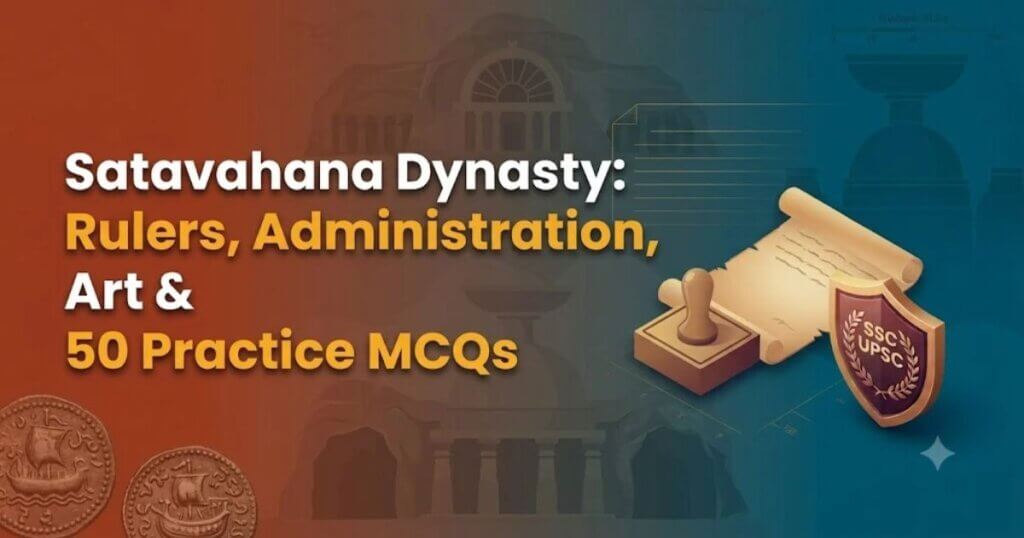
  • Yajna Sri Satakarni (27th Ruler): Last prominent ruler. Usne Shakas se lost territories wapas jeeti. Unke coins par Ship / Maritime Motifs (नाव या जहाज का प्रतीक) bane hue hain, jo unke naval power aur maritime trade & commerce (Indo-Roman sea trade) ke supremacy ko indicate karte hain.

2. Administration, Land Grants, Coinage & Society

Satavahanas ne Mauryan administrative framework ko retain kiya par use feudal aur decentralized form mein transform kiya.

DomainInstitutional TermsKey Historical Significance
Administrative UnitsAhara & GramaDistrict was called Ahara, headed by Amatya or Mahamatra. The village was Grama, administered by Gramika. Rural military settlements were governed by Gaulmika (head of a military troop of 9 chariots, 9 elephants, 25 horses, 45 infantry).
First Land GrantsBrahmadeya / AgraharaSatavahanas hold the landmark distinction of issuing the earliest epigraphic record of tax-free land grants (with administrative immunities) to Buddhist monks and Brahmins (recorded in the Nanaghat Inscription of 1st century BCE).
Coinage MetalsLead (सीसा), Potin, Copper, BronzeSatavahanas are uniquely famous for minting predominantly Lead coins (सीसे के सिक्के) alongside Potin (an alloy of copper, lead, and tin), bronze, and copper. Gold coins (Suvarna) were rare and used primarily as bullion value.
Social StructureMetronymics & Patrilineal RuleKings prefixed their mothers’ names (e.g., Gautami-putra, Vasishthi-putra, Kausiki-putra), but the succession to the royal throne was strictly patrilineal (passed from father to son).

3. Art, Architecture & Literature

Satavahanas patronized both indigenous Prakrit literature and grand Buddhist rock-cut architecture across the Western Ghats and the Krishna-Godavari basin.

  • Amaravati School of Art: Andhra Pradesh mein Krishna river ke kinare flourish hua. Characteristic feature: use of white marble-like limestone (सफेद संगमरमर नुमा चूना पत्थर). Major themes: narrative relief sculptures depicting the Jataka tales and Buddha’s life episodes with dynamic human figures. Supported additionally by the Nagarjunakonda Stupa.
  • Rock-Cut Caves (Western Ghats):
    • Chaityas (Prayer Halls): The largest and most magnificent rock-cut Chaitya hall in India was excavated at Karle (Lonavala, Maharashtra). Other notable chaityas include Bhaja, Bedsa, Kanheri, and Ajanta (Caves 9 and 10).
    • Viharas (Monasteries): Living quarters for Buddhist monks excavated at Nashik (Pandavleni caves) containing Gautami Balashri’s inscription.
  • Official Language & Script: The official administrative language of the Satavahana state was Prakrit, and the script was Brahmi.

4. Exam Weightage & Importance Matrix

Exam CategoryExpected History QsSatavahanas WeightageHigh-Yield Exam Focus Areas
SSC CGL / CHSL / CPO4–6 Questions1 Direct QuestionFounder (Simuka), Lead coins, First land grant inscription (Nanaghat), Gautamiputra titles
RRB NTPC / Group D6–8 Questions1 QuestionCapital cities (Paithan/Amaravati), Ship-motif coins (Yajna Sri), Karle Chaitya location
State PSC (APPSC, TSPSC, MPSC, etc.)10–18 Questions2–4 Detailed QsGatha Saptasati composer (Hala), Jogalthambi coin hoard, Saka-Satavahana conflict, Gaulmika system
UPSC Civil Services Prelims12–16 QuestionsHigh PriorityAgrarian structure evolution (origin of Indian feudalism via land grants), Amaravati stylistic traits, Ptolemy references

5. 50 Practice MCQs (Bilingual Interactive Test)

Is test ko real exam environment mein attempt karein. Kisi bhi option ko click karne par blue background highlight hoga. Jab aap 50 questions solve kar lein, aakhiri mein 🚀 Submit Test & Check Live Score button click karein. Sahi options Green, aapka galat selection Red, aur har question ka detailed solution reveal ho jayega.

Q1. Who was the founder of the Satavahana Dynasty in the Deccan? / दक्कन में सातवाहन वंश का संस्थापक कौन था?
A) Satakarni I / शातकर्णी प्रथम
B) Simuka / सिमुक
C) Gautamiputra Satakarni / गौतमीपुत्र शातकर्णी
D) Hala / हाल
Explanation: Simuka founded the Satavahana dynasty after overthrowing the remnants of the Sunga and Kanva power in the 1st century BCE.
Q2. What was the ancient initial capital of the Satavahana Dynasty? / सातवाहन वंश की प्राचीन प्रारंभिक राजधानी कौन सी थी?
A) Amaravati / अमरावती
B) Pratishthana (Paithan) / प्रतिष्ठान (पैठन)
C) Nagarjunakonda / नागार्जुनकोंडा
D) Vidisha / विदिशा
Explanation: The early capital of the Satavahanas was Pratishthana (modern Paithan) situated on the banks of the Godavari River in Aurangabad district, Maharashtra.
Q3. By what name is the Satavahana dynasty commonly referred to in the ancient Puranas? / प्राचीन पुराणों में सातवाहन वंश को सामान्यतः किस नाम से संदर्भित किया गया है?
A) Chedis / चेदि
B) Yavanas / यवन
C) Andhras or Andhra-Jatiyah / आंध्र अथवा आंध्र-भृत्य
D) Rashtrakutas / राष्ट्रकूट
Explanation: In the Puranas (like Matsya and Vayu Purana), the dynasty is referred to as ‘Andhra’ or ‘Andhra-Jatiyah’, although their own inscriptions only mention the name ‘Satavahana’.
Q4. The famous Nanaghat Cave Inscription, recording the military achievements of Satakarni I, was issued by which queen? / शातकर्णी प्रथम की सैन्य उपलब्धियों को दर्ज करने वाला प्रसिद्ध नानाघाट गुफा अभिलेख किस रानी द्वारा जारी किया गया था?
A) Gautami Balashri / गौतमी बलश्री
B) Queen Nayanika (Naganika) / रानी नयनिका (नागनिका)
C) Rudradaman’s daughter / रुद्रदामन की पुत्री
D) Prabhavatigupta / प्रभावतीगुप्त
Explanation: Queen Nayanika (Naganika), the widow of Satakarni I, issued the Nanaghat inscription in Maharashtra, describing his sacrifices and conquests.
Q5. Which Satavahana king performed two Ashvamedha sacrifices and one Rajasuya sacrifice as recorded in inscriptions? / अभिलेखों के अनुसार किस सातवाहन राजा ने दो अश्वमेध यज्ञ और एक राजसूय यज्ञ संपन्न किया था?
A) Simuka / सिमुक
B) Kanha (Krishna) / कान्ह (कृष्ण)
C) Satakarni I / शातकर्णी प्रथम
D) Yajna Sri Satakarni / यज्ञ श्री शातकर्णी
Explanation: The Nanaghat inscription credits Satakarni I with performing two Ashvamedha yajnas and a Rajasuya yajna to mark his imperial supremacy over Dakshinapatha.
Q6. The earliest epigraphic evidence of tax-free land grants to Brahmins and Buddhist monks in India is found in the inscription of: / भारत में ब्राह्मणों और बौद्ध भिक्षुओं को कर-मुक्त भूमि अनुदान का सबसे पहला पुरालेखीय साक्ष्य किसके अभिलेख में मिलता है?
A) Ashoka’s Rummindei Pillar / अशोक का रुम्मिनदेई स्तंभ
B) Nanaghat Inscription of the Satavahanas / सातवाहनों का नानाघाट अभिलेख
C) Allahabad Pillar Inscription / इलाहाबाद स्तंभ अभिलेख
D) Junagarh Inscription / जूनागढ़ अभिलेख
Explanation: The 1st century BCE Nanaghat inscription of Satavahana Queen Nayanika contains the earliest recorded grant of villages to priests, marking the inception of land grants in India.
Q7. Which Prakrit text of 700 erotic and pastoral verses was authored by the Satavahana King Hala? / 700 शृंगारिक और ग्रामीण छंदों वाले किस प्राकृत ग्रंथ की रचना सातवाहन राजा हाल ने की थी?
A) Brihatkatha / बृहत्कथा
B) Katantra / कातंत्र
C) Gatha Saptasati (Sattasai) / गाथा सप्तशती (सत्तसई)
D) Vasudevahimdi / वासुदेवहिंडी
Explanation: King Hala, the 17th Satavahana ruler, compiled the famous anthology of 700 Prakrit verses titled ‘Gatha Saptasati’ in the Maharashtri Prakrit dialect.
Q8. Who was the court scholar of King Hala who composed the legendary ‘Brihatkatha’ in Paisachi Prakrit? / राजा हाल के दरबारी विद्वान कौन थे जिन्होंने पैशाची प्राकृत में प्रसिद्ध ‘बृहत्कथा’ की रचना की थी?
A) Sarvavarman / सर्ववर्मन
B) Gunadhya / गुणाढ्य
C) Somadeva / सोमदेव
D) Kshemendra / क्षेमेंद्र
Explanation: Gunadhya served in the Satavahana court and composed the original ‘Brihatkatha’ in the Paisachi dialect, which served as the foundation for Somadeva’s later Kathasaritsagara.
Q9. Which Sanskrit grammatical treatise was composed by Sarvavarman in the court of King Hala for quick learning? / राजा हाल के दरबार में सर्ववर्मन द्वारा शीघ्र सीखने के लिए किस संस्कृत व्याकरण ग्रंथ की रचना की गई थी?
A) Ashtadhyayi / अष्टाध्यायी
B) Katantra (Kalapa) / कातंत्र (कलाप)
C) Mahabhasya / महाभाष्य
D) Siddhanta Kaumudi / सिद्धांत कौमुदी
Explanation: Sarvavarman composed the simplified Sanskrit grammar manual ‘Katantra’ to facilitate quick Sanskrit learning for King Hala.
Q10. Who is celebrated as the greatest and most illustrious ruler of the Satavahana Dynasty? / सातवाहन वंश का सबसे महान और प्रतापी शासक किसे माना जाता है?
A) Satakarni I / शातकर्णी प्रथम
B) Vasishthiputra Pulumavi / वासिष्ठीपुत्र पुलुमावी
C) Gautamiputra Satakarni / गौतमीपुत्र शातकर्णी
D) Simuka / सिमुक
Explanation: Gautamiputra Satakarni (reigned c. 106–130 CE) revived Satavahana fortunes, decisively vanquished the Western Kshatrapas, and vastly extended the borders of the realm.
Q11. The famous Nasik Prasasti (Cave No. 3 Inscription), detailing the victories of Gautamiputra Satakarni, was composed by his mother named: / गौतमीपुत्र शातकर्णी की विजयों का विवरण देने वाली प्रसिद्ध नासिक प्रशस्ति (गुफा संख्या 3) उनकी किस माता द्वारा उत्कीर्ण करवाई गई थी?
A) Nayanika / नयनिका
B) Gautami Balashri / गौतमी बलश्री
C) Yashomati / यशोमती
D) Vasishthi / वासिष्ठी
Explanation: Queen Mother Gautami Balashri composed the Nasik Cave inscription in the 19th regnal year of her grandson Pulumavi, praising the unmatched virtues and conquests of her son Gautamiputra Satakarni.
Q12. Which Western Kshatrapa (Saka) ruler of the Kshaharata clan was defeated and killed by Gautamiputra Satakarni? / क्षहरात वंश के किस पश्चिमी क्षत्रप (शक) शासक को गौतमीपुत्र शातकर्णी ने पराजित कर मार गिराया था?
A) Chastana / चष्टन
B) Nahapana / नहपान
C) Rudradaman I / रुद्रदामन प्रथम
D) Bhumaka / भूमक
Explanation: Gautamiputra Satakarni completely uprooted the Kshaharata family by defeating Saka ruler Nahapana around 124–125 CE.
Q13. In which coin hoard found in Nashik were thousands of silver coins of Nahapana found restruck by Gautamiputra Satakarni? / नासिक में मिले किस सिक्का भंडार में नहपान के हजारों चांदी के सिक्कों पर गौतमीपुत्र शातकर्णी द्वारा पुनः मुद्रण (restrike) पाया गया है?
A) Bayana Hoard / बयाना भंडार
B) Jogalthambi Hoard / जोगलथम्बी भंडार
C) Kausambi Hoard / कौशांबी भंडार
D) Raichur Hoard / रायचूर भंडार
Explanation: The Jogalthambi hoard discovered in 1906 contained over 13,000 silver coins of Nahapana, more than 9,000 of which had been restruck with Gautamiputra Satakarni’s royal emblems.
Q14. In the Nasik inscription, Gautamiputra Satakarni is conferred the title ‘Eka-Brahmana’. What does it signify? / नासिक अभिलेख में गौतमीपुत्र शातकर्णी को ‘एक-ब्राह्मण’ की उपाधि दी गई है। इसका क्या अर्थ है?
A) The only person who patronized Buddhism / बौद्ध धर्म को संरक्षण देने वाला एकमात्र व्यक्ति
B) Peerless / Unique Brahmin and protector of Brahminical order / अद्वितीय / अनुपम ब्राह्मण और वर्णाश्रम धर्म का रक्षक
C) A follower of Jainism / जैन धर्म का अनुयायी
D) The first Brahmin king of Magadha / मगध का पहला ब्राह्मण राजा
Explanation: ‘Eka-Brahmana’ signifies an ‘Incomparable / Peerless Brahmin’ who upheld Vedic traditions and halted the contamination of the four varnas (Vinivartita-chaturvarna-sankara).
Q15. What does the imperial title ‘Tri-samudra-toya-pita-vahana’, applied to Gautamiputra Satakarni, literally mean? / गौतमीपुत्र शातकर्णी के लिए प्रयुक्त शाही उपाधि ‘त्रि-समुद्र-तोय-पीत-वाहन’ का शाब्दिक अर्थ क्या है?
A) One who sailed across three oceans / जिसने तीन समुद्रों की यात्रा की हो
B) Lord of three trade guilds / तीन व्यापारिक श्रेणियों का स्वामी
C) One whose horses (chargers) drank the waters of three seas / जिसके घोड़ों ने तीनों समुद्रों का पानी पिया हो
D) Ruler of three sacred rivers / तीन पवित्र नदियों का शासक
Explanation: It poetically describes his pan-peninsular suzerainty, meaning his military mounts drank from the three seas: the Arabian Sea, the Bay of Bengal, and the Indian Ocean.
Q16. Which famous Western Kshatrapa ruler mentions in his Junagarh Rock Inscription that he twice defeated Satakarni, the Lord of Dakshinapatha? / किस प्रसिद्ध पश्चिमी क्षत्रप शासक ने अपने जूनागढ़ शैल अभिलेख में उल्लेख किया है कि उसने दक्षिणापथ के स्वामी शातकर्णी को दो बार पराजित किया था?
A) Nahapana / नहपान
B) Rudradaman I / रुद्रदामन प्रथम
C) Chastana / चष्टन
D) Maues / मोगा (माउस)
Explanation: In the Junagarh Rock Inscription (150 CE), Mahakshatrapa Rudradaman I recorded that he twice defeated Satakarni (Pulumavi or Vashishtiputra Satakarni) but spared him due to close family ties.
Q17. The coins of which Satavahana ruler prominently featured the motif of a two-masted ship, reflecting extensive maritime trade? / किस सातवाहन शासक के सिक्कों पर दो मस्तूलों वाले जहाज का प्रतीक प्रमुखता से अंकित था, जो व्यापक समुद्री व्यापार को दर्शाता है?
A) Simuka / सिमुक
B) Satakarni I / शातकर्णी प्रथम
C) Yajna Sri Satakarni / यज्ञ श्री शातकर्णी
D) Hala / हाल
Explanation: Yajna Sri Satakarni issued bilingual lead and bronze coins featuring double-masted seafaring ships, evidencing thriving maritime trade with the Roman Empire across the Coromandel coast.
Q18. What unique metal was most predominantly used by the Satavahanas for minting their currency? / सातवाहनों द्वारा अपनी मुद्रा ढालने के लिए मुख्य रूप से किस अद्वितीय धातु का सर्वाधिक उपयोग किया गया था?
A) Pure Gold / शुद्ध सोना
B) Lead (along with Potin) / सीसा (पोटीन के साथ)
C) Pure Nickel / शुद्ध निकल
D) Iron / लोहा
Explanation: The Satavahanas are distinctive in Indian numismatic history for minting large quantities of Lead coins, along with Potin (lead-copper alloy), copper, and bronze.
Q19. What material was predominantly used in the relief sculptures of the Amaravati School of Art developed under the Satavahanas? / सातवाहनों के अधीन विकसित अमरावती कला शैली की मूर्तियों में मुख्य रूप से किस सामग्री का उपयोग किया गया था?
A) Red Sandstone / लाल बलुआ पत्थर
B) White Marble-like Limestone / सफेद संगमरमर जैसा चूना पत्थर
C) Grey Schist / धूसर शिस्ट पत्थर
D) Terracotta Clay / टेराकोटा मिट्टी
Explanation: The Amaravati School of Art made extensive use of a characteristic white marble-like limestone (Palnad marble) to sculpt ornate medallion reliefs and stupa panels.
Q20. Where is the largest and best-preserved rock-cut Buddhist Chaitya hall of the Satavahana era located? / सातवाहन काल का सबसे बड़ा और सबसे सुरक्षित शैलकृत बौद्ध चैत्य गृह कहाँ स्थित है?
A) Ajanta / अजंता
B) Karle (Maharashtra) / कार्ले (महाराष्ट्र)
C) Ellora / एलोरा
D) Nagarjunakonda / नागार्जुनकोंडा
Explanation: The Great Chaitya at Karle (Lonavala, Maharashtra), excavated during the 1st–2nd century CE under Satavahana rule, is the grandest ancient rock-cut prayer hall in India.
Q21. What was the official administrative language of the Satavahana rulers in their royal inscriptions? / अपने शाही अभिलेखों में सातवाहन शासकों की आधिकारिक प्रशासनिक भाषा कौन सी थी?
A) Classical Sanskrit / शास्त्रीय संस्कृत
B) Prakrit (written in Brahmi script) / प्राकृत (ब्राह्मी लिपि में लिखित)
C) Pali / पालि
D) Old Telugu / प्राचीन तेलुगु
Explanation: All early Satavahana inscriptions and official records were composed in Prakrit and written in the Brahmi script.
Q22. What was a district or administrative subdivision called in the Satavahana administrative hierarchy? / सातवाहन प्रशासनिक पदानुक्रम में जिले या प्रशासनिक उपखंड को क्या कहा जाता था?
A) Bhukti / भुक्ति
B) Vishaya / विषय
C) Ahara / आहार
D) Rashtra / राष्ट्र
Explanation: As in the Mauryan times, districts under the Satavahanas were designated as ‘Aharas’, managed by royal officers called Amatyas.
Q23. In the rural administration of the Satavahanas, what was the military officer in charge of a rural outpost called? / सातवाहनों के ग्रामीण प्रशासन में ग्रामीण सैन्य चौकी के प्रभारी सैन्य अधिकारी को क्या कहा जाता था?
A) Gramika / ग्रामिक
B) Gaulmika / गौल्मिक
C) Rajuka / राजुक
D) Mahasenapati / महासेनापति
Explanation: Rural areas were often placed under a ‘Gaulmika’, the commander of a military squad (gulma) consisting of 9 chariots, 9 elephants, 25 horses, and 45 foot soldiers, ensuring order and tax collection.
Q24. In the Satavahana society, royal princes often used ‘metronymics’ (names derived from mothers). Did this indicate a matriarchal system of succession? / सातवाहन समाज में राजकुमार अपनी माताओं के नाम (मातृनाम) का उपयोग करते थे। क्या यह मातृसत्तात्मक उत्तराधिकार प्रणाली को दर्शाता था?
A) Yes, daughters inherited the royal throne / हाँ, पुत्रियाँ शाही सिंहासन की उत्तराधिकारी बनती थीं
B) No, the succession to the throne remained strictly patrilineal / नहीं, सिंहासन का उत्तराधिकार कड़ाई से पितृसत्तात्मक ही रहा
C) Succession was decided by maternal uncles / उत्तराधिकार का निर्णय मामा द्वारा किया जाता था
D) Queens ruled as sole absolute monarchs / रानियाँ ही एकमात्र निरंकुश शासक के रूप में शासन करती थीं
Explanation: Although rulers honored their mothers through metronymics (e.g., Gautamiputra), the throne was inherited strictly by male heirs from father to son (patrilineal succession).
Q25. What was a merchant or craft guild called during the Satavahana commercial era? / सातवाहन व्यापारिक काल में व्यापारी या शिल्पकार संघ (गिल्ड) को क्या कहा जाता था?
A) Mahasabha / महासभा
B) Shreni / Nigama / श्रेणी / निगम
C) Ur / उर
D) Samiti / समिति
Explanation: Craft and trade associations were organized into ‘Shrenis’ or ‘Nigamas’ (such as weavers, potters, oil-pressers), which acted as banking institutions and made donations to monasteries.
Q26. Which prominent port on the western coast served as a vital international trade conduit for the Satavahanas with the Roman Empire? / पश्चिमी तट पर कौन सा प्रमुख बंदरगाह रोमन साम्राज्य के साथ सातवाहनों के महत्वपूर्ण अंतरराष्ट्रीय व्यापार केंद्र के रूप में कार्य करता था?
A) Tamralipti / ताम्रलिप्ति
B) Barygaza (Bharuch) and Kalyan / भड़ौच (बेरीगाजा) और कल्याण
C) Tuticorin / तूतीकोरिन
D) Calicut / कालीकट
Explanation: The Periplus of the Erythraean Sea mentions Barygaza (Bharuch), Kalyan, and Sopara as flourishing western ports under the control or commercial orbit of the Satavahanas.
Q27. Which Greek geographer refers to Vasishthiputra Pulumavi as ‘Siriptolemaios’ ruling at Baithan (Pratishthana)? / कौन सा ग्रीक भूगोलवेत्ता वासिष्ठीपुत्र पुलुमावी को पैठन में शासन करने वाला ‘सिरिप्टोलेमियोस’ बताता है?
A) Strabo / स्ट्रैबो
B) Claudius Ptolemy / क्लॉडियस टॉलेमी
C) Pliny the Elder / प्लिनी द एल्डर
D) Megasthenes / मेगास्थनीज
Explanation: In his 2nd-century CE work ‘Geographia’, Ptolemy records ‘Siriptolemaios’ (Sri Pulumavi) ruling at Ozene’s rival southern capital, Baithan (Pratishthana).
Q28. What term was used for rich merchants or master craftsmen who donated generously to Buddhist cave monuments under the Satavahanas? / सातवाहनों के अधीन बौद्ध गुफा स्मारकों को उदारतापूर्वक दान देने वाले धनी व्यापारियों या प्रमुख शिल्पकारों के लिए किस शब्द का उपयोग किया जाता था?
A) Samanta / सामंत
B) Grahapati / Setthi / गृहपति / सेट्ठि
C) Kula / कुल
D) Vishayapati / विषयपति
Explanation: Epigraphs at Karle, Kanheri, and Amaravati record extensive religious benefactions made by wealthy landowners and merchant-traders called ‘Grahapatis’ and ‘Setthis’.
Q29. What was the name of the great Buddhist philosopher of the Madhyamaka school who was a contemporary and friend of Satavahana king Yajna Sri Satakarni? / माध्यमिक बौद्ध दर्शन के उस महान दार्शनिक का क्या नाम था जो सातवाहन राजा यज्ञ श्री शातकर्णी के समकालीन और मित्र थे?
A) Asanga / असंग
B) Vasubandhu / वसुबंधु
C) Acharya Nagarjuna / आचार्य नागार्जुन
D) Dignaga / दिग्नाग
Explanation: Acharya Nagarjuna, the founder of the Sunyavada/Madhyamaka school, was patronized by the Satavahanas at Nagarjunakonda; his philosophical letter ‘Suhrallekha’ was addressed to a Satavahana king.
Q30. Which ancient port on the eastern Coromandel coast served the Satavahanas for trade with Southeast Asia? / पूर्वी कोरोमंडल तट पर कौन सा प्राचीन बंदरगाह दक्षिण-पूर्व एशिया के साथ व्यापार के लिए सातवाहनों की सेवा करता था?
A) Muziris / मुज़िरिस
B) Arikamedu and Motupalli / अरिकामेडु और मोटुपल्ली
C) Surat / सूरत
D) Lothal / लोथल
Explanation: Ports along the Krishna and Godavari deltas, including Motupalli, Ghantasala, and Kodumanal, facilitated extensive oceanic trade toward Suvarnabhumi (Southeast Asia).
Q31. Which Satavahana monarch was called ‘Dakshinapathapati’ (Lord of the Southern Highway) for the first time in inscriptions? / अभिलेखों में पहली बार किस सातवाहन नरेश को ‘दक्षिणापथपति’ (दक्षिण का स्वामी) कहा गया था?
A) Simuka / सिमुक
B) Satakarni I / शातकर्णी प्रथम
C) Hala / हाल
D) Gautamiputra Satakarni / गौतमीपुत्र शातकर्णी
Explanation: The Nanaghat inscription explicitly styles Satakarni I as ‘Dakshinapathapati’, signifying his undisputed mastery over the southern trans-continental trade routes.
Q32. In the Amaravati Stupa, what are the characteristic standing pillars flanking the entrance platforms called? / अमरावती स्तूप में प्रवेश द्वारों पर स्थित विशिष्ट आयताकार चबूतरों के खंभों को क्या कहा जाता है?
A) Torana / तोरण
B) Medhi / मेधि
C) Ayaka Pillars / अयका स्तंभ
D) Harmika / हर्मिका
Explanation: In Andhra stupa architecture (Amaravati and Nagarjunakonda), platforms jutting out at the four cardinal points support clusters of five sacred pillars called ‘Ayaka pillars’.
Q33. What dynasty succeeded the Satavahanas in the eastern Andhra region (Krishna-Guntur valley) around the mid-3rd century CE? / तीसरी शताब्दी ईस्वी के मध्य में पूर्वी आंध्र क्षेत्र (कृष्णा-गुंटूर घाटी) में सातवाहनों का स्थान किस राजवंश ने लिया?
A) Vakatakas / वाकाटक
B) Ikshvakus / इक्ष्वाकु वंश
C) Kadambas / कदंब
D) Chalukyas / चालुक्य
Explanation: The Ikshvakus of Vijayapuri (Nagarjunakonda) arose as the immediate political successors of the declining Satavahanas in the Andhra delta.
Q34. Which dynasty succeeded the Satavahanas in the northern Maharashtra and Vidarbha regions? / उत्तरी महाराष्ट्र और विदर्भ क्षेत्र में सातवाहनों के उत्तराधिकारी के रूप में किस राजवंश का उदय हुआ?
A) Pallavas / पल्लव
B) Vakatakas / वाकाटक वंश
C) Rashtrakutas / राष्ट्रकूट
D) Cholas / चोल
Explanation: The Vakataka dynasty, founded by Vindhyashakti around the mid-3rd century CE, took over the erstwhile territories of the Satavahanas in Maharashtra and Central India.
Q35. What was the standard silver coin known as in the Satavahana domain, equivalent to the Greek drachma? / सातवाहन साम्राज्य में यूनानी द्राम के समकक्ष मानक चांदी का सिक्का किस नाम से जाना जाता था?
A) Dinara / दीनार
B) Karshapana / Kahapana / कार्षापण / कहापण
C) Tanka / टंका
D) Gadhaiya / गधैया
Explanation: Karshapanas (or Kahapanas) were the standard punch-marked and cast silver currency units widely circulating in business transactions.
Q36. What was a potin coin composed of in ancient Satavahana numismatics? / प्राचीन सातवाहन मुद्राशास्त्र में पोटीन का सिक्का किन धातुओं का मिश्रधातु होता था?
A) Gold and Silver / सोना और चांदी
B) Iron and Zinc / लोहा और जस्ता
C) Alloy of Copper, Lead, Tin, and Zinc / तांबा, सीसा, टिन और जस्ते का मिश्रधातु
D) Platinum and Nickel / प्लैटिनम और निकल
Explanation: Potin was a base alloy consisting primarily of copper, lead, tin, and zinc, widely utilized for everyday local commercial trade.
Q37. Which Ajanta caves contain exquisite mural paintings dating back to the Satavahana period? / अजंता की किन गुफाओं में सातवाहन काल के उत्कृष्ट भित्ति चित्र सुरक्षित हैं?
A) Caves 1 and 2 / गुफा संख्या 1 और 2
B) Caves 9 and 10 / गुफा संख्या 9 और 10
C) Caves 16 and 17 / गुफा संख्या 16 और 17
D) Cave 26 / गुफा संख्या 26
Explanation: The earliest phase of rock architecture and painting at Ajanta belongs to the Hinayana phase under Satavahana rule, seen in Caves 9 and 10.
Q38. What was the name of the brother of Simuka who succeeded him as the second ruler of the Satavahana dynasty? / सिमुक के भाई का क्या नाम था जो सातवाहन वंश के दूसरे शासक के रूप में उसके उत्तराधिकारी बने?
A) Satakarni I / शातकर्णी प्रथम
B) Kanha (Krishna) / कान्ह (कृष्ण)
C) Pulumavi I / पुलुमावी प्रथम
D) Apilaka / अपिलक
Explanation: Simuka was succeeded by his brother Kanha (Krishna), who extended the kingdom westward toward Nashik, where a cave inscription mentions his administrative officer.
Q39. What did the land grants given by Satavahanas explicitly confer upon the beneficiaries regarding royal officials? / सातवाहनों द्वारा दिए गए भूमि अनुदानों ने लाभार्थियों को शाही अधिकारियों के संबंध में क्या स्पष्ट छूट प्रदान की?
A) Obligation to serve in the royal cavalry / शाही घुड़सवार सेना में सेवा करने का दायित्व
B) Freedom from entry of royal tax collectors and troops (A-chata-bhata-praveshya) / शाही कर संग्राहकों और सैनिकों के प्रवेश से मुक्ति (अ-चाट-भट-प्रवेश्य)
C) Right to mint independent gold coins / स्वतंत्र सोने के सिक्के ढालने का अधिकार
D) Permission to wage war on neighbors / पड़ोसियों पर युद्ध छेड़ने की अनुमति
Explanation: Satavahana charters specified that granted villages could not be entered by royal soldiers or revenue collectors (A-chata-bhata-praveshya), initiating the transfer of administrative sovereignty.
Q40. Which famous Roman author in his ‘Naturalis Historia’ lamented the massive drain of Roman gold into India for purchasing luxury items like muslin and spices? / किस प्रसिद्ध रोमन लेखक ने अपनी ‘नेचुरलिस हिस्टोरिया’ में मलमल और मसालों जैसी विलासिता की वस्तुओं को खरीदने के लिए भारत में रोमन सोने के भारी रिसाव पर दुख व्यक्त किया था?
A) Ptolemy / टॉलेमी
B) Strabo / स्ट्रैबो
C) Pliny the Elder / प्लिनी द एल्डर
D) Tacitus / टैसीटस
Explanation: Pliny the Elder (c. 77 CE) lamented that Rome was drained of nearly 50 million sesterces annually to pay for Indian goods exported through ports under Satavahana and Tamil rulers.
Q41. What religious faith was personal to the Satavahana kings, even though they patronized Buddhism extensively? / सातवाहन राजा व्यक्तिगत रूप से किस धर्म के अनुयायी थे, भले ही वे बौद्ध धर्म को बड़े पैमाने पर संरक्षण देते थे?
A) Digambara Jainism / दिगंबर जैन धर्म
B) Vedic Brahmanism (Vaishnavism & Shaivism) / वैदिक ब्राह्मण धर्म (वैष्णव एवं शैव धर्म)
C) Ajivika faith / आजीवक संप्रदाय
D) Mahayana Buddhism / महायान बौद्ध धर्म
Explanation: The kings performed Vedic rituals (Ashvamedha, Rajasuya) and invoked deities like Vasudeva, Indra, and Shiva, while demonstrating state neutrality by donating lavishly to Buddhist viharas and stupas.
Q42. Which prominent Western Kshatrapa city was captured and held briefly by Gautamiputra Satakarni in Central India? / मध्य भारत में किस प्रमुख पश्चिमी क्षत्रप शहर पर गौतमीपुत्र शातकर्णी ने कब्जा किया था?
A) Pataliputra / पाटलिपुत्र
B) Ujjain (Avanti) / उज्जैन (अवंती)
C) Mathura / मथुरा
D) Taxila / तक्षशिला
Explanation: In his campaigns against Nahapana, Gautamiputra Satakarni annexed Malwa and entered Ujjayini (Ujjain), restoring Satavahana influence in central trade hubs.
Q43. The Pandavleni Caves, containing significant royal inscriptions of the Satavahanas, are located near which modern city? / सातवाहनों के महत्वपूर्ण शाही अभिलेखों वाली पांडवलेनी गुफाएं किस आधुनिक शहर के पास स्थित हैं?
A) Pune / पुणे
B) Kolhapur / कोल्हापुर
C) Nashik / नासिक
D) Nanded / नांदेड़
Explanation: The Pandavleni (Nashik Caves) complex in Maharashtra contains 24 rock-cut Buddhist caves harboring inscriptions of Gautamiputra Satakarni and his mother Gautami Balashri.
Q44. What was the title assumed by Satavahana kings that reflected their divine descent from traditional lineage deities? / सातवाहन राजाओं द्वारा धारण की गई वह कौन सी उपाधि थी जो पारंपरिक कुल देवताओं से उनकी दिव्य उत्पत्ति को दर्शाती थी?
A) Devanampiya / देवानांपिय
B) Rajan / राजन
C) Devaputra / देवपुत्र
D) Maharajadhiraja / महाराजाधिराज
Explanation: Unlike the Kushanas who used ‘Devaputra’, the Satavahanas maintained traditional modest Vedic titles, styling themselves simply as ‘Rajan’ alongside religious and regional epithets.
Q45. Which of the following Satavahana rulers is mentioned in the Hathigumpha Inscription of King Kharavela of Kalinga? / कलिंग के राजा खारवेल के हाथीगुम्फा अभिलेख में निम्नलिखित में से किस सातवाहन शासक का उल्लेख मिलता है?
A) Gautamiputra Satakarni / गौतमीपुत्र शातकर्णी
B) Satakarni I / शातकर्णी प्रथम
C) Yajna Sri Satakarni / यज्ञ श्री शातकर्णी
D) Pulumavi IV / पुलुमावी चतुर्थ
Explanation: In the 4th line of the Hathigumpha inscription, Kharavela claims that in his second regnal year, disregarding Satakarni, he dispatched a vast army to the west.
Q46. What was the royal insignia or emblem most frequently stamped on ancient Satavahana coins? / प्राचीन सातवाहन सिक्कों पर सर्वाधिक मुद्रित किया जाने वाला शाही प्रतीक या राजचिह्न कौन सा था?
A) Garuda and Peacock / गरुड़ और मोर
B) Varaha / वराह
C) Chaitya (Three-arched hill) and Ujjain Symbol (Cross and Balls) / चैत्य (तीन मेहराबदार पहाड़) और उज्जैन प्रतीक
D) Double-headed Eagle / दोमुंहा चील
Explanation: Typical Satavahana coins bore the three-peaked or six-peaked hill (Chaitya symbol) along with the Ujjain symbol (four circles joined by a cross), alongside elephants, lions, or ships.
Q47. What does the term ‘Ujjain Symbol’ on ancient Satavahana coinage represent? / प्राचीन सातवाहन सिक्कों पर ‘उज्जैन प्रतीक’ क्या प्रदर्शित करता है?
A) A trident / एक त्रिशूल
B) Four balls or orbs connected by a cross / एक क्रॉस से जुड़े चार गोले या चक्र
C) A five-pointed star / पांच कोनों वाला तारा
D) An Ashokan chakra / एक अशोक चक्र
Explanation: The Ujjain symbol consists of four hollow circles joined by two cross arms, representing sovereign authority and widespread geographic influence.
Q48. In the administrative terminology of the Satavahanas, what did the term ‘Kataka’ or ‘Skandhavara’ signify? / सातवाहनों की प्रशासनिक शब्दावली में ‘कटक’ या ‘स्कंधावार’ शब्द का क्या तात्पर्य था?
A) Royal temple treasury / शाही मंदिर का खजाना
B) Military camp or mobile royal headquarters / सैन्य शिविर या सचल शाही मुख्यालय
C) Granary storehouse / अनाज का भंडारगृह
D) Harbor lighthouse / बंदरगाह का प्रकाशस्तंभ
Explanation: Several Satavahana royal charters were issued from ‘Katakas’ and ‘Skandhavaras’, which were fortified military encampments that served as temporary seats of administration.
Q49. Which of the following rulers was the last recorded king of the main branch of the Satavahana dynasty? / निम्नलिखित में से कौन सातवाहन वंश की मुख्य शाखा का अंतिम दर्ज राजा था?
A) Yajna Sri Satakarni / यज्ञ श्री शातकर्णी
B) Pulamavi IV / पुलुमावी चतुर्थ
C) Vijaya Satakarni / विजय शातकर्णी
D) Chandra Sri Satakarni / चंद्र श्री शातकर्णी
Explanation: Pulamavi IV was the last ruler of the main Satavahana line mentioned in Puranic lists; with his demise around 225 CE, the empire fragmented into regional principalities.
Q50. The rise and expansion of the Satavahana power is historically most significant because it: / सातवाहन शक्ति का उदय और विस्तार ऐतिहासिक रूप से सबसे महत्वपूर्ण है क्योंकि इसने:
A) Conquered the Roman Empire by navy / नौसेना द्वारा रोमन साम्राज्य को जीत लिया था
B) Acted as a cultural and economic bridge between North and South India / उत्तर और दक्षिण भारत के बीच एक सांस्कृतिक और आर्थिक सेतु के रूप में कार्य किया
C) Abolished the caste system permanently / जाति व्यवस्था को स्थायी रूप से समाप्त कर दिया
D) Introduced the first paper currency / पहली कागजी मुद्रा की शुरुआत की
Explanation: The Satavahanas integrated the Gangetic plain’s cultural, legal, and literary traditions with the indigenous traditions of the Deccan, creating a unified trans-Vindhyan economic and cultural continuum.

📊 Live Performance Scorecard

Ancient Indian History: Satavahana Dynasty Evaluation

50
Total Questions
0
Attempted
0
Correct Answers
0
Wrong Answers
Overall Accuracy: 0%

5. Download Satavahana Dynasty Revision Notes PDF

📥 Ancient India Quick Revision PDF (Satavahanas Dynasty)

Download clean one-liner facts, rulers’ chronologies, land grants breakdown, Amaravati school details, and all 50 bilingual practice MCQs formatted for rapid printing and offline revision.

⏳ File Ready to Download. Click below to verify link.
🔥 Ancient India Bible
India’s Ancient Past by R.S. Sharma (Oxford)

Standard academic reference text detailing the socio-economic setup, land grants, coinage, and urban trade under the Satavahanas.

★★★★★ (4.8/5)
🛒 Check Discount on Amazon
⭐ All-Rounder GK
Lucent’s General Knowledge (Bilingual Edition)

Point-to-point one-liners on Satavahana kings, Gatha Saptasati, lead coinage, and key cave locations.

★★★★★ (4.6/5)
🛒 Check Discount on Amazon
🚀 SSC PYQ Booster
Disha 33 Years SSC CGL General Awareness Solved Papers

Contains 4500+ chapter-wise TCS PYQs with detailed explanations covering Ancient Indian History dynasties.

★★★★☆ (4.7/5)
🛒 Check Discount on Amazon
💡 Railway / SSC Special
Kiran SSC General Awareness Chapterwise Solved Papers

Comprehensive collection of authentic TCS pattern objective questions with solutions for SSC CGL, CHSL, CPO, and RRB NTPC.

★★★★☆ (4.5/5)
🛒 Check Discount on Amazon

📢 Join Our Official Exam Prep Groups

Master All Subjects with Our Centralized Free Study Hub

Access thousands of topic-wise chapter notes, previous years question papers, formula sheets, and live mock quizzes without any registration.

🔙 Go to Main Competitive Exam Notes Hub (All Subjects) ➔

7. Frequently Asked Questions (FAQs)

Q1. Why are the Satavahanas historically associated with the origin of land grants in India?
The Satavahanas hold the milestone distinction of issuing the earliest epigraphically recorded tax-free land grants to Brahmins and Buddhist monks (evidenced in Queen Nayanika’s Nanaghat inscription of the 1st century BCE). These grants included administrative immunities (‘A-chata-bhata-praveshya’), meaning royal troops and tax gatherers could not enter, planting the earliest institutional seeds of Indian feudalism.
Q2. What is the historical importance of the Jogalthambi coin hoard?
Discovered near Nashik in 1906, the Jogalthambi hoard contained more than 13,000 silver coins issued by the Western Kshatrapa ruler Nahapana. Over 9,000 of these coins were re-struck with the royal symbols and name of Gautamiputra Satakarni, providing decisive numismatic confirmation of Gautamiputra’s total victory over the Kshaharata dynasty.
Q3. What makes the Amaravati School of Art distinctive from Gandhara and Mathura?
Unlike Gandhara (grey schist) and Mathura (red sandstone), the Amaravati School (developed under the Satavahanas and Ikshvakus along the Krishna-Godavari basin) predominantly utilized white marble-like limestone. It is characterized by dynamic, sensory narrative relief medallions depicting Buddha’s life episodes and Jataka tales, featuring elongated, graceful human figures.
Q4. Did the use of metronymics mean that the Satavahana society was matriarchal?
No. While Satavahana kings prefixed their maternal names (e.g., Gautamiputra Satakarni, Vasishthiputra Pulumavi) to honor maternal lineage and maintain status, the political structure was strictly patrilineal. The crown descended directly from father to son, and the king was the supreme patriarch of the household and state.

⚠️ Disclaimer: All study materials, notes, and PDFs shared on SarkariExamPDF.in are provided purely for educational and reference purposes to assist competitive exam aspirants. We do not claim ownership of any original books or official publications. If you are the rightful copyright owner and have any objection regarding any material, please contact us through our Contact Page for immediate removal.

Leave a Comment

Your email address will not be published. Required fields are marked *

Scroll to Top