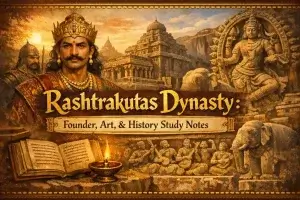
When you flip through the pages of Indian medieval history, few names shine as brightly as the Rashtrakutas Dynasty. For competitive exam aspirants—whether you are preparing for UPSC, SSC, or State PSCs—understanding this empire is crucial. They weren’t just warriors; they were the bridge between North and South Indian cultures.
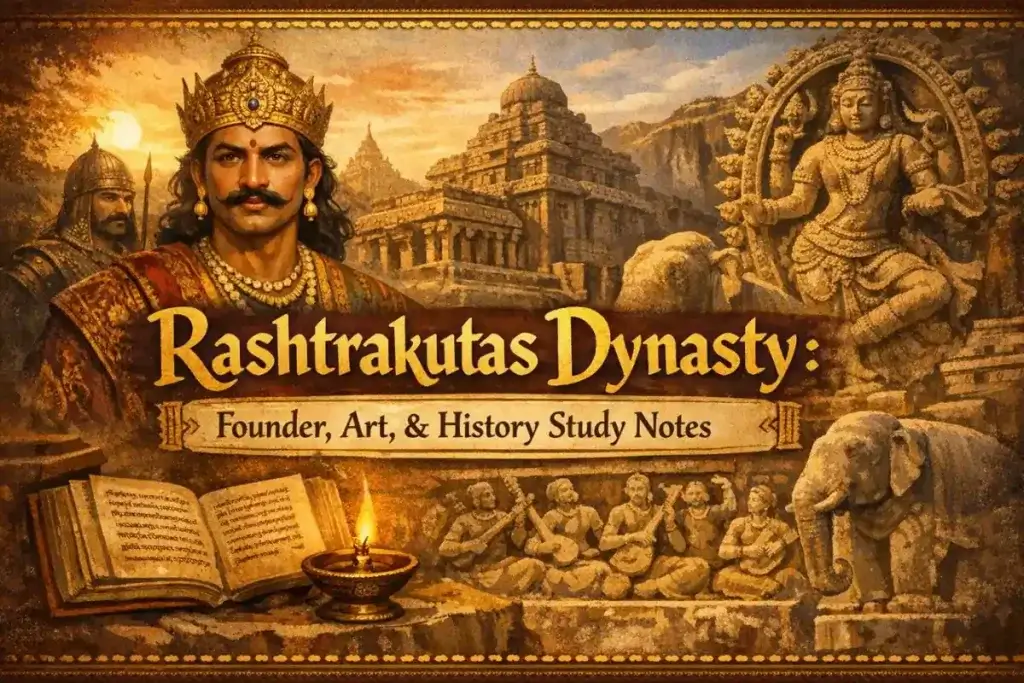
In this guide, we will break down everything from their origins to their magnificent temples, ensuring you have all the facts for your next exam.
What is the Rashtrakutas Dynasty?
The Rashtrakutas Dynasty was a powerful Indian royal lineage that ruled large parts of the Indian subcontinent between the 8th and 10th centuries. At their peak, their empire stretched from the Kaveri River in the south to the fertile plains of the Ganges in the north.
They are best known for their military might, as they were one of the three main players in the famous “Tripartite Struggle” for the control of Kannauj (alongside the Palas and the Gurjara-Pratiharas). If you are looking for a dynasty that defined the “Golden Age” of the Deccan, the Rashtrakutas are it.
Key Facts to Remember
- Founder: Dantidurga (also known as Dantivarman).
- Capital: Initially Lattaluru, later shifted to Manyakheta (modern-day Malkhed in Karnataka) by Amoghavarsha I.
- The Tripartite Struggle: They were a key party in the long-standing conflict against the Pratiharas and the Palas for control over the symbolic city of Kannauj.
- Greatest Ruler: Amoghavarsha I, often compared to Ashoka for his religious leanings and Ashoka-like peaceful governance. He authored the Kavirajamarga, the earliest available writing on Kannada poetics.
- Architectural Marvel: The Kailasa Temple at Ellora (Cave 16), carved out of a single rock, was built during the reign of Krishna I.
- Religion: They were remarkably tolerant, supporting Hinduism, Jainism, and Buddhism. They even allowed Arab traders to settle and build mosques.
- Decline: The empire weakened under the later rulers and was eventually toppled by Tailapa II, the founder of the Western Chalukyas (Chalukyas of Kalyani).
Who is the Founder of the Rashtrakutas Dynasty?
Every great empire has a beginning. The founder of the Rashtrakutas Dynasty was Dantidurga (also known as Dantivarman).
- The Origin: Initially, the Rashtrakutas were feudatories (subordinates) of the Chalukyas of Badami.
- The Turning Point: In 753 AD, Dantidurga overthrew the last Chalukyan king, Kirtivarman II, and established an independent kingdom.
- The Ritual: To solidify his power, he performed the Hiranya-garbha (Golden Womb) ritual at Ujjain, symbolizing his rise to a higher kshatriya status.
Important Rulers of the Rashtrakutas Dynasty
While there were many kings, a few standout names are essential for your notes:
| Ruler Name | Key Achievement |
| Dantidurga | Founded the dynasty and defeated the Chalukyas. |
| Krishna I | Famous for building the rock-cut Kailasa Temple at Ellora. |
| Govinda III | Known as one of the greatest conquerors; he expanded the empire to the Himalayas. |
| Amoghavarsha I | Often called the “Ashoka of the South.” He was a scholar and wrote Kavirajamarga, the earliest Kannada work on poetics. |
| Krishna III | The last great king who defeated the Cholas at the Battle of Takkolam. |
Art and Architecture of the Rashtrakutas Dynasty
If you ever visit Maharashtra, you will see the living legacy of this dynasty. Their contribution to Indian art is unparalleled. They followed a style that blended northern and southern influences.
1. The Kailasa Temple (Ellora)
Commissioned by Krishna I, this is a wonder of the world. It is a monolithic structure, meaning it was carved out of a single solid rock from the top down. It represents Mount Kailash, the abode of Lord Shiva.
2. Elephanta Caves
Located on an island near Mumbai, these caves are dedicated to Lord Shiva. The famous Trimurti sculpture (representing the three aspects of Shiva) is a masterpiece of Rashtrakuta craftsmanship.
3. Literature
They weren’t just builders; they were patrons of language. While Sanskrit was the official language, Kannada flourished. Amoghavarsha I himself was a celebrated author, proving that the pen was as mighty as the sword in this era.
Rashtrakutas Dynasty MCQs (Practice Set)
Test your knowledge with these exam-style questions:
Q1. Who was the founder of the Rashtrakuta Dynasty? / राष्ट्रकूट वंश का संस्थापक कौन था?
A) Krishna I / कृष्ण I, B) Dantidurga / दन्तिदुर्ग, C) Amoghavarsha / अमोघवर्ष, D) Govinda III / गोविन्द III
Check Answer
Answer: B) Dantidurga / दन्तिदुर्ग
Q2. Which Rashtrakuta king built the Kailasa Temple at Ellora? / किस राष्ट्रकूट राजा ने एलोरा में कैलाश मंदिर का निर्माण करवाया था?
A) Dantidurga / दन्तिदुर्ग, B) Krishna I / कृष्ण I, C) Dhruva / ध्रुव, D) Amoghavarsha / अमोघवर्ष
Check Answer
Answer: B) Krishna I / कृष्ण I
Q3. What was the capital of the Rashtrakuta Empire? / राष्ट्रकूट साम्राज्य की राजधानी क्या थी?
A) Vatapi / वातापी, B) Kannauj / कन्नौज, C) Manyakheta / मान्यखेट, D) Kanchi / कांची
Check Answer
Answer: C) Manyakheta / मान्यखेट
Q4. Which ruler is known as the “Ashoka of the South”? / किस शासक को “दक्षिण का अशोक” कहा जाता है?
A) Krishna III / कृष्ण III, B) Amoghavarsha I / अमोघवर्ष I, C) Indra III / इंद्र III, D) Govinda II / गोविन्द II
Check Answer
Answer: B) Amoghavarsha I / अमोघवर्ष I
Q5. The Rashtrakutas fought the Tripartite Struggle for which city? / राष्ट्रकूटों ने किस शहर के लिए त्रिपक्षीय संघर्ष लड़ा था?
A) Pataliputra / पाटलिपुत्र, B) Kannauj / कन्नौज, C) Ujjain / उज्जैन, D) Badami / बादामी
Check Answer
Answer: B) Kannauj / कन्नौज
Q6. Who wrote ‘Kavirajamarga’, the earliest Kannada work? / ‘कविराजमार्ग’, जो सबसे पुरानी कन्नड़ कृति है, किसने लिखी थी?
A) Pampa / पम्पा, B) Ponna / पोन्ना, C) Amoghavarsha I / अमोघवर्ष I, D) Ranna / रन्ना
Check Answer
Answer: C) Amoghavarsha I / अमोघवर्ष I
Q7. Which dynasty was overthrown by Dantidurga? / दन्तिदुर्ग ने किस वंश को उखाड़ फेंका था?
A) Pallavas / पल्लव, B) Cholas / चोल, C) Chalukyas of Badami / बादामी के चालुक्य, D) Cheras / चेर
Check Answer
Answer: C) Chalukyas of Badami / बादामी के चालुक्य
Q8. Krishna I belonged to which dynasty? / कृष्ण प्रथम किस वंश से संबंधित थे?
A) Pala / पाल, B) Pratihara / प्रतिहार, C) Rashtrakuta / राष्ट्रकूट, D) Chola / चोल
Check Answer
Answer: C) Rashtrakuta / राष्ट्रकूट
Q9. The Elephanta Caves were primarily built during whose reign? / एलीफेंटा की गुफाएं मुख्य रूप से किसके शासनकाल में बनाई गई थीं?
A) Chalukyas / चालुक्य, B) Rashtrakutas / राष्ट्रकूट, C) Marathas / मराठा, D) Kalachuris / कलचुरी
Check Answer
Answer: B) Rashtrakutas / राष्ट्रकूट
Q10. Which Rashtrakuta ruler defeated the Pala king Dharmapala? / किस राष्ट्रकूट शासक ने पाल राजा धर्मपाल को हराया था?
A) Dhruva / ध्रुव, B) Krishna II / कृष्ण II, C) Govinda IV / गोविन्द IV, D) Karkka II / कर्क II
Check Answer
Answer: A) Dhruva / ध्रुव
Q11. Who was the last great ruler of the Rashtrakutas? / राष्ट्रकूटों का अंतिम महान शासक कौन था?
A) Krishna III / कृष्ण III, B) Indra IV / इंद्र IV, C) Khottiga / खोट्टिगा, D) Govinda III / गोविन्द III
Check Answer
Answer: A) Krishna III / कृष्ण III
Q12. The word ‘Rashtrakuta’ literally means? / ‘राष्ट्रकूट’ शब्द का शाब्दिक अर्थ क्या है?
A) King of the Nation / राष्ट्र का राजा, B) Territory Officers / क्षेत्र के अधिकारी, C) Warriors / योद्धा, D) Land Owners / जमींदार
Check Answer
Answer: B) Territory Officers / क्षेत्र के अधिकारी
Q13. Which Arab traveler visited the Rashtrakuta court? / किस अरब यात्री ने राष्ट्रकूट दरबार का दौरा किया था?
A) Al-Beruni / अल-बिरूनी, B) Ibn Battuta / इब्न बतूता, C) Suleiman / सुलेमान, D) Al-Masudi / अल-मसूदी
Check Answer
Answer: C) Suleiman / सुलेमान
Q14. Amoghavarsha I was a follower of which religion? / अमोघवर्ष प्रथम किस धर्म के अनुयायी थे?
A) Buddhism / बौद्ध धर्म, B) Shaivism / शैव धर्म, C) Jainism / जैन धर्म, D) Vaishnavism / वैष्णव धर्म
Check Answer
Answer: C) Jainism / जैन धर्म
Q15. Who was the author of ‘Ratnamalika’? / ‘रत्नमालिका’ के लेखक कौन थे?
A) Amoghavarsha I / अमोघवर्ष I, B) Jinasena / जिनसेन, C) Sakatayana / शाकटायन, D) Mahaviracharya / महावीराचार्य
Check Answer
Answer: A) Amoghavarsha I / अमोघवर्ष I
Q16. The Rashtrakuta administration was divided into provinces called? / राष्ट्रकूट प्रशासन को किन प्रांतों में विभाजित किया गया था?
A) Bhuktis / भुक्ति, B) Rashtras / राष्ट्र, C) Vishayas / विषय, D) Gramas / ग्राम
Check Answer
Answer: B) Rashtras / राष्ट्र
Q17. Who was the head of a ‘Vishaya’ in the Rashtrakuta Empire? / राष्ट्रकूट साम्राज्य में ‘विषय’ का प्रमुख कौन था?
A) Rashtrapati / राष्ट्रपति, B) Vishayapati / विषयपति, C) Gramapala / ग्रामपाल, D) Deshmukh / देशमुख
Check Answer
Answer: B) Vishayapati / विषयपति
Q18. Which Rashtrakuta king performed the ‘Hiranya-garbha’ ritual? / किस राष्ट्रकूट राजा ने ‘हिरण्य-गर्भ’ अनुष्ठान किया था?
A) Govinda III / गोविन्द III, B) Dantidurga / दन्तिदुर्ग, C) Krishna II / कृष्ण II, D) Amoghavarsha / अमोघवर्ष
Check Answer
Answer: B) Dantidurga / दन्तिदुर्ग
Q19. The famous poets Pampa and Ponna were patronized by? / प्रसिद्ध कवि पम्पा और पोन्ना को किसका संरक्षण प्राप्त था?
A) Cholas / चोल, B) Rashtrakutas / राष्ट्रकूट, C) Cheras / चेर, D) Pallavas / पल्लव
Check Answer
Answer: B) Rashtrakutas / राष्ट्रकूट
Q20. Who defeated the Rashtrakuta king Karkka II in 973 AD? / 973 ईस्वी में राष्ट्रकूट राजा कर्क II को किसने हराया था?
A) Pulakeshin II / पुलकेशिन II, B) Vikramaditya VI / विक्रमादित्य VI, C) Tailapa II / तैलप II, D) Rajaraja Chola / राजराज चोल
Check Answer
Answer: C) Tailapa II / तैलप II
Q21. Which Rashtrakuta king assumed the title ‘Akshavarsha’? / किस राष्ट्रकूट राजा ने ‘अक्षवर्ष’ की उपाधि धारण की थी?
A) Indra III / इंद्र III, B) Krishna III / कृष्ण III, C) Krishna I / कृष्ण I, D) Amoghavarsha I / अमोघवर्ष I
Check Answer
Answer: B) Krishna III / कृष्ण III
Q22. The copper plates of the Rashtrakutas were usually written in? / राष्ट्रकूटों के ताम्रपत्र आमतौर पर किसमें लिखे जाते थे?
A) Sanskrit and Kannada / संस्कृत और कन्नड़, B) Tamil / तमिल, C) Pali / पालि, D) Telugu / तेलुगु
Check Answer
Answer: A) Sanskrit and Kannada / संस्कृत और कन्नड़
Q23. Which ruler built the city of Manyakheta? / मान्यखेट शहर का निर्माण किस शासक ने करवाया था?
A) Dantidurga / दन्तिदुर्ग, B) Amoghavarsha I / अमोघवर्ष I, C) Dhruva / ध्रुव, D) Govinda III / गोविन्द III
Check Answer
Answer: B) Amoghavarsha I / अमोघवर्ष I
Q24. The ‘Tripartite Struggle’ involved Rashtrakutas, Palas and? / ‘त्रिपक्षीय संघर्ष’ में राष्ट्रकूट, पाल और कौन शामिल थे?
A) Cholas / चोल, B) Gurjara-Pratiharas / गुर्जर-प्रतिहार, C) Parmaras / परमार, D) Solankis / सोलंकी
Check Answer
Answer: B) Gurjara-Pratiharas / गुर्जर-प्रतिहार
Q25. Who was the spiritual teacher (Guru) of Amoghavarsha I? / अमोघवर्ष I के आध्यात्मिक गुरु कौन थे?
A) Jinasena / जिनसेन, B) Hemachandra / हेमचंद्र, C) Shankarcharya / शंकराचार्य, D) Madhvacharya / मध्वाचार्य
Check Answer
Answer: A) Jinasena / जिनसेन
Q26. Which Rashtrakuta king invaded Sri Lanka? / किस राष्ट्रकूट राजा ने श्रीलंका पर आक्रमण किया था?
A) Govinda III / गोविन्द III, B) Krishna III / कृष्ण III, C) Indra III / इंद्र III, D) Dhruva / ध्रुव
Check Answer
Answer: B) Krishna III / कृष्ण III
Q27. The ‘Adi Purana’ was written by whom in the Rashtrakuta court? / राष्ट्रकूट दरबार में ‘आदि पुराण’ किसके द्वारा लिखा गया था?
A) Jinasena / जिनसेन, B) Pampa / पम्पा, C) Ranna / रन्ना, D) Ponna / पोन्ना
Check Answer
Answer: A) Jinasena / जिनसेन
Q28. What was the basic unit of administration in the Rashtrakuta Empire? / राष्ट्रकूट साम्राज्य में प्रशासन की मूल इकाई क्या थी?
A) Rashtra / राष्ट्र, B) Vishaya / विषय, C) Grama / ग्राम, D) Bhukti / भुक्ति
Check Answer
Answer: C) Grama / ग्राम
Q29. Which title was NOT used by Rashtrakuta kings? / राष्ट्रकूट राजाओं द्वारा कौन सी उपाधि उपयोग नहीं की गई थी?
A) Paramabhattaraka / परमभट्टारक, B) Maharajadhiraja / महाराजाधिराज, C) Dharmamaharamaditya / धर्ममहामदित्य, D) Chakravartin / चक्रवर्तिन
Check Answer
Answer: C) Dharmamaharamaditya / धर्ममहामदित्य
Q30. Sanjan copper plates belong to which king? / संजन ताम्रपत्र किस राजा से संबंधित हैं?
A) Amoghavarsha I / अमोघवर्ष I, B) Indra III / इंद्र III, C) Dhruva / ध्रुव, D) Krishna I / कृष्ण I
Check Answer
Answer: A) Amoghavarsha I / अमोघवर्ष I
Q31. Which sect of Jainism was prominent during the Rashtrakuta period? / राष्ट्रकूट काल के दौरान जैन धर्म का कौन सा संप्रदाय प्रमुख था?
A) Shvetambara / श्वेतांबर, B) Digambara / दिगंबर, C) Terapanthi / तेरापंथी, D) Bispanthi / बीसपंथी
Check Answer
Answer: B) Digambara / दिगंबर
Q32. The battle of Takkolam was fought between Rashtrakutas and? / तक्कोलम का युद्ध राष्ट्रकूट और किसके बीच लड़ा गया था?
A) Pallavas / पल्लव, B) Cholas / चोल, C) Cheras / चेर, D) Pandyas / पांड्य
Check Answer
Answer: B) Cholas / चोल
Q33. Who wrote ‘Ganitasarasangraha’ during this era? / इस युग के दौरान ‘गणितसारसंग्रह’ किसने लिखा था?
A) Mahaviracharya / महावीराचार्य, B) Aryabhatta / आर्यभट्ट, C) Bhaskara / भास्कर, D) Varahmihira / वराहमिहिर
Check Answer
Answer: A) Mahaviracharya / महावीराचार्य
Q34. Which Rashtrakuta king crossed the Narmada and defeated Vatsaraja? / किस राष्ट्रकूट राजा ने नर्मदा पार कर वत्सराज को हराया था?
A) Dhruva / ध्रुव, B) Govinda III / गोविन्द III, C) Krishna I / कृष्ण I, D) Indra III / इंद्र III
Check Answer
Answer: A) Dhruva / ध्रुव
Q35. The village headman under Rashtrakutas was called? / राष्ट्रकूटों के अधीन ग्राम प्रधान को क्या कहा जाता था?
A) Grama-mahata / ग्राम-महाता, B) Gramini / ग्रामिणी, C) Pattakila / पट्टकिल, D) Nambudiri / नंबूदिरी
Check Answer
Answer: C) Pattakila / पट्टकिल
Q36. Rashtrakutas were initially feudatories of? / राष्ट्रकूट शुरू में किसके सामंत थे?
A) Chalukyas / चालुक्य, B) Pallavas / पल्लव, C) Satavahanas / सातवाहन, D) Kadambas / कदम्ब
Check Answer
Answer: A) Chalukyas / चालुक्य
Q37. Who was the father of Amoghavarsha I? / अमोघवर्ष प्रथम के पिता कौन थे?
A) Govinda III / गोविन्द III, B) Dhruva / ध्रुव, C) Krishna II / कृष्ण II, D) Indra II / इंद्र II
Check Answer
Answer: A) Govinda III / गोविन्द III
Q38. How many caves are there in Ellora? / एलोरा में कितनी गुफाएं हैं?
A) 24, B) 34, C) 12, D) 44
Check Answer
Answer: B) 34
Q39. Which Rashtrakuta king led the first successful expedition to North India? / किस राष्ट्रकूट राजा ने उत्तर भारत में पहला सफल अभियान चलाया था?
A) Dhruva / ध्रुव, B) Krishna I / कृष्ण I, C) Govinda II / गोविन्द II, D) Amoghavarsha / अमोघवर्ष
Check Answer
Answer: A) Dhruva / ध्रुव
Q40. The tax ‘Udranga’ was related to? / ‘उद्रंग’ कर किससे संबंधित था?
A) Trade / व्यापार, B) Land / भूमि, C) Religion / धर्म, D) War / युद्ध
Check Answer
Answer: B) Land / भूमि
Q41. Who wrote ‘Shakatayana-Vyakarana’? / ‘शाकटायन-व्याकरण’ किसने लिखा था?
A) Jinasena / जिनसेन, B) Shakatayana / शाकटायन, C) Ranna / रन्ना, D) Pampa / पम्पा
Check Answer
Answer: B) Shakatayana / शाकटायन
Q42. Which Rashtrakuta king built the Navavilas Temple? / किस राष्ट्रकूट राजा ने नवविलास मंदिर का निर्माण करवाया था?
A) Amoghavarsha I / अमोघवर्ष I, B) Indra III / इंद्र III, C) Govinda IV / गोविन्द IV, D) Krishna II / कृष्ण II
Check Answer
Answer: A) Amoghavarsha I / अमोघवर्ष I
Q43. The Rashtrakuta army was known for its? / राष्ट्रकूट सेना अपनी किस खूबी के लिए जानी जाती थी?
A) Navy / नौसेना, B) Elephant Corps / हाथी सेना, C) Camel Corps / ऊंट सेना, D) Archery / तीरंदाजी
Check Answer
Answer: B) Elephant Corps / हाथी सेना
Q44. Which cave at Ellora is the Vishvakarma Cave? / एलोरा की कौन सी गुफा ‘विश्वकर्मा गुफा’ है?
A) Cave 10 / गुफा 10, B) Cave 16 / गुफा 16, C) Cave 1 / गुफा 1, D) Cave 32 / गुफा 32
Check Answer
Answer: A) Cave 10 / गुफा 10
Q45. Who was the chief deity of the Rashtrakutas initially? / प्रारंभ में राष्ट्रकूटों के मुख्य देवता कौन थे?
A) Vishnu / विष्णु, B) Shiva / शिव, C) Ganesha / गणेश, D) Indra / इंद्र
Check Answer
Answer: B) Shiva / शिव
Q46. Which Rashtrakuta king captured Kannauj and defeated Indra’s successor? / किस राष्ट्रकूट राजा ने कन्नौज पर कब्जा किया और इंद्र के उत्तराधिकारी को हराया?
A) Indra III / इंद्र III, B) Govinda III / गोविन्द III, C) Dhruva / ध्रुव, D) Krishna III / कृष्ण III
Check Answer
Answer: A) Indra III / इंद्र III
Q47. The Jain caves at Ellora are numbered? / एलोरा में जैन गुफाओं की संख्या क्या है?
A) 1-12, B) 13-29, C) 30-34, D) 25-30
Check Answer
Answer: C) 30-34
Q48. Who was the Pallava contemporary of Dantidurga? / दन्तिदुर्ग के समकालीन पल्लव कौन थे?
A) Nandivarman II / नंदीवर्मन II, B) Mahendravarman I / महेंद्रवर्मन I, C) Narasimhavarman II / नरसिंहवर्मन II, D) Aparajita / अपराजित
Check Answer
Answer: A) Nandivarman II / नंदीवर्मन II
Q49. In Rashtrakuta administration, ‘Bhukti’ was? / राष्ट्रकूट प्रशासन में, ‘भुक्ति’ क्या था?
A) A sub-division of Vishaya / विषय का एक उप-विभाजन, B) A village / एक गाँव, C) A tax / एक कर, D) A title / एक उपाधि
Check Answer
Answer: A) A sub-division of Vishaya
Q50. What was the royal emblem of the Rashtrakutas? / राष्ट्रकूटों का शाही प्रतीक क्या था?
A) Boar / वराह, B) Golden Eagle / गरुड़, C) Lion / शेर, D) Fish / मछली
Check Answer
Answer: B) Golden Eagle / गरुड़
Q51. Who defeated the Chola king Parantaka I in the Battle of Takkolam? / तक्कोलम के युद्ध में चोल राजा परांतक प्रथम को किसने हराया था?
A) Krishna III / कृष्ण III, B) Krishna II / कृष्ण II, C) Govinda III / गोविन्द III, D) Indra III / इंद्र III
Check Answer
Answer: A) Krishna III / कृष्ण III
Q52. The famous Jain work ‘Parsvabhyudaya’ was written by? / प्रसिद्ध जैन कृति ‘पार्श्वभ्युदय’ किसके द्वारा लिखी गई थी?
A) Jinasena / जिनसेन, B) Gunabhadra / गुणभद्र, C) Pampa / पम्पा, D) Ranna / रन्ना
Check Answer
Answer: A) Jinasena / जिनसेन
Q53. Which Rashtrakuta king assumed the title of ‘Nripatunga’? / किस राष्ट्रकूट राजा ने ‘नृपतुंग’ की उपाधि धारण की थी?
A) Dantidurga / दन्तिदुर्ग, B) Amoghavarsha I / अमोघवर्ष I, C) Dhruva / ध्रुव, D) Govinda II / गोविन्द II
Check Answer
Answer: B) Amoghavarsha I / अमोघवर्ष I
Q54. The Dashavatara Cave (Cave 15) at Ellora was initiated during the reign of? / एलोरा में दशावतार गुफा (गुफा 15) किसके शासनकाल में शुरू की गई थी?
A) Krishna I / कृष्ण I, B) Dantidurga / दन्तिदुर्ग, C) Indra III / इंद्र III, D) Govinda III / गोविन्द III
Check Answer
Answer: B) Dantidurga / दन्तिदुर्ग
Q55. What was the gold coin of the Rashtrakuta period called? / राष्ट्रकूट काल के सोने के सिक्के को क्या कहा जाता था?
A) Dramma / द्रम्म, B) Gadyana / गद्याण, C) Pana / पण, D) Suvarna / सुवर्ण
Check Answer
Answer: B) Gadyana / गद्याण
Q56. Which officer looked after the ‘Rashtra’ (Province)? / ‘राष्ट्र’ (प्रांत) की देखभाल कौन सा अधिकारी करता था?
A) Rashtrapati / राष्ट्रपति, B) Vishayapati / विषयपति, C) Gramakuta / ग्रामकूट, D) Bhogapati / भोगपति
Check Answer
Answer: A) Rashtrapati / राष्ट्रपति
Q57. Who was the author of the mathematical work ‘Ganita Sara Samgraha’? / गणितीय कृति ‘गणित सार संग्रह’ के लेखक कौन थे?
A) Bhaskara II / भास्कर II, B) Mahaviracharya / महावीराचार्य, C) Brahmagupta / ब्रह्मगुप्त, D) Varahamihira / वराहमिहिर
Check Answer
Answer: B) Mahaviracharya / महावीराचार्य
Q58. The Rashtrakuta king Govinda III belonged to which century? / राष्ट्रकूट राजा गोविन्द III किस शताब्दी के थे?
A) 7th Century / 7वीं शताब्दी, B) 8th-9th Century / 8वीं-9वीं शताब्दी, C) 10th Century / 10वीं शताब्दी, D) 6th Century / 6वीं शताब्दी
Check Answer
Answer: B) 8th-9th Century
Q59. Which city was known as ‘Lattaluru’ in Rashtrakuta records? / राष्ट्रकूट अभिलेखों में किस शहर को ‘लत्तलुरु’ के रूप में जाना जाता था?
A) Latur / लातूर, B) Lucknow / लखनऊ, C) Ludhiana / लुधियाना, D) Lahore / लाहौर
Check Answer
Answer: A) Latur / लातूर
Q60. The Jain poet Pampa is known as the ‘Adikavi’ of which language? / जैन कवि पम्पा को किस भाषा का ‘आदिकवि’ कहा जाता है?
A) Tamil / तमिल, B) Telugu / तेलुगु, C) Kannada / कन्नड़, D) Malayalam / मलयालम
Check Answer
Answer: C) Kannada / कन्नड़
Q61. Which Rashtrakuta king is mentioned in the Sanjan Plates? / संजन ताम्रपत्रों में किस राष्ट्रकूट राजा का उल्लेख है?
A) Amoghavarsha I / अमोघवर्ष I, B) Krishna I / कृष्ण I, C) Dantidurga / दन्तिदुर्ग, D) Dhruva / ध्रुव
Check Answer
Answer: A) Amoghavarsha I / अमोघवर्ष I
Q62. The office of ‘Mahasandhivigrahika’ was related to? / ‘महासांधिविग्रहिक’ का पद किससे संबंधित था?
A) Revenue / राजस्व, B) Foreign Affairs / विदेश मामले, C) Religion / धर्म, D) Military / सैन्य
Check Answer
Answer: B) Foreign Affairs / विदेश मामले
Q63. Which Rashtrakuta king established a victory pillar at Rameshwaram? / किस राष्ट्रकूट राजा ने रामेश्वरम में एक विजय स्तंभ स्थापित किया था?
A) Krishna III / कृष्ण III, B) Indra III / इंद्र III, C) Govinda III / गोविन्द III, D) Krishna II / कृष्ण II
Check Answer
Answer: A) Krishna III / कृष्ण III
Q64. The ‘Kavirajamarga’ deals with which subject? / ‘कविराजमार्ग’ किस विषय से संबंधित है?
A) Medicine / चिकित्सा, B) Poetics and Grammar / काव्यशास्त्र और व्याकरण, C) Astronomy / खगोल विज्ञान, D) Warfare / युद्ध कला
Check Answer
Answer: B) Poetics and Grammar
Q65. Who was the mother of Amoghavarsha I? / अमोघवर्ष प्रथम की माता कौन थीं?
A) Rebanimmadi / रेबनिम्मादी, B) Mahadevi / महादेवी, C) Lokamahadevi / लोकमहादेवी, D) Kundavai / कुंदवई
Check Answer
Answer: A) Rebanimmadi / रेबनिम्मादी
Q66. The term ‘Uparikara’ in the Rashtrakuta period referred to? / राष्ट्रकूट काल में ‘उपरिकर’ शब्द का तात्पर्य क्या था?
A) Trade tax / व्यापार कर, B) Additional land tax / अतिरिक्त भूमि कर, C) Religious tax / धार्मिक कर, D) House tax / गृह कर
Check Answer
Answer: B) Additional land tax / अतिरिक्त भूमि कर
Q67. Which university was patronized by the Rashtrakutas? / राष्ट्रकूटों द्वारा किस विश्वविद्यालय को संरक्षण दिया गया था?
A) Nalanda / नालंदा, B) Vikramshila / विक्रमशिला, C) Salotgi / सालोटगी, D) Taxila / तक्षशिला
Check Answer
Answer: C) Salotgi / सालोटगी
Q68. Who was the Rashtrakuta king when the Arab traveler Al-Masudi visited India? / जब अरब यात्री अल-मसूदी ने भारत का दौरा किया तब राष्ट्रकूट राजा कौन था?
A) Indra III / इंद्र III, B) Govinda IV / गोविन्द IV, C) Amoghavarsha III / अमोघवर्ष III, D) Krishna III / कृष्ण III
Check Answer
Answer: A) Indra III / इंद्र III
Q69. The Rashtrakuta rulers were successors of which dynasty in the Deccan? / राष्ट्रकूट शासक दक्कन में किस वंश के उत्तराधिकारी थे?
A) Satavahanas / सातवाहन, B) Badami Chalukyas / बादामी के चालुक्य, C) Pallavas / पल्लव, D) Vakatakas / वाकाटक
Check Answer
Answer: B) Badami Chalukyas / बादामी के चालुक्य
Q70. Which Rashtrakuta king wrote ‘Ratnamalika’? / किस राष्ट्रकूट राजा ने ‘रत्नमालिका’ लिखी थी?
A) Amoghavarsha I / अमोघवर्ष I, B) Krishna I / कृष्ण I, C) Indra II / इंद्र II, D) Khottiga / खोट्टिगा
Check Answer
Answer: A) Amoghavarsha I / अमोघवर्ष I
Q71. What was the unit of 10-20 villages in the Rashtrakuta administration called? / राष्ट्रकूट प्रशासन में 10-20 गाँवों की इकाई को क्या कहा जाता था?
A) Bhukti / भुक्ति, B) Pathaka / पाठक, C) Mandalam / मंडलम, D) Nadu / नाडु
Check Answer
Answer: A) Bhukti / भुक्ति
Q72. Who was the court poet of Krishna III? / कृष्ण III के दरबारी कवि कौन थे?
A) Ponna / पोन्ना, B) Pampa / पम्पा, C) Ranna / रन्ना, D) Jinasena / जिनसेन
Check Answer
Answer: A) Ponna / पोन्ना
Q73. The ‘Sravana Belagola’ became a prominent center for which religion? / ‘श्रवणबेलगोला’ किस धर्म का प्रमुख केंद्र बना?
A) Jainism / जैन धर्म, B) Buddhism / बौद्ध धर्म, C) Vaishnavism / वैष्णव धर्म, D) Shaivism / शैव धर्म
Check Answer
Answer: A) Jainism / जैन धर्म
Q74. Which Rashtrakuta ruler abdicated the throne to pursue religious life? / किस राष्ट्रकूट शासक ने धार्मिक जीवन जीने के लिए सिंहासन त्याग दिया था?
A) Amoghavarsha I / अमोघवर्ष I, B) Krishna I / कृष्ण I, C) Dhruva / ध्रुव, D) Govinda III / गोविन्द III
Check Answer
Answer: A) Amoghavarsha I / अमोघवर्ष I
Q75. The rock-cut architecture at Elephanta is dedicated to which God? / एलीफेंटा की रॉक-कट वास्तुकला किस भगवान को समर्पित है?
A) Vishnu / विष्णु, B) Shiva / शिव, C) Brahma / ब्रह्मा, D) Ganesha / गणेश
Check Answer
Answer: B) Shiva / शिव
Q76. Who was the first Rashtrakuta king to capture the fort of Chittor? / चित्तौड़ के किले पर कब्जा करने वाला पहला राष्ट्रकूट राजा कौन था?
A) Govinda III / गोविन्द III, B) Krishna II / कृष्ण II, C) Indra III / इंद्र III, D) Dhruva / ध्रुव
Check Answer
Answer: A) Govinda III / गोविन्द III
Q77. The Rashtrakuta kingdom was divided into ‘Rashtras’ which were headed by? / राष्ट्रकूट साम्राज्य को ‘राष्ट्रों’ में विभाजित किया गया था जिनका प्रमुख कौन था?
A) Rashtrapati / राष्ट्रपति, B) Amatya / अमात्य, C) Nayaka / नायक, D) Rajuka / राजुक
Check Answer
Answer: A) Rashtrapati / राष्ट्रपति
Q78. Which language flourished most during the Rashtrakuta period? / राष्ट्रकूट काल के दौरान किस भाषा का सबसे अधिक विकास हुआ?
A) Kannada / कन्नड़, B) Tamil / तमिल, C) Marathi / मराठी, D) Malayalam / मलयालम
Check Answer
Answer: A) Kannada / कन्नड़
Q79. Who defeated the Rashtrakuta king Khottiga? / राष्ट्रकूट राजा खोट्टिगा को किसने हराया था?
A) Tailapa II / तैलप II, B) Siyaka II (Paramara) / सियाक II (परमार), C) Rajaraja I / राजराज I, D) Pulakeshin II / पुलकेशिन II
Check Answer
Answer: B) Siyaka II (Paramara)
Q80. The ‘Tripartite Struggle’ lasted for approximately how many years? / ‘त्रिपक्षीय संघर्ष’ लगभग कितने वर्षों तक चला?
A) 50 years, B) 100 years, C) 200 years, D) 300 years
Check Answer
Answer: C) 200 years
Q81. Who was the author of ‘Shantipura’? / ‘शांतिपुरा’ के लेखक कौन थे?
A) Ponna / पोन्ना, B) Pampa / पम्पा, C) Ranna / रन्ना, D) Jinasena / जिनसेन
Check Answer
Answer: A) Ponna / पोन्ना
Q82. Which Rashtrakuta king is credited with defeating the Gurjara king Nagabhata II? / किस राष्ट्रकूट राजा को गुर्जर राजा नागभट्ट II को हराने का श्रेय दिया जाता है?
A) Govinda III / गोविन्द III, B) Dhruva / ध्रुव, C) Krishna I / कृष्ण I, D) Amoghavarsha / अमोघवर्ष
Check Answer
Answer: A) Govinda III / गोविन्द III
Q83. The temple of ‘Kashivishvanatha’ at Pattadakal was built by? / पट्टडकल में ‘काशीविश्वनाथ’ मंदिर किसके द्वारा बनाया गया था?
A) Rashtrakutas / राष्ट्रकूट, B) Chalukyas / चालुक्य, C) Pallavas / पल्लव, D) Pandyas / पांड्य
Check Answer
Answer: A) Rashtrakutas / राष्ट्रकूट
Q84. Who were the ‘Nadugaundas’ in the Rashtrakuta administration? / राष्ट्रकूट प्रशासन में ‘नाडुगौंडा’ कौन थे?
A) Village Elders / ग्राम बुजुर्ग, B) District Officers / जिला अधिकारी, C) Priests / पुजारी, D) Soldiers / सैनिक
Check Answer
Answer: B) District Officers / जिला अधिकारी
Q85. Which Arab writer calls the Rashtrakutas the ‘Balhara’? / कौन सा अरब लेखक राष्ट्रकूटों को ‘बलहारा’ कहता है?
A) Sulaiman / सुलेमान, B) Ibn Battuta / इब्न बतूता, C) Al-Beruni / अल-बिरूनी, D) Marco Polo / मार्को पोलो
Check Answer
Answer: A) Sulaiman / सुलेमान
Q86. In which year did Dantidurga establish the independent Rashtrakuta kingdom? / दन्तिदुर्ग ने किस वर्ष स्वतंत्र राष्ट्रकूट साम्राज्य की स्थापना की थी?
A) 753 AD, B) 653 AD, C) 853 AD, D) 953 AD
Check Answer
Answer: A) 753 AD
Q87. Who was the Rashtrakuta king during the Chola-Rashtrakuta conflict for Kanchi? / कांची के लिए चोल-राष्ट्रकूट संघर्ष के दौरान राष्ट्रकूट राजा कौन था?
A) Krishna III / कृष्ण III, B) Govinda III / गोविन्द III, C) Indra III / इंद्र III, D) Krishna I / कृष्ण I
Check Answer
Answer: A) Krishna III / कृष्ण III
Q88. The ‘Viragal’ or hero stones started becoming common during which dynasty? / ‘वीरगल’ या नायक पत्थर किस वंश के दौरान सामान्य होने लगे थे?
A) Rashtrakutas / राष्ट्रकूट, B) Guptas / गुप्त, C) Mauryas / मौर्य, D) Kushanas / कुषाण
Check Answer
Answer: A) Rashtrakutas / राष्ट्रकूट
Q89. Amoghavarsha I is often compared to which Mughal Emperor for his tolerance? / अमोघवर्ष I की तुलना उनकी सहिष्णुता के लिए अक्सर किस मुगल सम्राट से की जाती है?
A) Akbar / अकबर, B) Aurangzeb / औरंगजेब, C) Babur / बाबर, D) Humayun / हुमायूँ
Check Answer
Answer: A) Akbar / अकबर
Q90. The cave number 16 at Ellora is world-famous as? / एलोरा की गुफा संख्या 16 विश्व प्रसिद्ध है?
A) Indra Sabha / इंद्र सभा, B) Kailasa Temple / कैलाश मंदिर, C) Dhumar Lena / धुमर लेना, D) Vishvakarma / विश्वकर्मा
Check Answer
Answer: B) Kailasa Temple / कैलाश मंदिर
Q91. Which Rashtrakuta king defeated the Eastern Chalukyas of Vengi? / किस राष्ट्रकूट राजा ने वेंगी के पूर्वी चालुक्यों को हराया था?
A) Krishna II / कृष्ण II, B) Govinda III / गोविन्द III, C) Dhruva / ध्रुव, D) Indra III / इंद्र III
Check Answer
Answer: B) Govinda III / गोविन्द III
Q92. What was the main source of income for the Rashtrakuta state? / राष्ट्रकूट राज्य की आय का मुख्य स्रोत क्या था?
A) Trade tax / व्यापार कर, B) Land Revenue / भू-राजस्व, C) Loot from wars / युद्धों से लूट, D) Religious donations / धार्मिक दान
Check Answer
Answer: B) Land Revenue / भू-राजस्व
Q93. Who was the founder of the Western Chalukya dynasty that replaced Rashtrakutas? / राष्ट्रकूटों की जगह लेने वाले पश्चिमी चालुक्य वंश का संस्थापक कौन था?
A) Tailapa II / तैलप II, B) Someshvara I / सोमेश्वर I, C) Vikramaditya VI / विक्रमादित्य VI, D) Pulakeshin II / पुलकेशिन II
Check Answer
Answer: A) Tailapa II / तैलप II
Q94. The poem ‘Parsvabhyudaya’ is based on the life of? / कविता ‘पार्श्वभ्युदय’ किसके जीवन पर आधारित है?
A) Parshvanatha / पार्श्वनाथ, B) Mahavira / महावीर, C) Rishabhanatha / ऋषभनाथ, D) Buddha / बुद्ध
Check Answer
Answer: A) Parshvanatha / पार्श्वनाथ
Q95. What does the name ‘Manyakheta’ mean? / ‘मान्यखेट’ नाम का क्या अर्थ है?
A) Land of the Respected / सम्मानितों की भूमि, B) City of Hills / पहाड़ियों का शहर, C) Field of Victory / विजय का क्षेत्र, D) River Valley / नदी घाटी
Check Answer
Answer: A) Land of the Respected
Q96. Which Rashtrakuta king faced a major rebellion from his brothers? / किस राष्ट्रकूट राजा को अपने भाइयों के बड़े विद्रोह का सामना करना पड़ा था?
A) Govinda III / गोविन्द III, B) Amoghavarsha I / अमोघवर्ष I, C) Dhruva / ध्रुव, D) Krishna I / कृष्ण I
Check Answer
Answer: A) Govinda III / गोविन्द III
Q97. The bronze statues of the Rashtrakuta period were made using? / राष्ट्रकूट काल की कांस्य प्रतिमाएँ किसका उपयोग करके बनाई गई थीं?
A) Lost Wax Process / लॉस्ट वैक्स प्रक्रिया, B) Sand Casting / सैंड कास्टिंग, C) Hammering / हथौड़ा चलाना, D) Welding / वेल्डिंग
Check Answer
Answer: A) Lost Wax Process / लॉस्ट वैक्स प्रक्रिया
Q98. Who among the following was a woman poet of the Rashtrakuta era? / निम्नलिखित में से कौन राष्ट्रकूट युग की एक महिला कवि थीं?
A) Kanti / कांति, B) Avantisundari / अवंतीसुंदरी, C) Akka Mahadevi / अक्का महादेवी, D) Molla / मोल्ला
Check Answer
Answer: A) Kanti / कांति
Q99. The title ‘Shubhatunga’ was held by? / ‘शुभतुंग’ की उपाधि किसके पास थी?
A) Krishna II / कृष्ण II, B) Indra III / इंद्र III, C) Govinda II / गोविन्द II, D) Amoghavarsha I / अमोघवर्ष I
Check Answer
Answer: A) Krishna II / कृष्ण II
Q100. In which year did the Rashtrakuta dynasty officially come to an end? / राष्ट्रकूट वंश आधिकारिक तौर पर किस वर्ष समाप्त हुआ?
A) 982 AD, B) 1000 AD, C) 753 AD, D) 973 AD
Check Answer
Answer: D) 973 AD
Rashtrakutas Dynasty PDFs
For students looking for structured notes, we provide comprehensive Rashtrakutas Dynasty PDFs on our platform. These PDFs include:
- Timeline of the Kings.
- Detailed maps of the empire’s expansion.
- Specific notes on Administrative units like Rashtras, Vishayas, and Bhuktis.
- Previous year questions from UPSC and SSC.
📥 Download Rashtrakutas Dynasty Notes
Pro Tip: When downloading PDFs, always look for those that categorize information into “Administration,” “Economy,” and “Culture” for better retention.
Conclusion
The Rashtrakutas Dynasty stands as a testament to the political and cultural maturity of medieval India. From Dantidurga’s bold founding to Amoghavarsha’s literary genius and the architectural marvel of the Kailasa Temple, their impact is undeniable. For an aspirant, mastering this topic provides a solid foundation for understanding the complex history of the Deccan and the Tripartite Struggle.
Stay focused on their contributions to art and their unique administrative structure, and you’ll be well-prepared for any question that comes your way!
FAQs Related to Rashtrakutas Dynasty
1. What was the capital of the Rashtrakutas Dynasty?
The capital of the Rashtrakutas was Manyakheta (modern-day Malkhed in Karnataka). It was established and made famous by King Amoghavarsha I.
2. Why is the Rashtrakuta dynasty important in Indian history?
They are significant because they controlled a vast empire that linked North and South India. They protected the country from early Arab invasions and created some of India’s most iconic rock-cut architecture.
3. What religion did the Rashtrakuta kings follow?
The kings were generally followers of Shaivism and Vaishnavism, but they were extremely tolerant. Many kings, like Amoghavarsha I, patronized Jainism, and Buddhism also received support during their reign.
4. What was the “Tripartite Struggle” involving the Rashtrakutas?
It was a long-running conflict between the Rashtrakutas, the Palas of Bengal, and the Gurjara-Pratiharas for control over Kannauj, which was the symbol of sovereignty in North India at the time.
5. How did the Rashtrakuta dynasty come to an end?
The empire weakened after the death of Krishna III. In 973 AD, Tailapa II, a feudatory who belonged to the Chalukyas of Kalyani, overthrew the last Rashtrakuta king, Karka II, and established a new dynasty.
- Buddhism Notes PDF: Life and Teachings of Buddha, 50 MCQs

- Jainism Teachings of Mahavira Notes PDF | 50 MCQs
- Satavahanas Dynasty Notes PDF: Rulers, Art & 50 MCQs
- Vijayanagar Empire: History, Founders, Rulers, and Key Facts for Aspirants

- Who is Sher Shah Suri? History, Admin Reforms, and Free PDF MCQs
- Who is Humayun? A Complete Guide for Government Exam Aspirants
- Temple Architecture: Nagara, Dravida & Vesara Styles PDF
- Rashtrakutas Dynasty: Founder, Art, & History Study Notes
- Pallavas of Kanchi: History, Kings, Temples & Study Notes PDF
- Chalukyas of Badami: Founder, Capital, History & PDF Notes
- Quit India Movement: Causes, Date, PDF & Important MCQs
- Battle of Buxar: Main Aspects, Features & MCQs Guide
- 16 Mahajanapadas: Names, Capitals, Map & PDF Download

- Vedic Age: History, Time Period aur 100 Important MCQs PDF
- Indus Valley Civilization Town Planning: Layout & Key Features
- Prehistoric Age: Meaning, Time Period, and Stages in India

Exam Expert & Content Strategist with over 5+ years of experience in the competitive exam sector. I specialize in analyzing government recruitment patterns and simplifying complex syllabi for aspirants. Having helped thousands of students through Sarkari Exam PDF, my mission is to provide authentic, updated, and high-quality study materials for SSC, UPSC, Railways, and Banking exams to help every candidate achieve their career goals.
⚠️ Disclaimer: All study materials, notes, and PDFs shared on SarkariExamPDF.in are provided purely for educational and reference purposes to assist competitive exam aspirants. We do not claim ownership of any original books or official publications. If you are the rightful copyright owner and have any objection regarding any material, please contact us through our Contact Page for immediate removal.