
For every government exam aspirant, whether you are eyeing the UPSC civil services or SSC CGL, the “Art and Culture” section is a goldmine. One of the most important topics in this section is Hindu temple architecture.
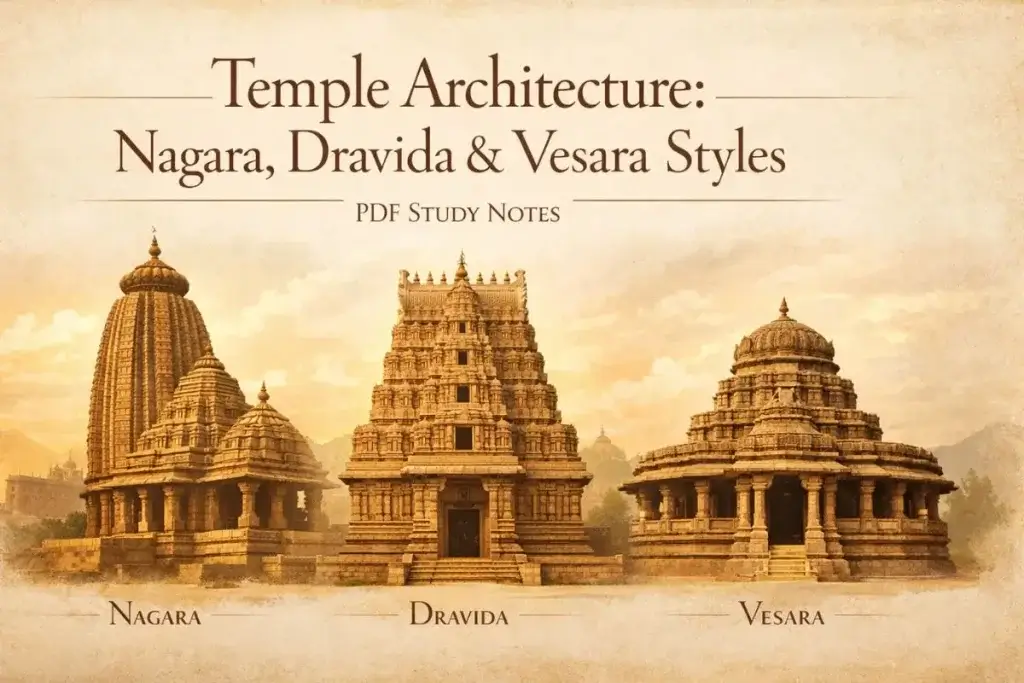
In this blog, we will simplify the complex structures of ancient Indian temples into easy-to-understand notes. By the end of this post, you’ll be able to identify a temple’s style just by looking at its roof!
What is Temple Architecture?
At its heart, temple architecture is the study of how ancient and medieval Indian temples were designed and built. It isn’t just about stone and mortar; it’s about the philosophy, geometry, and spiritual beliefs of the time.
In India, a temple is more than a place of worship—it is a “Teertha” or a bridge between the human and the divine. From a small cave shrine to the massive monolithic structures like Kailasa, the evolution is fascinating.
3 Types of Temple Architecture in India
Broadly speaking, Indian temples are classified into three distinct styles based on their geographical location and design features:
- Nagara Style: Popular in North India.
- Dravida Style: Found primarily in South India.
- Vesara Style: A “hybrid” style found in the Deccan (Central India), mixing features of both Nagara and Dravida.
Nagara Style of Temple Architecture
The Nagara style flourished in North India. If you see a temple with a beehive-shaped tower that curves inward, you are likely looking at a Nagara temple.
Key Features of Nagara Style:
- Shikhara: The main tower is called a Shikhara. It has a curved (curvilinear) shape.
- Panchayatana Style: This is a common layout where the main temple is surrounded by four smaller secondary shrines.
- No Boundary Walls: Unlike Southern temples, Northern temples usually do not have massive gate-walls (Gopurams) or water tanks inside the complex.
- Raised Platform: The temples are built on a high stone platform called a Jagati.
Dravida Style: The Glory of the South
The Dravida style is the hallmark of South India, perfected by dynasties like the Cholas, Pallavas, and Pandyas.
Key Features of Dravida Style:
- Vimana: Unlike the curved Shikhara of the North, the Southern tower is like a stepped pyramid that rises geometrically. It is called a Vimana.
- Gopurams: These are the massive, highly decorated entrance gateways that are often taller than the main temple itself.
- Boundary Walls: The entire temple complex is enclosed within high walls.
- Water Tanks: A large water tank (Temple Tank) is almost always present within the enclosure.
Khajuraho Temple Architecture
The temples at Khajuraho (Madhya Pradesh) represent the peak of the Nagara style, specifically the Chandela school.
Built between 950 and 1050 AD, these temples are world-famous for their intricate carvings and erotic sculptures. However, from an architectural standpoint, their “Sandhara” style (having a circumambulatory path) and the high “Adhisthana” (base) make them unique. The Kandariya Mahadeva Temple is the best example here, designed to look like a mountain range.
Types of Temple Architecture: A Quick Comparison
| Feature | Nagara (North) | Dravida (South) |
| Main Tower | Shikhara (Curved) | Vimana (Stepped Pyramid) |
| Entrance | Simple | Massive Gopurams |
| Pedestal | High Platform (Jagati) | On the ground level |
| Water Tank | Not mandatory | Always present |
| Examples | Sun Temple (Konark) | Brihadiswara Temple |
Temple Architecture MCQs (Practice for Aspirants)
Temple Architecture Practice Set (100 Questions)
Q1. Which style of temple architecture is famous for the ‘curvilinear shikhara’? / किस मंदिर वास्तुकला की शैली ‘वक्राकार शिखर’ के लिए प्रसिद्ध है?
Check Answer
Answer: B) Nagara / नागर
Q2. In which dynasty’s reign did the Dravida style reach its peak? / किस वंश के शासनकाल में द्रविड़ शैली अपने चरम पर पहुँची?
Check Answer
Answer: B) Chola / चोल
Q3. The massive gateway of a South Indian temple is called? / दक्षिण भारतीय मंदिर के विशाल प्रवेश द्वार को क्या कहा जाता है?
Check Answer
Answer: C) Gopuram / गोपुरम
Q4. The ‘Panchayatana’ style refers to? / ‘पंचायतन’ शैली का तात्पर्य किससे है?
Check Answer
Answer: B) Temple Layout / मंदिर लेआउट
Q5. Which temple is known as the ‘Black Pagoda’? / किस मंदिर को ‘ब्लैक पगोडा’ के नाम से जाना जाता है?
Check Answer
Answer: B) Sun Temple, Konark / सूर्य मंदिर, कोणार्क
Q6. The highest point of a Nagara style temple is usually topped with? / नागर शैली के मंदिर के उच्चतम बिंदु पर आमतौर पर क्या होता है?
Check Answer
Answer: B) Amalaka / आमलक
Q7. Where is the Brihadeeswarar Temple located? / बृहदेश्वर मंदिर कहाँ स्थित है?
Check Answer
Answer: B) Thanjavur / तंजावुर
Q8. Which temple architecture style is a hybrid of Nagara and Dravida? / कौन सी मंदिर वास्तुकला शैली नागर और द्रविड़ का मिश्रण है?
Check Answer
Answer: A) Vesara / वेसर
Q9. The Shore Temple at Mahabalipuram was built by? / महाबलीपुरम का शोर मंदिर किसके द्वारा बनवाया गया था?
Check Answer
Answer: B) Pallavas / पल्लव
Q10. ‘Garbhagriha’ in a temple refers to? / मंदिर में ‘गर्भगृह’ का तात्पर्य क्या है?
Check Answer
Answer: B) Inner Sanctum / गर्भगृह (मुख्य कक्ष)
Q11. Khajuraho temples were built by which dynasty? / खजुराहो के मंदिरों का निर्माण किस वंश ने करवाया था?
Check Answer
Answer: B) Chandela / चंदेल
Q12. The ‘Vimana’ is a characteristic feature of which style? / ‘विमान’ किस शैली की एक विशेषता है?
Check Answer
Answer: B) Dravida / द्रविड़
Q13. Which temple is famous for its erotic sculptures? / कौन सा मंदिर अपनी कामुक मूर्तियों के लिए प्रसिद्ध है?
Check Answer
Answer: B) Khajuraho / खजुराहो
Q14. The Rathas of Mahabalipuram are an example of? / महाबलीपुरम के रथ किसका उदाहरण हैं?
Check Answer
Answer: B) Monolithic rock-cut architecture / एकाश्म पत्थर-कट वास्तुकला
Q15. Who built the Kailasa Temple at Ellora? / एलोरा के कैलाश मंदिर का निर्माण किसने करवाया था?
Check Answer
Answer: A) Krishna I / कृष्ण I
Q16. The Sun Temple at Modhera is located in which state? / मोढेरा का सूर्य मंदिर किस राज्य में स्थित है?
Check Answer
Answer: B) Gujarat / गुजरात
Q17. In Dravida architecture, the pillared hall is known as? / द्रविड़ वास्तुकला में खंभों वाले हॉल को क्या कहा जाता है?
Check Answer
Answer: A) Mandapa / मण्डप
Q18. Which Gupta period temple is made entirely of bricks? / गुप्त काल का कौन सा मंदिर पूरी तरह से ईंटों से बना है?
Check Answer
Answer: B) Bhitargaon Temple / भीतरगाँव मंदिर
Q19. Lingaraja Temple in Bhubaneswar belongs to which school? / भुवनेश्वर का लिंगराज मंदिर किस शैली/स्कूल से संबंधित है?
Check Answer
Answer: A) Kalinga School / कलिंग स्कूल
Q20. The vestibule connecting the Garbhagriha and Mandapa is? / गर्भगृह और मण्डप को जोड़ने वाला गलियारा क्या है?
Check Answer
Answer: B) Antarala / अंतराल
Q21. Which style has a square base and a pyramid spire? / किस शैली का आधार वर्गाकार और शिखर पिरामिडनुमा होता है?
Check Answer
Answer: B) Dravida / द्रविड़
Q22. The Hoysaleswara Temple at Halebidu is built with? / हलेबिडु का होयसलेश्वर मंदिर किससे बना है?
Check Answer
Answer: B) Soapstone (Schist) / सोपस्टोन
Q23. Which part of the temple represents the ‘vehicle’ of the deity? / मंदिर का कौन सा भाग देवता के ‘वाहन’ का प्रतिनिधित्व करता है?
Check Answer
Answer: A) Vahana Mandapa / वाहन मण्डप
Q24. The Dilwara Jain Temples at Mount Abu are made of? / माउंट आबू के दिलवाड़ा जैन मंदिर किससे बने हैं?
Check Answer
Answer: B) White Marble / सफेद संगमरमर
Q25. Who built the Gangaikonda Cholapuram temple? / गंगईकोंडा चोलपुरम मंदिर का निर्माण किसने करवाया था?
Check Answer
Answer: B) Rajendra I / राजेंद्र I
Q26. Which feature is NOT found in Nagara style? / नागर शैली में कौन सी विशेषता नहीं पाई जाती है?
Check Answer
Answer: B) Gopuram / गोपुरम
Q27. The ‘Airavatesvara’ Temple at Darasuram was built by? / दरासुरम का ‘ऐरावतेश्वर’ मंदिर किसने बनवाया था?
Check Answer
Answer: B) Cholas / चोल
Q28. The famous Meenakshi Amman Temple is in? / प्रसिद्ध मीनाक्षी अम्मन मंदिर कहाँ है?
Check Answer
Answer: A) Madurai / मदुरै
Q29. Vesara style was patronized mostly by? / वेसर शैली को मुख्य रूप से किसके द्वारा संरक्षण दिया गया था?
Check Answer
Answer: B) Chalukyas of Badami / बादामी के चालुक्य
Q30. The ‘Jagannath Temple’ at Puri was built by? / पुरी का ‘जगन्नाथ मंदिर’ किसने बनवाया था?
Check Answer
Answer: A) Anantavarman Chodaganga / अनंतवर्मन चोडगंग
Q31. In Nagara style, the platform on which the temple stands is? / नागर शैली में, जिस चबूतरे पर मंदिर खड़ा होता है, उसे क्या कहते हैं?
Check Answer
Answer: A) Jagati / जगती
Q32. Which temple is famous for the ‘Musical Pillars’? / कौन सा मंदिर ‘संगीत स्तंभों’ के लिए प्रसिद्ध है?
Check Answer
Answer: A) Vitthala Temple, Hampi / विट्ठल मंदिर, हम्पी
Q33. The ‘Teli ka Mandir’ in Gwalior is a mix of? / ग्वालियर का ‘तेली का मंदिर’ किसका मिश्रण है?
Check Answer
Answer: A) Nagara & Dravida / नागर और द्रविड़
Q34. Which is the earliest example of a Panchayatana temple? / पंचायतन मंदिर का सबसे पुराना उदाहरण कौन सा है?
Check Answer
Answer: A) Dashavatara Temple, Deogarh / दशावतार मंदिर, देवगढ़
Q35. The star-shaped (Stellate) plan is a feature of? / तारा-आकार (तारकीय) योजना किसकी विशेषता है?
Check Answer
Answer: B) Hoysala / होयसल
Q36. The Virupaksha Temple at Pattadakal was built by? / पट्टडकल का विरूपाक्ष मंदिर किसके द्वारा बनवाया गया था?
Check Answer
Answer: A) Queen Lokamahadevi / रानी लोकमहादेवी
Q37. Which style has ‘water tanks’ as a mandatory feature? / किस शैली में ‘पानी के टैंक’ एक अनिवार्य विशेषता हैं?
Check Answer
Answer: B) Dravida / द्रविड़
Q38. The ‘Amalaka’ is found in which part of the temple? / ‘आमलक’ मंदिर के किस भाग में पाया जाता है?
Check Answer
Answer: A) Top of Shikhara / शिखर के ऊपर
Q39. Which temple is known as the ‘Lighthouse of the South’? / किसे ‘दक्षिण का प्रकाश स्तंभ’ कहा जाता है?
Check Answer
Answer: A) Brihadeeswarar Temple / बृहदेश्वर मंदिर
Q40. The temple architecture of Odisha is also known as? / ओडिशा की मंदिर वास्तुकला को और किस नाम से जाना जाता है?
Check Answer
Answer: A) Kalinga Style / कलिंग शैली
Q41. Khajuraho temples are dedicated to which deities? / खजुराहो के मंदिर किन देवताओं को समर्पित हैं?
Check Answer
Answer: C) Both A and B / A और B दोनों
Q42. What is ‘Vimana’ in South Indian temples? / दक्षिण भारतीय मंदिरों में ‘विमान’ क्या है?
Check Answer
Answer: B) Storey above the sanctum / गर्भगृह के ऊपर की मंजिलें
Q43. The temple of Somnath is an example of which style? / सोमनाथ का मंदिर किस शैली का उदाहरण है?
Check Answer
Answer: A) Maru-Gurjara / मारू-गुर्जर
Q44. Who is considered the father of Dravida architecture? / द्रविड़ वास्तुकला का जनक किसे माना जाता है?
Check Answer
Answer: A) Mahendravarman I / महेंद्रवर्मन I
Q45. The ‘Ladh Khan’ temple at Aihole was originally a? / ऐहोल का ‘लाध खान’ मंदिर मूल रूप से क्या था?
Check Answer
Answer: B) Hall for social gatherings / सामाजिक समारोहों के लिए हॉल
Q46. Which temple is called the ‘Epitome of Chola Architecture’? / किस मंदिर को ‘चोल वास्तुकला का प्रतीक’ कहा जाता है?
Check Answer
Answer: A) Brihadeeswarar / बृहदेश्वर
Q47. In which state is the Martand Sun Temple located? / मार्तंड सूर्य मंदिर किस राज्य में स्थित है?
Check Answer
Answer: C) Jammu & Kashmir / जम्मू और कश्मीर
Q48. Which temple has the world’s largest monolithic Nandi? / किस मंदिर में दुनिया की सबसे बड़ी एकाश्म नंदी की मूर्ति है?
Check Answer
Answer: B) Lepakshi Temple / लेपाक्षी मंदिर
Q49. The ‘Rekha-Deul’ and ‘Pidha-Deul’ are terms in? / ‘रेखा-देउल’ और ‘पीढ़ा-देउल’ शब्द किसमें उपयोग होते हैं?
Check Answer
Answer: A) Odishan Architecture / ओडिशा वास्तुकला
Q50. The ‘Lad Khan’ and ‘Durga’ temples are located in? / ‘लाध खान’ और ‘दुर्गा’ मंदिर कहाँ स्थित हैं?
Check Answer
Answer: A) Aihole / ऐहोल
Q51. Which style is known for having ‘Multiple Shikharas’? / किस शैली को ‘एकाधिक शिखरों’ के लिए जाना जाता है?
Check Answer
Answer: A) Nagara / नागर
Q52. The ‘Gopuram’ became a prominent feature under? / ‘गोपुरम’ किसके अधीन एक प्रमुख विशेषता बन गया?
Check Answer
Answer: A) Vijayanagara Empire / विजयनगर साम्राज्य
Q53. Where is the Kamakhya Temple located? / कामाख्या मंदिर कहाँ स्थित है?
Check Answer
Answer: A) Assam / असम
Q54. Which dynasty built the Badami cave temples? / बादामी गुफा मंदिरों का निर्माण किस वंश ने करवाया था?
Check Answer
Answer: A) Chalukyas / चालुक्य
Q55. The ‘Kandariya Mahadeva’ temple belongs to? / ‘कंडारिया महादेव’ मंदिर किससे संबंधित है?
Check Answer
Answer: A) Shiva / शिव
Q56. The ‘Thousand Pillar Temple’ at Hanumakonda was built by? / हनुमकोंडा में ‘हजार स्तंभ मंदिर’ किसके द्वारा बनवाया गया था?
Check Answer
Answer: A) Kakatiyas / काकतीय
Q57. Which architectural style flourished under the Chandela rulers? / चंदेल शासकों के अधीन कौन सी स्थापत्य शैली फली-फूली?
Check Answer
Answer: A) Khajuraho Style / खजुराहो शैली
Q58. What is ‘Antarala’ in temple architecture? / मंदिर वास्तुकला में ‘अंतराल’ क्या है?
Check Answer
Answer: A) Threshold / दहलीज (गलियारा)
Q59. The ‘Muktesvara Temple’ in Bhubaneswar is a gem of? / भुवनेश्वर का ‘मुक्तेश्वर मंदिर’ किसका रत्न है?
Check Answer
Answer: A) Odishan Architecture / ओडिशा वास्तुकला
Q60. The ‘Rajarani Temple’ at Bhubaneswar is famous for? / भुवनेश्वर का ‘राजराणी मंदिर’ किसके लिए प्रसिद्ध है?
Check Answer
Answer: A) Use of red-gold sandstone / लाल-सुनहरे बलुआ पत्थर का उपयोग
Q61. Which style of temple is most common in the Himalayan region? / हिमालयी क्षेत्र में किस शैली के मंदिर सबसे आम हैं?
Check Answer
Answer: A) Pagoda/Penthouse / पगोडा/पेंटहाउस
Q62. The ‘Vaikuntha Perumal Temple’ was built by? / ‘वैकुंठ पेरुमल मंदिर’ किसके द्वारा बनवाया गया था?
Check Answer
Answer: A) Nandivarman II / नंदीवर्मन II
Q63. The ‘Sahasra Linga’ carvings are found in? / ‘सहस्र लिंग’ नक्काशी कहाँ पाई जाती है?
Check Answer
Answer: A) Sirsi, Karnataka / सिरसी, कर्नाटक
Q64. Which style is often referred to as ‘Deccan Architecture’? / किस शैली को अक्सर ‘दक्कन वास्तुकला’ कहा जाता है?
Check Answer
Answer: A) Vesara / वेसर
Q65. The ‘Great Living Chola Temples’ are a UNESCO site in? / ‘महान जीवंत चोल मंदिर’ यूनेस्को स्थल कहाँ हैं?
Check Answer
Answer: A) Tamil Nadu / तमिलनाडु
Q66. The ‘Chausath Yogini’ temple at Mitaoli inspired? / मितावली का ‘चौसठ योगिनी’ मंदिर किससे प्रेरित था?
Check Answer
Answer: A) Indian Parliament House / भारतीय संसद भवन
Q67. The ‘Amalaka’ is a feature of? / ‘आमलक’ किसकी विशेषता है?
Check Answer
Answer: A) Nagara / नागर
Q68. The ‘Gopurams’ in Vijayanagara style are called? / विजयनगर शैली के ‘गोपुरमों’ को क्या कहा जाता है?
Check Answer
Answer: A) Raya Gopurams / राय गोपुरम
Q69. Who built the famous Sun Temple at Konark? / कोणार्क का प्रसिद्ध सूर्य मंदिर किसने बनवाया था?
Check Answer
Answer: A) Narasimhadeva I / नरसिंहदेव I
Q70. The ‘Dravida’ word literally means? / ‘द्रविड़’ शब्द का शाब्दिक अर्थ क्या है?
Check Answer
Answer: A) South / दक्षिण
Q71. Which is NOT a subtype of Nagara style? / नागर शैली का उप-प्रकार कौन सा नहीं है?
Check Answer
Answer: D) Vimana
Q72. The ‘Kailasanathar Temple’ at Kanchipuram was built by? / कांचीपुरम का ‘कैलाशनाथर मंदिर’ किसने बनवाया था?
Check Answer
Answer: A) Pallavas / पल्लव
Q73. The ‘Chennakesava Temple’ at Belur is an example of? / बेलूर का ‘चेन्नाकेशव मंदिर’ किसका उदाहरण है?
Check Answer
Answer: A) Hoysala / होयसल
Q74. The ‘Papanatha Temple’ at Pattadakal is built in? / पट्टडकल का ‘पापनाथ मंदिर’ किसमें बना है?
Check Answer
Answer: A) Nagara Style / नागर शैली
Q75. The ‘Mandapa’ is used for? / ‘मण्डप’ का उपयोग किसके लिए किया जाता है?
Check Answer
Answer: A) Public gatherings/Prayers / सार्वजनिक सभा/प्रार्थना
Q76. Which deity is worshipped in the Lingaraja Temple? / लिंगराज मंदिर में किस देवता की पूजा की जाती है?
Check Answer
Answer: A) Harihara (Shiva-Vishnu) / हरिहर
Q77. The ‘Stupika’ is the top part of which spire? / ‘स्तूपिका’ किस शिखर का शीर्ष भाग है?
Check Answer
Answer: A) Vimana / विमान
Q78. Which temple has the ‘Longest Corridor’ in the world? / किस मंदिर में दुनिया का ‘सबसे लंबा गलियारा’ है?
Check Answer
Answer: A) Ramanathaswamy Temple / रामनाथस्वामी मंदिर
Q79. The ‘Kashi Vishwanath’ temple at Varanasi was rebuilt by? / वाराणसी के ‘काशी विश्वनाथ’ मंदिर का पुनर्निर्माण किसने करवाया था?
Check Answer
Answer: A) Ahilyabai Holkar / अहिल्याबाई होल्कर
Q80. The ‘Hoysala’ architecture is known for? / ‘होयसल’ वास्तुकला किसके लिए जानी जाती है?
Check Answer
Answer: A) Intricate carvings / जटिल नक्काशी
Q81. Where is the ‘Golden Temple’ of Sripuram located? / श्रीपुरम का ‘स्वर्ण मंदिर’ कहाँ स्थित है?
Check Answer
Answer: A) Tamil Nadu / तमिलनाडु
Q82. Which temple is shaped like a ‘Giant Chariot’? / कौन सा मंदिर ‘विशाल रथ’ के आकार का है?
Check Answer
Answer: A) Konark Sun Temple / कोणार्क सूर्य मंदिर
Q83. The ‘Panch Pandav Rath’ are located in? / ‘पंच पांडव रथ’ कहाँ स्थित हैं?
Check Answer
Answer: A) Mahabalipuram / महाबलीपुरम
Q84. Which temple is famous for ‘1000 Pillars’? / ‘1000 स्तंभों’ के लिए कौन सा मंदिर प्रसिद्ध है?
Check Answer
Answer: C) Both A and B / A और B दोनों
Q85. The ‘Valabhi’ style shikhara is? / ‘वल्लभी’ शैली का शिखर कैसा होता है?
Check Answer
Answer: A) Barrel-roofed / बैरल की छत जैसा
Q86. The ‘Jagannath Temple’ at Puri follows which style? / पुरी का ‘जगन्नाथ मंदिर’ किस शैली का अनुसरण करता है?
Check Answer
Answer: A) Kalinga / कलिंग
Q87. The ‘Maha Mandapa’ is? / ‘महा मण्डप’ क्या है?
Check Answer
Answer: A) Large Hall / बड़ा हॉल
Q88. Who built the ‘Virupaksha Temple’ at Hampi? / हम्पी का ‘विरूपाक्ष मंदिर’ किसने बनवाया था?
Check Answer
Answer: A) Vijayanagara Rulers / विजयनगर शासक
Q89. The ‘Keshava Temple’ at Somnathpur is a? / सोमनाथपुर का ‘केशव मंदिर’ क्या है?
Check Answer
Answer: A) Trikuta (Three shrines) / त्रिकूट
Q90. The temple tanks are called? / मंदिर के टैंकों को क्या कहा जाता है?
Check Answer
Answer: D) All of above / उपरोक्त सभी
Q91. Which is the ‘Oldest Functional Temple’ in India? / भारत का ‘सबसे पुराना कार्यात्मक मंदिर’ कौन सा है?
Check Answer
Answer: A) Mundeshwari Devi Temple / मुंडेश्वरी देवी मंदिर
Q92. The ‘Gopuram’ of which temple is the tallest in Asia? / किस मंदिर का ‘गोपुरम’ एशिया में सबसे ऊँचा है?
Check Answer
Answer: A) Srirangam Ranganathaswamy / श्रीरंगम रंगनाथस्वामी
Q93. Which rock-cut temple is called ‘Dharasur’? / किस पत्थर-कट मंदिर को ‘धरासुर’ कहा जाता है?
Check Answer
Answer: D) Darasuram / दरासुरम
Q94. ‘Vesara’ literally means? / ‘वेसर’ का शाब्दिक अर्थ क्या है?
Check Answer
Answer: A) Mule (Hybrid) / खच्चर (मिश्रित)
Q95. The ‘Sun Temple’ at Konark was built in? / कोणार्क का ‘सूर्य मंदिर’ किस शताब्दी में बना था?
Check Answer
Answer: A) 13th Century / 13वीं शताब्दी
Q96. Which is a common motif in Hoysala art? / होयसल कला में एक सामान्य आकृति क्या है?
Check Answer
Answer: C) Both A and B / A और B दोनों
Q97. The ‘Lad Khan’ temple is dedicated to? / ‘लाध खान’ मंदिर किसे समर्पित है?
Check Answer
Answer: A) Shiva / शिव
Q98. ‘Amalaka’ looks like which fruit? / ‘आमलक’ किस फल जैसा दिखता है?
Check Answer
Answer: A) Indian Gooseberry (Amla) / आंवला
Q99. The ‘Dashavatara Temple’ is in which district? / ‘दशावतार मंदिर’ किस जिले में है?
Check Answer
Answer: A) Lalitpur, UP / ललितपुर, यूपी
Q100. What is the crown of a Dravida temple called? / द्रविड़ मंदिर के मुकुट को क्या कहा जाता है?
Check Answer
Answer: A) Stupika / स्तूपिका
Temple Architecture PDFs
To help you memorize these complex terms like Garbhagriha, Mandapa, and Vimana, we have prepared detailed Temple Architecture PDFs. These documents include:
- High-quality diagrams of temple parts.
- List of UNESCO World Heritage temples in India.
- Table of Dynasties and their architectural contributions.
- Previous year questions from UPSC and SSC.
You can download these resources directly from Sarkariexampdf.in to enhance your last-minute revision.
Conclusion
Understanding temple architecture is like learning a visual language. Once you know the difference between a Shikhara and a Vimana, or a Nagara and a Dravida style, history comes alive. For aspirants, this topic is not just about scoring marks but about appreciating the engineering marvels our ancestors created with simple tools. Keep revising the key terms, and you will find this one of the easiest topics to master!
FAQs Related to Temple Architecture
1. What are the three styles of temple architecture?
The three main styles are Nagara (North Indian), Dravida (South Indian), and Vesara (Hybrid/Deccan style).
2. Khajuraho temple belongs to which style of architecture?
The Khajuraho temples are built in the Nagara style, specifically the Chandela sub-school.
3. Puri Jagannath temple follows which style of architecture?
The Jagannath Temple in Puri is built in the Kalinga style, which is a sub-style of the Nagara architecture.
4. Who is associated with Khajuraho temple architecture?
The Chandela Dynasty rulers are the patrons and creators of the Khajuraho temple complex.
5. Konark Sun temple follows which style of architecture?
The Konark Sun Temple is a classic example of the Kalinga (Nagara) style of architecture.
6. Lingaraj temple is in which style of architecture?
The Lingaraj Temple in Bhubaneswar is built in the Kalinga style.
7. What is Vimana in temple architecture?
In Dravida (South Indian) architecture, the Vimana is the main tower over the sanctum sanctorum (Garbhagriha). Unlike the curved North Indian Shikhara, it is shaped like a stepped pyramid.
8. Which is the cradle of temple architecture?
Aihole in Karnataka is often called the “Cradle of Indian Temple Architecture” because of the early structural temple experiments conducted there by the Chalukyas.
9. How many types of temple architecture are there in India?
Mainly three (Nagara, Dravida, and Vesara), though several regional sub-styles like Kalinga, Solanki, and Hoysala also exist.
- Vijayanagar Empire: History, Founders, Rulers, and Key Facts for Aspirants

- Who is Sher Shah Suri? History, Admin Reforms, and Free PDF MCQs
- Who is Humayun? A Complete Guide for Government Exam Aspirants
- Temple Architecture: Nagara, Dravida & Vesara Styles PDF
- Rashtrakutas Dynasty: Founder, Art, & History Study Notes
- Pallavas of Kanchi: History, Kings, Temples & Study Notes PDF
- Chalukyas of Badami: Founder, Capital, History & PDF Notes
- Quit India Movement: Causes, Date, PDF & Important MCQs
- Battle of Buxar: Main Aspects, Features & MCQs Guide
- 16 Mahajanapadas: Names, Capitals, Map & PDF Download

- Vedic Age: History, Time Period aur 100 Important MCQs PDF
- Indus Valley Civilization Town Planning: Layout & Key Features
- Prehistoric Age: Meaning, Time Period, and Stages in India







Exam Expert & Content Strategist with over 5+ years of experience in the competitive exam sector. I specialize in analyzing government recruitment patterns and simplifying complex syllabi for aspirants. Having helped thousands of students through Sarkari Exam PDF, my mission is to provide authentic, updated, and high-quality study materials for SSC, UPSC, Railways, and Banking exams to help every candidate achieve their career goals.
⚠️ Disclaimer: All study materials, notes, and PDFs shared on SarkariExamPDF.in are provided purely for educational and reference purposes to assist competitive exam aspirants. We do not claim ownership of any original books or official publications. If you are the rightful copyright owner and have any objection regarding any material, please contact us through our Contact Page for immediate removal.