
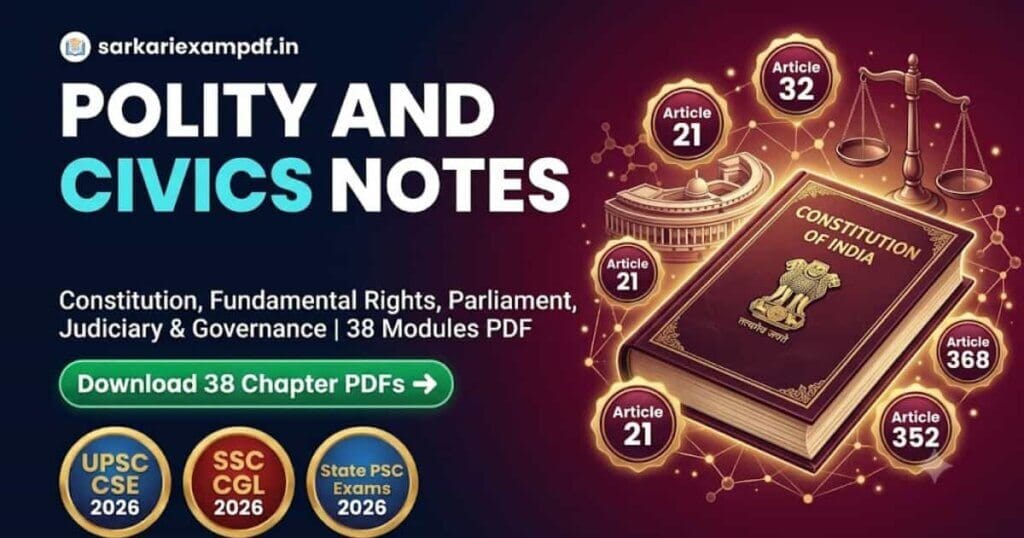
Overview: Polity and Civics Notes (Complete 38 Modules)
UPSC Civil Services Prelims & Mains (GS Paper 2), State PSCs, SSC (CGL, CHSL, CPO, GD), Railway (RRB NTPC, JE), CDS, NDA, aur Judicial examinations ke General Studies section me Indian Polity and Governance sabse high-weightage aur scoring vishay hai. Is Polity and Civics Notes master hub me Constitution making, Preamble, Fundamental Rights & Duties, Union & State Executives, Parliament, Supreme Court & High Courts, Constitutional Bodies, Emergency provisions, aur Local Self-Government ke sabhi 38 modules structured format me available hain.
Key Constitutional Pillars Covered in this 38-Module Set
- Constitutional Framework & Philosophy: Evolution of Indian Constitution, Constituent Assembly, Preamble, Sources of Constitution, Federal & Unitary features, Special features, Reorganization of States, and Citizenship.
- Rights, Duties & Directives: Fundamental Rights (Articles 12 to 35 & 5 Writs), Directive Principles of State Policy (DPSP Articles 36 to 51), and Fundamental Duties (Article 51A).
- Union & State Government: President, Vice-President, Prime Minister & Council of Ministers, Parliament (Lok Sabha & Rajya Sabha), Governor, State Executive, State Legislature, and Union Territories.
- Judiciary & Federal Bodies: Supreme Court, High Courts, Inter-State Council, National Integration Council, Delimitation Commission, Finance Commission, UPSC, Election Commission, and Planning/NDC bodies.
- Local Governance & Emergency Provisions: Panchayats (73rd Amendment), Municipalities (74th Amendment), National/State/Financial Emergency (Articles 352, 356, 360), and Constitutional Amendment Procedures (Article 368).
Sabhi subjects ke complete study materials aur notes download karne ke liye hamare central Competitive Exam Notes Master Hub ko zaroor access karein.
Must-Remember Constitutional Articles & Parts
| Part / Article | Subject Matter | Key Significance |
|---|---|---|
| Part III (Art 12–35) | Fundamental Rights | Justiciable rights enforceable by Supreme Court (Art 32) & High Courts (Art 226). |
| Part IV (Art 36–51) | Directive Principles of State Policy | Non-justiciable guidelines for establishing a welfare state (Socialist, Gandhian, Liberal-intellectual). |
| Part IVA (Art 51A) | Fundamental Duties | 11 Moral & civic obligations of citizens, added by 42nd & 86th Amendments. |
| Part IX & IXA | Panchayats & Municipalities | 3-tier local self-governance added via 73rd and 74th Constitutional Amendments (1992). |
| Article 280 | Finance Commission | Quinquennial constitutional body for tax devolution between Centre and States. |
| Article 324 | Election Commission of India | Superintendence, direction, and control of elections to Parliament and State Legislatures. |
| Article 368 | Power & Procedure of Amendment | Constituent power of Parliament to amend Constitution without altering its ‘Basic Structure’. |
High-Yield Practice Questions on Indian Polity
Apni preparation evaluate karne ke liye ye 5 selected standard exam questions solve karein:
Q1. The ‘Basic Structure Doctrine’ of the Indian Constitution was propounded by the Supreme Court in which landmark judgment?
Check Answer
Answer: Kesavananda Bharati vs. State of Kerala (1973). The 13-judge bench ruled that Parliament cannot alter the essential basic features of the Constitution under Article 368.
Q2. Which Constitutional Amendment is known as the ‘Mini-Constitution’ due to its sweeping comprehensive changes?
Check Answer
Answer: 42nd Constitutional Amendment Act, 1976. It added the words ‘Socialist, Secular, Integrity’ to the Preamble, inserted Part IVA (Fundamental Duties), and curtailed judicial powers.
Q3. Who presides over the Joint Sitting of both Houses of Parliament summoned by the President under Article 108?
Check Answer
Answer: Speaker of the Lok Sabha (in the absence of the Speaker, the Deputy Speaker of Lok Sabha presides; the Chairman of Rajya Sabha never presides).
Q4. The Inter-State Council was established under which Article of the Constitution and on the recommendation of which committee?
Check Answer
Answer: Established under Article 263 in 1990 on the recommendation of the Sarkaria Commission on Centre-State Relations.
Q5. Under which Article can the President promulgate State Emergency (President’s Rule) due to failure of constitutional machinery in a State?
Check Answer
Answer: Article 356 (read along with Article 365 for non-compliance with Union directions).
Download 38 Chapter-Wise Polity and Civics Notes PDF
Niche diye gaye constitutional topic buttons me se kisi par bhi click karein. 20-second timer ke baad direct Google Drive download link unlock ho jayega:
📜 Lapse of Paramountcy
Integration of princely states, Indian Independence Act 1947 & Sardar Patel’s diplomacy.
👤 Executive of Union: The President
Electoral college, election process, executive/legislative/judicial powers & impeachment (Art 61).
🏛️ Evolution of Indian Constitution
Constitutional historical landmarks: Regulating Act 1773, Charter Acts to GoI Act 1935.
📜 Making of the Constitution
Cabinet Mission plan, Drafting Committee, Dr. Ambedkar, debates & enactment dates.
🤝 Inter-State Relations
Inter-State river water disputes (Art 262), full faith & credit clause, and trade freedom.
🏛️ Inter-State Council (Art 263)
Composition, mandate, Sarkaria Commission recommendations & dispute resolution.
🏛️ The Parliament of India
Lok Sabha, Rajya Sabha, Speaker, Parliamentary committees, Budget procedure & Bills.
🇮🇳 National Integration Council (NIC)
Objectives, communal harmony mandate, regionalism management & advisory functions.
🚨 Emergency Provisions (Art 352-360)
National Emergency (352), President’s Rule (356), Financial Emergency (360) & 44th Amendment.
📊 National Development Council (NDC)
Planning Commission coordination, Five-Year Plan approvals & NITI Aayog transition.
⚖️ Fundamental Duties (Art 51A)
Swaran Singh Committee, 11 Fundamental Duties, 86th Amendment & non-justiciable status.
🗺️ Reorganization of States
Dhar Commission, JVP Committee, Fazal Ali Commission & States Reorganisation Act 1956.
🔄 Amending the Constitution (Art 368)
Simple majority, Special majority, Special majority with state ratification & basic structure.
📑 Important Constitutional Articles
Consolidated master handbook of high-frequency articles from Article 1 to Article 395.
📜 The Preamble
Objective Resolution (Nehru), Sovereign, Socialist, Secular, Democratic, Republic, Justice & Liberty.
🇮🇳 Integration & Merger of States
Accession of Junagadh, Hyderabad (Operation Polo), Kashmir & Privy purses abolition.
👤 Citizenship (Articles 5-11)
Acquisition & termination, Citizenship Act 1955, Single citizenship & dual citizenship concepts.
🇮🇳 National Symbols of India
National Flag (Tiranga), National Emblem, Anthem (Jana Gana Mana), Song, Calendar & Animals.
📜 Landmark Constitutional Amendments
1st, 7th, 24th, 42nd, 44th, 52nd (Anti-defection), 61st, 73rd, 86th, 101st (GST) to 106th Amendments.
🏔️ Special Position of J&K (History to Present)
Article 370 history, Article 35A, J&K Reorganisation Act 2019 & current UT status.
⚖️ The Supreme Court of India
Jurisdictions (Original, Appellate, Advisory Art 143), Collegium system & Judicial Review.
📖 Glossary of Constitutional Terms
Quorum, Guillotine, Prorogation, Adjournment Sine Die, Lame Duck session & Whip.
🗣️ Official Languages (8th Schedule)
Articles 343-351: Union official language, 22 recognized languages & Classical language status.
⚖️ Federal & Unitary Features
Quasi-federal character (K.C. Wheare), division of powers (7th Schedule) & Union tilt.
✨ Special Features of Constitution
Longest written constitution, blend of rigidity & flexibility, adult suffrage, secular state.
🏙️ Municipalities (74th Amendment)
Part IXA, 12th Schedule (18 functional items), Nagar Panchayats, Municipal Councils & Corporations.
🗺️ Delimitation Commission
Article 82 & 170, constituency redrawing, boundary commissions & constitutional freezes.
🏢 State Executive & Governor
Governor’s constitutional powers, Chief Minister, State Council of Ministers & Advocate General.
⚖️ Fundamental Rights (Part III)
Right to Equality (14-18), Freedom (19-22), Exploitation (23-24), Religion (25-28), Remedies (32).
🗺️ Union & Its Territory (Art 1-4)
India as a Union of States, admission or establishment of new states, boundary alterations.
🏛️ UPSC & State PSCs (Art 315-323)
Appointment, tenure, removal, functions & independence of Union & State Service Commissions.
🌾 Panchayats (73rd Amendment)
Part IX, 11th Schedule (29 functional subjects), Gram Sabha, Balwant Rai Mehta committee.
💰 Finance Commission (Art 280)
Composition, qualifications, revenue distribution criteria & 15th/16th Commission reports.
⚖️ The High Courts in India
Articles 214-231: Writ jurisdiction (Art 226), appointment of judges, transfers & subordinate courts.
📜 DPSP (Part IV, Art 36-51)
Irish origin, Socialist/Gandhian/Liberal principles, Uniform Civil Code (Art 44) & Panchayats (Art 40).
📊 Planning Commission & NITI Aayog
Extra-constitutional origins, Five-Year Plan history, NITI Aayog structure & cooperative federalism.
🌍 Sources of the Constitution
Borrowed provisions: UK, USA, Ireland, Canada, Australia, USSR, Germany, South Africa & 1935 Act.
🗳️ Elections in India & Election Commission (Master Module)
Part XV, Articles 324 to 329: Chief Election Commissioner, Model Code of Conduct, EVM/VVPAT, electoral reforms & Representation of the People Acts (RPA 1950 & 1951).
Indian Polity by M. Laxmikanth (Latest Edition)
The ultimate benchmark reference handbook for UPSC CSE, State PSCs & SSC CGL exams.
Parmar Sir SSC GK Batch Notes (Complete 8 Booklets)
Complete theory coverage for Indian Polity, History, Geography, Science & Static GK.
Disha 33 Year-wise SSC Solved Question Bank
Combined Graduate Level comprehensive polity & civics PYQs with authentic explanations.
Railway & SSC Samanya Vigyan & GK by Radhika Ma'am
General Awareness Theory + 2000+ Chapterwise PYQs for Railway & SSC CBTs.
📥 Join Our Social Channels for Daily Free Study Material
FAQs: Polity and Civics Notes
Q1: How many modules are included in these Polity and Civics Notes?
Ans: This handbook covers all 38 core modules of Indian Polity, from the framing of the Constitution to Fundamental Rights, Parliament, Supreme Court, Panchayati Raj, and Election Commission.
Q2: Are constitutional amendments and article tables included?
Ans: Yes, landmark amendments (42nd, 44th, 73rd, 86th, 101st) and high-frequency articles from Article 1 to Article 395 are structured in dedicated PDF chapters.
Q3: How do I download the Chapter-Wise Polity and Civics Notes PDFs on SarkariExamPDF?
Ans: Click on your preferred chapter card above, wait 20 seconds for the countdown timer to finish, and click the unlocked download button to access the Google Drive file.
Q4: Are these polity notes aligned with the UPSC CSE and State PSC syllabus?
Ans: Yes, all fundamental concepts, administrative frameworks, and standard reference materials (similar to M. Laxmikanth standards) are concisely summarized for revision.
- RRB Mechanical Engineering Notes PDF: 5 Solved Technical Modules

- RRB Civil Engineering Notes PDF: 8 Chapter-Wise Technical Modules
- RRB Electrical and Electronics Notes PDF: 7 Engineering Modules
- Computers Notes PDF: 16 Chapter-Wise Computer Awareness Modules
- English Language Notes PDF: 15 Chapter-Wise Grammar & Vocab Modules
- English Chapter Wise Notes PDF: 11 Solved Grammar & Vocab Modules
- Reasoning Notes PDF: 23 Chapter-Wise Solved Topic Modules
- Reasoning Verbal Notes PDF: 18 Chapter-Wise Solved Topic Modules
- General Awareness Chapter Wise PDF: Complete 7 Subject Modules
- Static GK Notes PDF: 36 Chapter-Wise General Knowledge Modules
- Economics Notes PDF: 15 Chapter-Wise Indian Economy Modules
- RRB Polity Notes PDF: 29 Chapter-Wise Railway Exam Study Modules
- Polity and Civics Notes PDF: 38 Chapter-Wise Indian Constitution Modules
- RRB General Science Chapter Wise PDF: Physics, Chemistry & Biology Notes
- Chemistry Notes PDF: 15 Chapter-Wise General Science Topics
- Arts and Culture Notes PDF: 8 Chapter-Wise Indian Heritage & Architecture Modules
- Physics Notes PDF: 23 Chapter-Wise General Science Topics
- World History Notes PDF: 34 Chapter-Wise Global History Modules
- Modern History Notes PDF: 15 Chapter-Wise Freedom Struggle Modules
- Medieval History Notes PDF: 6 Chapter-Wise Indian History Modules
- Ancient History Notes PDF: 7 Chapter-Wise Indian History Modules
- Geography Notes PDF: 46 Chapter-Wise Physical, Indian & World Geography Modules
- Environment Notes PDF: 13 Chapter-Wise Ecology & Biodiversity Modules
- Mathematics Chapter Wise Notes PDF: 14 Solved Math Topics for Competitive Exams
- Aptitude Notes PDF: 28 Chapter-Wise Quantitative Aptitude Topics
- Computer Basics Mcqs for Government Exams Notes+100 MCQs

- Reasoning Questions – Best Guide for Competitive Exams
- Gagan Pratap – Best Maths PDFs and Books for SSC & Competitive Exams

- Rakesh Yadav – Best Maths Books and PDFs for SSC & Competitive Exams
- Aditya Ranjan Sir – Best Maths & GK PDFs for Competitive Exams
- Piyush Sir Reasoning Book PDF – Best Resource for SSC, Banking & Other Competitive Exams
- Computer Questions for All Competitive Exams
- GENERAL STUDIES Complete 138 PDF Series: High-Yield Notes & Topic Booster
- QUANTITATIVE APTITUDE PDF Complete 133 Series: Arithmetic & Advanced Maths Notes
- REASONING PRACTICE SETS Complete 139 Series: Verbal & Non-Verbal PDF Notes
- Competitive Exam Notes PDF: Subject-Wise Complete Study Material




Exam Expert & Content Strategist with over 5+ years of experience in the competitive exam sector. I specialize in analyzing government recruitment patterns and simplifying complex syllabi for aspirants. Having helped thousands of students through Sarkari Exam PDF, my mission is to provide authentic, updated, and high-quality study materials for SSC, UPSC, Railways, and Banking exams to help every candidate achieve their career goals.
⚠️ Disclaimer: All study materials, notes, and PDFs shared on SarkariExamPDF.in are provided purely for educational and reference purposes to assist competitive exam aspirants. We do not claim ownership of any original books or official publications. If you are the rightful copyright owner and have any objection regarding any material, please contact us through our Contact Page for immediate removal.