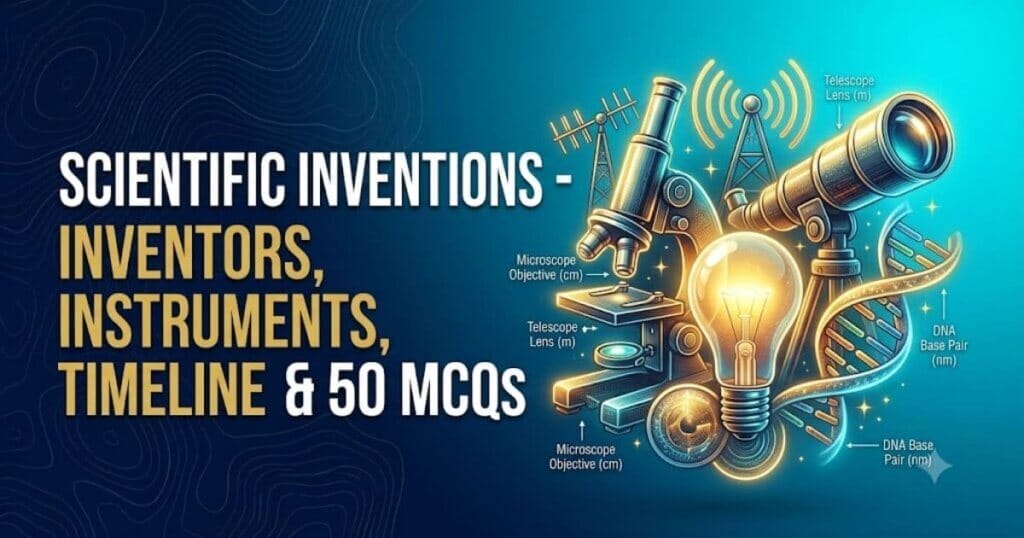
General Science (Static GK & Applied Science Section) | Target Exams: SSC CGL, CHSL, CPO, RRB NTPC, Group D, State PSCs & Police Exams
General Science ke Static GK segment me Scientific Inventions (वैज्ञानिक आविष्कार एवं खोजें) ek aisi direct scoring category hai jahan se TCS, NTA aur State Boards har saal seedhe factual sawal puchte hain. Physics ke instruments (Barometer, Seismograph, Galvanometer), Chemistry ki fundamental discoveries (Electrons, Protons, Periodic Table, Dynamite), Biology ki historic medical milestones (Penicillin, Vaccines, Blood Groups, Microscope), aur modern day telecommunication inventions (Radio, Telephone, Television, World Wide Web)—in sabhi ka accurate timeline aur unke aavishkarkon (inventors) ke baare me clear knowledge hona mandatory hai.
1. Scientific Inventions: Major Discoveries, Inventors & Instruments
A. Milestone Discoveries in Physics & Mechanical Inventions
| Invention / Discovery (आविष्कार / खोज) | Inventor / Scientist (वैज्ञानिक) | Year / Nationality | Scientific Application / Core Principle |
|---|---|---|---|
| Barometer (वायुदाबमापी) | Evangelista Torricelli | 1643 (Italy) | Atmospheric pressure measurement using mercury column |
| Steam Engine (Condensing) | James Watt | 1769 (Scotland) | Conversion of heat energy into mechanical work |
| Electric Battery (Voltaic Pile) | Alessandro Volta | 1800 (Italy) | Conversion of chemical energy into continuous electrical current |
| Electromagnetic Induction & Dynamo | Michael Faraday | 1831 (UK) | Generating electrical current via changing magnetic flux |
| X-Rays (एक्स-किरणें) | Wilhelm Conrad Röntgen | 1895 (Germany) | First Nobel Prize in Physics (1901); medical radiography |
| Radio & Wireless Telegraphy | Guglielmo Marconi | 1896 (Italy) | Transmission of sound through electromagnetic radio waves |
| Aeroplane (Power-driven flight) | Orville and Wilbur Wright | 1903 (USA) | Aerodynamic lift using internal combustion engine |
| Safety Lamp (Miner’s lamp) | Humphry Davy | 1815 (UK) | Wire gauze dissipating heat to prevent coal mine methane explosions |
B. Breakthrough Discoveries in Chemistry & Atomic Physics
- Electron: J.J. Thomson (1897) ne Cathode Ray tube experiments se negatively charged subatomic particle ‘Electron’ discover kiya (Plum Pudding atomic model).
- Proton: Ernest Rutherford (1917) ne alpha particle nitrogen collision se proton identify kiya (Positive charge naming). Eugen Goldstein ne 1886 me Canal rays (Anode rays) observe ki thi.
- Neutron: James Chadwick (1932) ne Beryllium foil par alpha bombardment karke neutral charge wala mass particle ‘Neutron’ discover kiya.
- Radioactivity: Henri Becquerel (1896) ne Uranium salts me spontaneous radiation discover ki. Marie Curie aur Pierre Curie ne Radium aur Polonium elements discover kiye.
- Dynamite: Alfred Nobel (1867) ne Nitroglycerin ko kieselguhr me absorb karake stable explosive ‘Dynamite’ invent kiya. Unhi ke will ke aadhar par Nobel Prizes shuru hue.
- Periodic Table: Dmitri Mendeleev (1869) ne atomic mass ke aadhar par 63 elements ka periodic law diya. Henry Moseley (1913) ne Atomic Number ke aadhar par Modern Periodic Table banayi.
C. Landmark Inventions in Biology & Medicine
| Discovery / Medical Milestone | Scientist | Key Significance |
|---|---|---|
| Smallpox Vaccine (First Vaccine) | Edward Jenner (1796) | Used cowpox virus; Father of Immunology |
| Rabies Vaccine & Pasteurization | Louis Pasteur (1885) | Germ theory of disease; heat treatment of milk |
| Penicillin (First Wonder Antibiotic) | Alexander Fleming (1928) | Discovered from Penicillium notatum fungus |
| Human ABO Blood Groups | Karl Landsteiner (1900) | Discovered A, B, O groups; won Nobel Prize in 1930 |
| Insulin Hormone (Diabetes Therapy) | Frederick Banting & Charles Best (1921) | Isolated from canine pancreatic islets |
| Polio Vaccines (Salk & Sabin) | Jonas Salk (1953 IPV) / Albert Sabin (1961 OPV) | Salk: Injectable killed virus; Sabin: Oral live-attenuated drops |
| Stethoscope | René Laennec (1816) | Acoustic auscultation of heart and lung sounds |
D. Important Scientific Measuring Instruments
- Altimeter: Aircraft me altitude (unchai) measure karne wala aneroid barometer.
- Anemometer: Wind speed aur direction measure karne ka instrument.
- Hygrometer: Vayumandal ki apekshik aadrata (relative humidity) mapne ka instrument.
- Hydrometer: Taral padarthon ka apekshik ghantva (specific gravity of liquids) mapne ka yantra.
- Lactometer: Doodh ki shuddhata aur ghantva mapne ka hydrometer.
- Sphygmomanometer: Manav sharir me blood pressure (rakt daab) mapne wala inflatable cuff yantra.
- Pyrometer: Door sthit uchh tapman (high temperatures like furnaces & sun) ko radiation dwara mapne wala yantra.
2. Exam Weightage & Trends Table
| Competitive Exam | Average Questions | Core High-Yield Focus Areas |
|---|---|---|
| SSC CGL / CHSL (Tier 1 & Tier 2) | 2 – 3 Questions | Nobel prize milestones (Roentgen, Fleming, Landsteiner), Subatomic particles (Thomson, Rutherford, Chadwick), Measuring instruments (Pyrometer, Sphygmomanometer). |
| RRB NTPC / Group D / ALP | 3 – 4 Questions | Vaccines (Edward Jenner, Louis Pasteur, Salk/Sabin), Barometer, Dynamo, Safety Lamp, Transformer (Faraday), Computer & Telephone inventors. |
| State PSCs (BPSC, UPPSC, MPPSC) | 2 – 4 Questions | Working principles of instruments (Sonar, Radar, Seismograph), Indian scientific pioneers (J.C. Bose, C.V. Raman, Homi Bhabha), Dynamite, Cement (Aspdin). |
| Defense & Police (NDA, CDS, Police SI) | 2 – 3 Questions | Radar (Robert Watson-Watt), Sonar, Nuclear reactor (Enrico Fermi), Jet engine (Frank Whittle), Ballistics and optics instruments. |
📥 Download Scientific Inventions Complete Study Notes PDF
Chronological inventions timeline, scientific measuring instruments dictionary, physics & chemistry discovery tables, and all 50 practice questions with complete solutions compiled in one offline revision PDF.
4. Recommended General Science Preparation Books
5. Frequently Asked Questions (FAQs)
Q1: Who discovered X-Rays and what was its significance in Nobel Prize history?
Ans: German physicist Wilhelm Conrad Röntgen discovered X-Rays in 1895 while experimenting with cathode-ray tubes. In recognition of this monumental discovery, which revolutionized medical diagnostic imaging and modern crystallography, Röntgen was awarded the very first Nobel Prize in Physics in 1901.
Q2: Who were the scientists responsible for discovering the three fundamental subatomic particles?
Ans: The three subatomic particles were discovered by: (1) Electron: J.J. Thomson (1897) through cathode ray discharge tube experiments; (2) Proton: Ernest Rutherford (1917) through alpha particle bombardment experiments (anode rays observed earlier by Goldstein in 1886); and (3) Neutron: James Chadwick (1932) through alpha particle bombardment on beryllium.
Q3: What is the difference between a Hygrometer and a Hydrometer?
Ans: A Hygrometer is a meteorological instrument designed to measure the moisture content or relative humidity of air and gases. A Hydrometer is an instrument based on Archimedes’ principle of flotation designed to measure the specific gravity or relative density of liquids (e.g., lactometer for milk or battery acid tester).
Q4: Who discovered the wonder antibiotic Penicillin and how was it discovered?
Ans: Scottish bacteriologist Sir Alexander Fleming discovered Penicillin in 1928 at St. Mary’s Hospital in London. It was an accidental discovery when he observed that a contaminating mould identified as Penicillium notatum produced a chemical secretion that inhibited and dissolved surrounding staphylococcal bacterial colonies.
- Nutrition and Vitamins Notes PDF: Deficiency & 50 MCQs

- Scientific Inventions Notes PDF: Discoveries & 50 MCQs
- Pollution Basics Notes PDF: Air, Water, Soil & 50 MCQs
- Vaccination and Immunization Notes PDF: Types, Schedule & 50 MCQs
- Magnetism Basics Notes & 50 Practice MCQs for SSC & Banking

Exam Expert & Content Strategist with over 5+ years of experience in the competitive exam sector. I specialize in analyzing government recruitment patterns and simplifying complex syllabi for aspirants. Having helped thousands of students through Sarkari Exam PDF, my mission is to provide authentic, updated, and high-quality study materials for SSC, UPSC, Railways, and Banking exams to help every candidate achieve their career goals.
⚠️ Disclaimer: All study materials, notes, and PDFs shared on SarkariExamPDF.in are provided purely for educational and reference purposes to assist competitive exam aspirants. We do not claim ownership of any original books or official publications. If you are the rightful copyright owner and have any objection regarding any material, please contact us through our Contact Page for immediate removal.