Human Digestive System Notes PDF: Enzymes, Organs & 50 MCQs

Human-Digestive-System

General Science (Human Physiology Section) | Target Exams: SSC CGL, CHSL, CPO, RRB NTPC, Group D, State PSCs & CDS

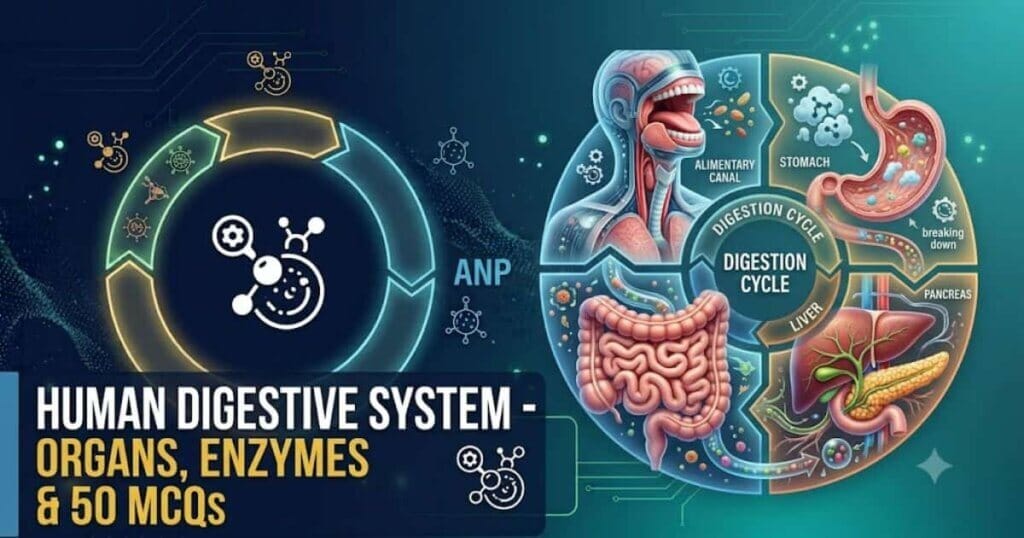
Human Biology me Human Digestive System (मानव पाचन तंत्र) ek ultra high-yielding aur core functional topic hai. Bhojan ke antargrahan (Ingestion) se lekar digestion, absorption, assimilation aur egestion tak—alag-alag digestive organs aur enzymes ek coordinated cascade me kaam karte hain. Mukh guha (oral cavity) me ptyalin dwara starch ke digestion se lekar aamashay (stomach) ke acid-pepsin action, liver ke bile juice, pancreas ke digestive enzymes aur small intestine ke villi dwara nutrient absorption tak, har competitive exam me yahan se conceptual aur direct factual sawal aate hain.

💡 Exam Pointer: Alimentary canal (Aahar Naal) ki kul lambai lagbhag 9 meters (lagbhag 30 feet) hoti hai. Iska sabse lamba hissa Small Intestine (Chhoti Aant ~ 6 meters) hota hai jahan lagbhag 90% digestion aur absorption complete hota hai.

1. Digestive System Core: Organs, Secretions & Biochemical Cascade

A. The Alimentary Canal: Organ-by-Organ Breakdown

  • Mouth & Buccal Cavity: Mechanical breakdown via teeth. Dental formula for adult humans is:
    Adult Dental Formula: $\frac{2\ 1\ 2\ 3}{2\ 1\ 2\ 3} \times 2 = 32$ (Incisors: 8, Canines: 4, Premolars: 8, Molars: 12).
    Child (Milk Teeth) Formula: $\frac{2\ 1\ 0\ 2}{2\ 1\ 0\ 2} \times 2 = 20$ (Premolars absent hote hain).
    Salivary glands (3 pairs: Parotid, Submandibular, Sublingual) din bhar me lagbhag 1-1.5 L saliva secret karti hain (pH ~6.8). Isme Salivary Amylase (Ptyalin) aur antibacterial enzyme Lysozyme hota hai.
  • Stomach (Aamashay): J-shaped muscular sac jisme food 4-5 hours retain hota hai (Chyme form me).
    • Oxyntic / Parietal cells: Hydrochloric acid ($HCl$, pH 1.5 – 2.5) aur Castle’s Intrinsic Factor (Vitamin B12 absorption ke liye anivarya) release karti hain.
    • Chief / Peptic cells: Inactive proenzymes Pepsinogen aur Prorennin release karti hain. $HCl$ pepsinogen ko active Pepsin me convert karta hai jo proteins ko proteoses aur peptones me todta hai.
    • Mucus Neck cells: Alkaline mucus secret karti hain jo stomach wall ko $HCl$ se autolysis hone se bachati hai.
  • Small Intestine (Chhoti Aant): 3 parts: C-shaped Duodenum (shortest), coiled Jejunum, aur highly coiled Ileum. Ileum me finger-like projections hote hain jinhe Villi & Microvilli kehte hain, jo absorption surface area lagbhag 600 times badha dete hain. Fat absorption lacteals (lymph vessels) ke through hota hai.
  • Large Intestine (Badi Aant): Cecum, Colon (ascending, transverse, descending, sigmoid), aur Rectum. Yahan water, minerals aur certain drugs ka absorption hota hai. Cecum se ek vestigial organ juda hota hai jise Vermiform Appendix kehte hain.

B. Master Table of Digestive Enzymes & Secretions

Source Gland / JuiceEnzyme / SecretionSubstrate (Target Nutrient)End Product (Pachit Roop)
Saliva (Mouth, pH 6.8)Salivary Amylase (Ptyalin)Starch (Carbohydrate ~30%)Maltose (Disaccharide)
Gastric Juice (Stomach, pH 1.5–2)PepsinProteinsProteoses and Peptones
Gastric Juice (Infants)Rennin (Chymosin)Casein (Milk protein)Paracasein (Curdling of milk)
Liver (Bile Juice, pH 7.8–8.6)Bile Salts (No enzymes!)Fat globulesEmulsified Fats (Micelles)
Pancreatic Juice (pH 7.8–8.4)Trypsinogen (activated by Enterokinase)Proteins, PeptonesDipeptides
Pancreatic JuicePancreatic Amylase (Amylopsin)Starch / GlycogenMaltose
Pancreatic JuicePancreatic Lipase (Steapsin)Emulsified FatsDiglycerides & Monoglycerides
Intestinal Juice (Succus Entericus, pH 7.8)Maltase, Sucrase, LactaseMaltose, Sucrose, LactoseGlucose, Fructose, Galactose
Intestinal JuiceDipeptidases & Intestinal LipaseDipeptides & MonoglyceridesAmino Acids, Fatty Acids & Glycerol

C. Key Associated Glands & Biochemical Facts

  • Liver (Yakrit): Largest gland in human body (weight ~1.2 to 1.5 kg). Iske paas highest regeneration power hoti hai. Ye Bile Juice banata hai jo gallbladder me store aur concentrate hota hai. Bile juice me koi bhi digestive enzyme nahi hota, par isme bile pigments (Bilirubin, Biliverdin) aur bile salts (Sodium glycocholate, Sodium taurocholate) hote hain jo fat emulsification ke liye anivarya hain.
  • Pancreas (Agnyashay): Compound heterocrine / mixed gland (endocrine + exocrine). Exocrine part pancreatic juice nikalta hai jise “Complete Digestive Juice” kehte hain kyunki isme carbohydrates, proteins aur fats teeno ko pachane wale enzymes hote hain. Endocrine part (Islets of Langerhans) se Insulin (Beta cells) aur Glucagon (Alpha cells) nikalte hain.

3. 50 Practice MCQs: Human Digestive System

Standard Level: SSC CGL Tier 1/2, RRB NTPC & State PSCs | Bilingual (English & Hindi) | Submit at Bottom

Q1. In which part of the human alimentary canal does the chemical digestion of carbohydrates begin?
मानव आहार नाल के किस भाग में कार्बोहाइड्रेट का रासायनिक पाचन प्रारंभ होता है?
Solution: (B) कार्बोहाइड्रेट का पाचन मुख गुहा में लार में उपस्थित टायलिन (लार एमाइलेज) एंजाइम द्वारा शुरू होता है, जो स्टार्च को माल्टोज़ में बदलता है।
Q2. What is the standard dental formula of a normal adult human being?
एक सामान्य वयस्क मनुष्य का मानक दंत सूत्र क्या है?
Solution: (C) वयस्क मानव का दंत सूत्र 2123/2123 होता है (2 कृंतक, 1 रदनक, 2 अग्रचर्वणक, 3 चर्वणक प्रति जबड़ा अर्धभाग)। बच्चों में यह 2102/2102 होता है (अग्रचर्वणक अनुपस्थित)।
Q3. Which cells in the gastric glands secrete Hydrochloric Acid (HCl) and Castle’s Intrinsic Factor?
जठर ग्रंथियों की कौन सी कोशिकाएं हाइड्रोक्लोरिक अम्ल (HCl) और कैसल के आंतरिक कारक का स्राव करती हैं?
Solution: (A) पैराइटल या ऑक्सिंटिक कोशिकाएं HCl (जो माध्यम को अम्लीय बनाता है) और आंतरिक कारक (जो विटामिन B12 के अवशोषण के लिए आवश्यक है) स्रावित करती हैं।
Q4. Which of the following digestive juices contains NO digestive enzymes at all?
निम्नलिखित में से किस पाचक रस में कोई भी पाचक एंजाइम नहीं पाया जाता है?
Solution: (D) यकृत द्वारा स्रावित पित्त रस (Bile juice) में कोई एंजाइम नहीं होता, लेकिन इसमें पित्त लवण होते हैं जो वसा के इमल्सीकरण (Emulsification) के लिए अनिवार्य हैं।
Q5. Where is bile juice produced and where is it stored and concentrated respectively?
पित्त रस का निर्माण कहाँ होता है तथा इसका संचयन और सांद्रण कहाँ होता है?
Solution: (B) पित्त रस का उत्पादन यकृत (Liver) की हेपेटिक कोशिकाओं द्वारा होता है और इसका संचय व सांद्रण पित्ताशय (Gallbladder) में होता है।
Q6. Which enzyme present in saliva acts as an antibacterial agent to prevent oral infections?
लार में मौजूद कौन सा एंजाइम जीवाणुरोधी एजेंट के रूप में कार्य करके संक्रमण को रोकता है?
Solution: (C) लार और आंसुओं में लाइसोजाइम (Lysozyme) एंजाइम होता है जो बैक्टीरिया की कोशिका भित्ति (पेप्टिडोग्लाइकन) को तोड़कर जीवाणुओं को नष्ट करता है।
Q7. The major site of complete digestion and nutrient absorption in the human body is:
मानव शरीर में भोजन के पूर्ण पाचन और पोषक तत्वों के अवशोषण का मुख्य स्थल कौन सा है?
Solution: (A) छोटी आंत (विशेष रूप से इलियम और जेजुनम) में विलाई और माइक्रोविलाई की सहायता से लगभग 90% पोषक तत्वों का अंतिम पाचन और अवशोषण संपन्न होता है।
Q8. Which enzyme converts inactive Trypsinogen into active Trypsin in the duodenum?
ग्रहणी में अक्रिय ट्रिप्सिनोजेन को सक्रिय ट्रिप्सिन में कौन सा एंजाइम परिवर्तित करता है?
Solution: (D) आंत के म्यूकोसा द्वारा स्रावित एंटरोकाइनेज (Enterokinase) एंजाइम अग्न्याशयी रस के अक्रिय ट्रिप्सिनोजेन को सक्रिय ट्रिप्सिन में बदलता है।
Q9. Emulsification of dietary fats is carried out primarily by:
आहार में उपस्थित वसा का पायसीकरण (Emulsification) मुख्य रूप से किसके द्वारा किया जाता है?
Solution: (B) पित्त लवण (सोडियम ग्लाइकोकोलेट व टॉरोकोलेट) वसा की बड़ी बूंदों को छोटी मिसेल्स में तोड़ते हैं, जिससे लाइपेज एंजाइम के कार्य करने हेतु पृष्ठीय क्षेत्रफल बढ़ जाता है।
Q10. The milk protein ‘Casein’ is coagulated and curdled in infant stomach by which enzyme?
शिशुओं के आमाशय में दूध के प्रोटीन ‘कैसिइन’ का थक्का जमाने और पचाने का कार्य कौन सा एंजाइम करता है?
Solution: (C) नवजात शिशुओं के जठर रस में रेनिन (Rennin) नामक प्रोटियोलिटिक एंजाइम होता है जो दूध प्रोटीन कैसिइन को पैराकैसिइन में बदलकर उसका पाचन सुगम बनाता है।
Q11. The wave-like involuntary muscular contractions that propel food along the alimentary canal are called:
आहार नाल में भोजन को आगे बढ़ाने वाली तरंग जैसी अनैच्छिक पेशीय गति को क्या कहते हैं?
Solution: (A) आहार नाल की चिकनी पेशियों के क्रमिक संकुचन और शिथिलन को क्रमाकुंचन (Peristalsis) कहते हैं, जो भोजन के बोलस को नीचे की ओर धकेलता है।
Q12. What is the hardest biological substance in the human body covering the tooth crown?
दांत के मुकुट (क्राउन) को ढकने वाला मानव शरीर का सबसे कठोर जैविक पदार्थ कौन सा है?
Solution: (D) दांत का इनेमल (Enamel) शरीर का सबसे कठोर पदार्थ है, जो मुख्यतः हाइड्रोक्सीएपेटाइट (कैल्शियम फॉस्फेट क्रिस्टल) से बना होता है और अमीलोब्लास्ट कोशिकाओं द्वारा स्रावित होता है।
Q13. In which part of the small intestine do the common bile duct and pancreatic duct open together?
पित्त वाहिनी और अग्न्याशयी वाहिनी संयुक्त होकर छोटी आंत के किस भाग में खुलती हैं?
Solution: (B) हेपेटो-अग्न्याशयी वाहिनी (Ampulla of Vater) ‘स्फिंक्टर ऑफ ओड्डी’ (Sphincter of Oddi) द्वारा नियंत्रित होकर छोटी आंत के C-आकार के भाग यानी ग्रहणी (Duodenum) में खुलती है।
Q14. The intestinal juice secreted by the crypts of Lieberkühn is scientifically known as:
लीबरकुन की दरारों (Crypts of Lieberkühn) द्वारा स्रावित आंत्रीय रस को वैज्ञानिक रूप से क्या कहा जाता है?
Solution: (C) आंतों की म्यूकोसा और ब्रूनर ग्रंथियों के संयुक्त स्राव को ‘सक्कस एंटेरिकस’ (Succus entericus / आंत्रीय रस) कहते हैं, जिसका pH लगभग 7.8 (क्षारीय) होता है।
Q15. Brunner’s glands, which secrete alkaline mucus to protect duodenum from gastric acid, are located in:
ग्रहणी को आमाशय के अम्ल से बचाने के लिए क्षारीय श्लेष्म स्रावित करने वाली ब्रूनर ग्रंथियां कहाँ स्थित होती हैं?
Solution: (A) ब्रूनर की ग्रंथियां (Brunner’s glands) ग्रहणी की सबम्यूकोसा परत में पाई जाती हैं जो क्षारीय तरल निकालकर आमाशय से आने वाले खट्टे काइम को उदासीन बनाती हैं।
Q16. Digested dietary fats and fatty acids are absorbed into specialized lymph capillaries in villi called:
पाचित वसा और फैटी एसिड का अवशोषण विलाई में स्थित किन विशेष लसीका केशिकाओं में होता है?
Solution: (D) वसा सीधे रक्त वाहिकाओं में नहीं जा सकती, अतः इसे काइलोमाइक्रोन के रूप में आंत के अंकुरों (Villi) में उपस्थित केंद्रीय लसीका वाहिका ‘लेक्टियल’ (Lacteal) में अवशोषित किया जाता है।
Q17. Which sphincter muscle controls the passage of food from the stomach into the duodenum?
आमाशय से ग्रहणी में भोजन के निकास को कौन सी संवरणी पेशी (Sphincter) नियंत्रित करती है?
Solution: (B) आमाशय के निचले भाग (Pylorus) पर पाइलोरिक संवरणी (Pyloric sphincter) स्थित होती है जो भोजन को थोड़ी-थोड़ी मात्रा में ग्रहणी में जाने देती है।
Q18. The semi-digested acidic pulpy food mass leaving the stomach is scientifically termed:
आमाशय से निकलने वाला अर्ध-पाचित अम्लीय लेई जैसा भोजन वैज्ञानिक रूप से क्या कहलाता है?
Solution: (C) मुख से चबाए भोजन को ‘बोलस’ कहते हैं, आमाशय के पाचित अम्लीय रूप को ‘काइम’ (Chyme) कहते हैं, और आंत में पाचित क्षारीय वसायुक्त तरल को ‘काइल’ (Chyle) कहते हैं।
Q19. Jaundice (पीलिया) is a clinical disorder associated with abnormal function of which organ?
पीलिया (Jaundice) किस अंग की असामान्य कार्यप्रणाली से संबंधित एक नैदानिक विकार है?
Solution: (A) पीलिया यकृत का रोग है जिसमें यकृत पित्त वर्णक बिलीरुबिन (Bilirubin) को ठीक से उत्सर्जित नहीं कर पाता, जिससे रक्त में बिलीरुबिन बढ़कर त्वचा और आंखों को पीला कर देता है।
Q20. Pancreatic lipase, which hydrolyzes dietary fats into fatty acids and glycerol, is also known as:
अग्न्याशयी लाइपेज, जो वसा को फैटी एसिड और ग्लिसरॉल में तोड़ता है, किस अन्य नाम से जाना जाता है?
Solution: (D) अग्न्याशयी रस के पाचक एंजाइमों में लाइपेज को स्टिएप्सिन (Steapsin) और अग्न्याशयी एमाइलेज को एमाइलोप्सिन (Amylopsin) भी कहा जाता है।
Q21. The blind sac located at the junction of the small and large intestine harboring symbiotic bacteria is:
छोटी और बड़ी आंत के जोड़ पर स्थित वह अंध थैली जिसमें सहजीवी जीवाणु पाए जाते हैं, क्या कहलाती है?
Solution: (B) सीकम (Caecum) बड़ी आंत का प्रारंभिक अंध थैली जैसा भाग है जिसमें सहजीवी सूक्ष्मजीव रहते हैं। इसी से कृमिरूप परिशेषिका (Vermiform Appendix) निकलती है।
Q22. Which hormone stimulates the gallbladder to contract and release concentrated bile into duodenum?
कौन सा हार्मोन पित्ताशय को संकुचित करके ग्रहणी में पित्त रस छोड़ने के लिए उत्तेजित करता है?
Solution: (A) ग्रहणी की दीवारों द्वारा स्रावित कोलेसिस्टोकाइनिन (CCK) पित्ताशय को संकुचित करता है और अग्न्याशय को पाचक एंजाइम निकालने के लिए प्रेरित करता है।
Q23. Which was the very first hormone discovered in the animal body (discovered by Bayliss and Starling in 1902)?
1902 में बेलिस और स्टारलिंग द्वारा खोजा गया जंतु शरीर का सबसे पहला हार्मोन कौन सा था?
Solution: (C) सीक्रेटिन (Secretin) पहला खोजा गया हार्मोन है। यह ग्रहणी म्यूकोसा द्वारा स्रावित होकर अग्न्याशय को पानी और बाइकार्बोनेट आयन स्रावित करने के लिए उत्तेजित करता है।
Q24. In the absence of Enterokinase enzyme, the digestion of which macromolecule will be most severely impaired?
एंटरोकाइनेज एंजाइम की अनुपस्थिति में किस पोषक तत्व का पाचन सबसे गंभीर रूप से बाधित होगा?
Solution: (B) एंटरोकाइनेज ट्रिप्सिनोजेन को सक्रिय ट्रिप्सिन में बदलता है, जो आगे चलकर काइमोट्रिप्सिन और प्रोकार्बोक्सीपेप्टिडेस को सक्रिय करता है। इसके बिना प्रोटीन पाचन रुक जाएगा।
Q25. Which vein transports absorbed water-soluble nutrients from the intestine directly to the liver?
कौन सी शिरा आंत से अवशोषित जल-घुलनशील पोषक तत्वों को सीधे यकृत तक ले जाती है?
Solution: (D) हेपेटिक पोर्टल वेन (Hepatic Portal Vein) पाचन तंत्र से पोषक तत्वों से भरपूर रक्त को हृदय में जाने से पहले यकृत में ले जाती है ताकि ग्लूकोज का नियमन और विषहरण हो सके।
Q26. What is the approximate pH of human saliva secreted under normal resting conditions?
सामान्य विश्राम अवस्था में स्रावित मानव लार का अनुमानित pH मान कितना होता है?
Solution: (A) मानव लार का औसत pH लगभग 6.8 होता है, जिस पर लार एमाइलेज (Ptyalin) स्टार्च को पचाने के लिए सबसे सक्रिय कार्य करता है।
Q27. The cartilaginous flap that prevents the entry of swallowed food into the trachea (windpipe) is the:
भोजन निगलते समय श्वासनली (विंडपाइप) में भोजन के प्रवेश को रोकने वाला उपास्थिमय फ्लैप क्या कहलाता है?
Solution: (C) एपिग्लोटिस (घांटी ढक्कन) लोचदार उपास्थि का बना होता है जो निगलने के दौरान ग्लॉटिस को ढक देता है, जिससे भोजन श्वासनली में न जाकर ग्रसनली में जाता है।
Q28. Conversion of excess toxic ammonia into non-toxic urea (Ornithine Cycle) takes place in which organ?
अत्यधिक विषैले अमोनिया को कम विषैले यूरिया में बदलने का कार्य (ऑर्निथिन चक्र) किस अंग में संपन्न होता है?
Solution: (B) यकृत (Liver) में ऑर्निथिन या यूरिया चक्र द्वारा प्रोटीन अपघटन से बनी अमोनिया को यूरिया में बदला जाता है, जिसे बाद में किडनी छानकर मूत्र द्वारा बाहर निकालती है।
Q29. Kupffer cells, specialized phagocytic macrophages that destroy worn-out RBCs and microbes, are located in:
कुफ़्फ़र कोशिकाएं (Kupffer cells), जो मृत RBC और जीवाणुओं को नष्ट करती हैं, किस अंग में पाई जाती हैं?
Solution: (D) कुफ़्फ़र कोशिकाएं (Kupffer cells) यकृत की साइनोसॉइड्स में स्थित विशेष मैक्रोफेज हैं जो रक्त को साफ करती हैं और पुराने बैक्टीरिया व टूटी आरबीसी का भक्षण करती हैं।
Q30. Kwashiorkor and Marasmus are severe nutritional deficiency disorders caused primarily by the lack of:
क्वाशिओरकोर और मरास्मस किस पोषक तत्व की गंभीर कमी के कारण होने वाले कुपोषण विकार हैं?
Solution: (A) क्वाशिओरकोर केवल प्रोटीन की कमी से होता है (सूजन व उभरा पेट), जबकि मरास्मस प्रोटीन और कुल कैलोरी दोनों की गंभीर कमी से होता है (मांसपेशियों का अत्यधिक क्षय)।
Q31. Which of the following teeth types are completely absent in human temporary (milk) dentition?
मानव के अस्थायी (दूध के) दांतों में निम्नलिखित में से कौन से दांत पूरी तरह अनुपस्थित होते हैं?
Solution: (C) बच्चों के दूध के दांतों में अग्रचर्वणक (Premolars) बिल्कुल नहीं होते हैं (दंत सूत्र: 2102/2102)। ये केवल स्थायी दंत विन्यास में ही निकलते हैं।
Q32. How many pairs of salivary glands are present in the human buccal cavity?
मानव मुख गुहा में कितने जोड़ी लार ग्रंथियां उपस्थित होती हैं?
Solution: (B) मानव में 3 जोड़ी लार ग्रंथियां होती हैं: पैरोटिड (गाल के पास – सबसे बड़ी), सबमैंडिबुलर (निचले जबड़े के पास), और सबलिंगुअल (जीभ के नीचे)।
Q33. Surgical removal of the stomach (Gastrectomy) in humans impairs the absorption of which essential vitamin?
शल्य चिकित्सा द्वारा आमाशय को हटाने (Gastrectomy) पर किस आवश्यक विटामिन का अवशोषण गंभीर रूप से बाधित होता है?
Solution: (D) आमाशय की पैराइटल कोशिकाएं ‘कैसल का आंतरिक कारक’ बनाती हैं। आमाशय हटने पर आंतरिक कारक नहीं बनता, जिससे इलियम में विटामिन B12 अवशोषित नहीं होता और घातक रक्ताल्पता (Pernicious Anemia) हो जाती है।
Q34. The yellow color of human feces (मल) is due to the presence of which degradation byproduct of bile?
मानव मल का विशिष्ट पीला-भूरा रंग पित्त वर्णक के किस अपघटन उत्पाद के कारण होता है?
Solution: (A) यकृत के पित्त वर्णक बिलीरुबिन को आंतों के बैक्टीरिया स्टर्कोबिलिनोजेन और अंततः स्टर्कोबिलिन (Stercobilin) में बदल देते हैं, जिससे मल का रंग भूरा-पीला होता है। मूत्र का पीला रंग यूरोक्रोम से होता है।
Q35. The longest individual anatomical portion of the human small intestine is the:
मानव छोटी आंत का सबसे लंबा व्यक्तिगत शारीरिक भाग कौन सा है?
Solution: (C) इलियम (Ileum) छोटी आंत का अंतिम और सबसे लंबा भाग है (लगभग 3.5 मीटर लंबा)। ग्रहणी (~25 सेमी) सबसे छोटी और जेजुनम (~2.5 मीटर) मध्य भाग होता है।
Q36. Gallstones (cholelithiasis) are crystalline concretions predominantly composed of accumulated:
पित्ताशय की पथरी (Gallstones) मुख्य रूप से किसके संचय और क्रिस्टलीकरण से बनती है?
Solution: (B) अधिकांश पित्त की पथरियां पित्त में अत्यधिक कोलेस्ट्रॉल के अवक्षेपण से बनती हैं। (गुर्दे की पथरी मुख्यतः कैल्शियम ऑक्सालेट की बनी होती है)।
Q37. Which human tooth type is specially modified with sharp pointed edges for tearing flesh in carnivores?
मांसाहारियों में मांस को चीरने-फाड़ने के लिए नुकीले किनारों वाले कौन से दांत विशेष रूप से अनुकूलित होते हैं?
Solution: (D) कैनिन (रदनक) दांत नुकीले और मजबूत होते हैं जिनका प्राथमिक कार्य भोजन को चीरना-फाड़ना होता है। कृंतक (Incisors) काटने का और चर्वणक चबाने का काम करते हैं।
Q38. The viral infection ‘Mumps’ causes painful swelling of which salivary gland?
वायरल संक्रमण ‘गलसुआ’ (Mumps) किस लार ग्रंथि में दर्दनाक सूजन का कारण बनता है?
Solution: (A) गलसुआ (Mumps) पैरामिक्सोवायरस संक्रमण है जो कान के ठीक नीचे स्थित सबसे बड़ी लार ग्रंथि यानी पैरोटिड ग्रंथि (Parotid gland) में सूजन लाता है।
Q39. The enzyme Maltase breaks down one molecule of Maltose into:
माल्टेज एंजाइम माल्टोज़ के एक अणु को किसमें जल-अपघटित करता है?
Solution: (C) माल्टेज माल्टोज़ को 2 ग्लूकोज अणुओं में तोड़ता है। सुक्रेज सुक्रोज को ग्लूकोज + फ्रुक्टोज में तोड़ता है, और लैक्टेज लैक्टोज को ग्लूकोज + गैलेक्टोज में तोड़ता है।
Q40. Pancreatic juice is referred to as the ‘Complete Digestive Juice’ primarily because:
अग्न्याशयी रस को ‘पूर्ण पाचक रस’ क्यों कहा जाता है?
Solution: (B) अग्न्याशयी रस में ट्रिप्सिन (प्रोटीन), एमाइलेज (कार्बोहाइड्रेट), लाइपेज (वसा) और न्यूक्लिएज (न्यूक्लिक अम्ल) सभी पोषक तत्वों को पचाने वाले एंजाइम उपस्थित होते हैं।
Q41. Gastric ulcers are most commonly caused by bacterial infection of which microorganism?
आमाशय के अल्सर (पेप्टिक अल्सर) मुख्य रूप से किस जीवाणु के संक्रमण के कारण होते हैं?
Solution: (D) रॉबिन वॉरेन और बैरी मार्शल ने खोजा कि अधिकांश पेप्टिक अल्सर Helicobacter pylori बैक्टीरिया के संक्रमण से आमाशय की म्यूकोसा परत टूटने के कारण होते हैं।
Q42. Which tissue anchors the tongue to the floor of the oral cavity?
जीभ को मुख गुहा के फर्श से जोड़ने वाला संयोजी ऊतक क्या कहलाता है?
Solution: (A) जीभ एक पेशीय अंग है जो अपने पिछले आधार पर मुख गुहा के फर्श से ‘लिंगुअल फ्रीनुलम’ (Frenulum) नामक लचीली श्लेष्म तह द्वारा जुड़ी होती है।
Q43. The primary physiological function of the human Large Intestine is the absorption of:
मानव बड़ी आंत का प्राथमिक कार्य किसका अवशोषण करना है?
Solution: (C) बड़ी आंत में कोई महत्वपूर्ण पाचन क्रिया नहीं होती; इसका मुख्य कार्य अपचित कचरे से पानी, खनिजों और कुछ दवाओं का अवशोषण कर मल तैयार करना है।
Q44. Which vitamin is synthesized endogenously by symbiotic bacteria residing in the human colon?
मानव बड़ी आंत (कोलन) में रहने वाले सहजीवी बैक्टीरिया द्वारा किस विटामिन का संश्लेषण किया जाता है?
Solution: (B) बड़ी आंत में मौजूद E. coli जैसे सहजीवी बैक्टीरिया रक्त का थक्का जमाने के लिए आवश्यक विटामिन K तथा कुछ मात्रा में विटामिन B12 व बायोटिन का संश्लेषण करते हैं।
Q45. The functional structural units of the human liver are microscopic hexagons termed:
मानव यकृत की संरचनात्मक और कार्यात्मक इकाइयां क्या कहलाती हैं?
Solution: (D) यकृत की मूलभूत इकाइयां ‘हेपेटिक लोब्यूल्स’ (Hepatic lobules) हैं, जो पतले संयोजी ऊतक आवरण ‘ग्लिसन्स कैप्सूल’ (Glisson’s capsule) से ढकी होती हैं।
Q46. The duct that drains bile from the gallbladder to join the common hepatic duct is the:
पित्ताशय से पित्त को बाहर निकालकर सामान्य यकृत वाहिनी से जोड़ने वाली वाहिनी कौन सी है?
Solution: (A) पित्ताशय की वाहिनी को सिस्टिक डक्ट (Cystic duct) कहते हैं, जो यकृत से आने वाली हेपेटिक डक्ट से मिलकर ‘कॉमन बाइल डक्ट’ (CBD) बनाती है।
Q47. Starch is chemically converted to Maltose by salivary amylase at which optimum pH?
लार एमाइलेज द्वारा स्टार्च को माल्टोज़ में बदलने की रासायनिक क्रिया किस अनुकूलतम pH पर होती है?
Solution: (C) टायलिन (Salivary Amylase) का इष्टतम pH 6.8 होता है। जैसे ही भोजन आमाशय में पहुँचता है, $HCl$ (pH 1.5-2.0) टायलिन को निष्क्रिय कर देता है।
Q48. The muscular sphincter present at the opening of the stomach from the esophagus is the:
ग्रसनली और आमाशय के जोड़ पर स्थित संवरणी पेशी कौन सी है जो भोजन के उल्टे प्रवाह को रोकती है?
Solution: (B) कार्डियक या गैस्ट्रोएसोफेगल स्फिंक्टर ग्रसनली से आमाशय में भोजन के प्रवेश को नियंत्रित करता है और एसिड रिफ्लक्स (Heartburn) को रोकता है।
Q49. Which organ of the human body has the highest capacity for cellular regeneration?
मानव शरीर के किस अंग में कोशिकीय पुनर्जनन (Regeneration) की क्षमता सर्वाधिक होती है?
Solution: (D) यकृत (Liver) में असाधारण पुनर्जनन क्षमता होती है; यदि इसका 70% भाग शल्य चिकित्सा द्वारा हटा भी दिया जाए, तो यह कुछ ही हफ्तों में सामान्य आकार में विकसित हो जाता है।
Q50. The correct sequence of the five major steps in animal nutrition and digestion is:
जंतु पोषण और पाचन के पांच प्रमुख चरणों का सही क्रम कौन सा है?
Solution: (C) पोषण का सही क्रम है: 1. Ingestion (भोजन ग्रहण), 2. Digestion (पाचन), 3. Absorption (अवशोषण), 4. Assimilation (ऊतकों द्वारा उपयोग), और 5. Egestion (अपशिष्ट का निष्कासन)।

📊 Live Performance Scorecard

Test Submitted Successfully! Detailed result breakdown:

50
Total Questions
0
Attempted
0
Correct Answers
0
Wrong Answers
Overall Percentage: 0%

📥 Download Human Digestive System Complete Study Notes PDF

High-yield anatomical diagrams, complete enzyme-substrate cascade tables, dental formulas, liver & pancreas physiology, and all 50 practice questions with detailed solutions compiled in one single offline revision PDF.

Explore Competitive Exam Preparation Vault

Access all master subjects, chapter-wise PDF booklets, and solved question sets on our central portal:

🔙 Go to Main Competitive Exam Notes Hub (All Subjects) ➔

5. Frequently Asked Questions (FAQs)

Q1: Why is bile juice essential for digestion even though it contains no enzymes?

Ans: Bile juice contains bile salts (Sodium glycocholate and taurocholate) that emulsify large fat globules into minute droplets (micelles), vastly increasing the surface area for pancreatic lipase to act. Additionally, its alkaline nature neutralizes the acidic chyme entering from the stomach, creating the necessary alkaline pH (~8.0) for pancreatic and intestinal enzymes.

Q2: What is the adult human dental formula and what do the numbers represent?

Ans: The adult human dental formula is 2123 / 2123. In order from the midline of each half of the jaw, the numbers represent: 2 Incisors (cutting), 1 Canine (tearing), 2 Premolars (grinding), and 3 Molars (crushing), giving $(2+1+2+3) \times 2 = 16$ teeth per jaw, totaling 32 teeth.

Q3: What causes Pernicious Anemia after surgical removal of the stomach (Gastrectomy)?

Ans: The parietal (oxyntic) cells of the stomach mucosa produce Castle’s Intrinsic Factor along with $HCl$. Intrinsic factor is strictly mandatory for the absorption of Vitamin B12 (Cyanocobalamin) in the terminal ileum. In its absence, erythropoiesis fails, leading to macrocytic Pernicious Anemia.

Q4: Why is Pancreatic Juice considered the ‘Complete Digestive Juice’?

Ans: Pancreatic juice is called the ‘complete digestive juice’ because it contains potent enzymes capable of hydrolyzing all three major organic macronutrients: Proteases (Trypsinogen, Chymotrypsinogen) for proteins, Pancreatic Amylase (Amylopsin) for starches/carbohydrates, Pancreatic Lipase (Steapsin) for fats, and Nucleases for nucleic acids.

⚠️ Disclaimer: All study materials, notes, and PDFs shared on SarkariExamPDF.in are provided purely for educational and reference purposes to assist competitive exam aspirants. We do not claim ownership of any original books or official publications. If you are the rightful copyright owner and have any objection regarding any material, please contact us through our Contact Page for immediate removal.

Leave a Comment

Your email address will not be published. Required fields are marked *

Scroll to Top